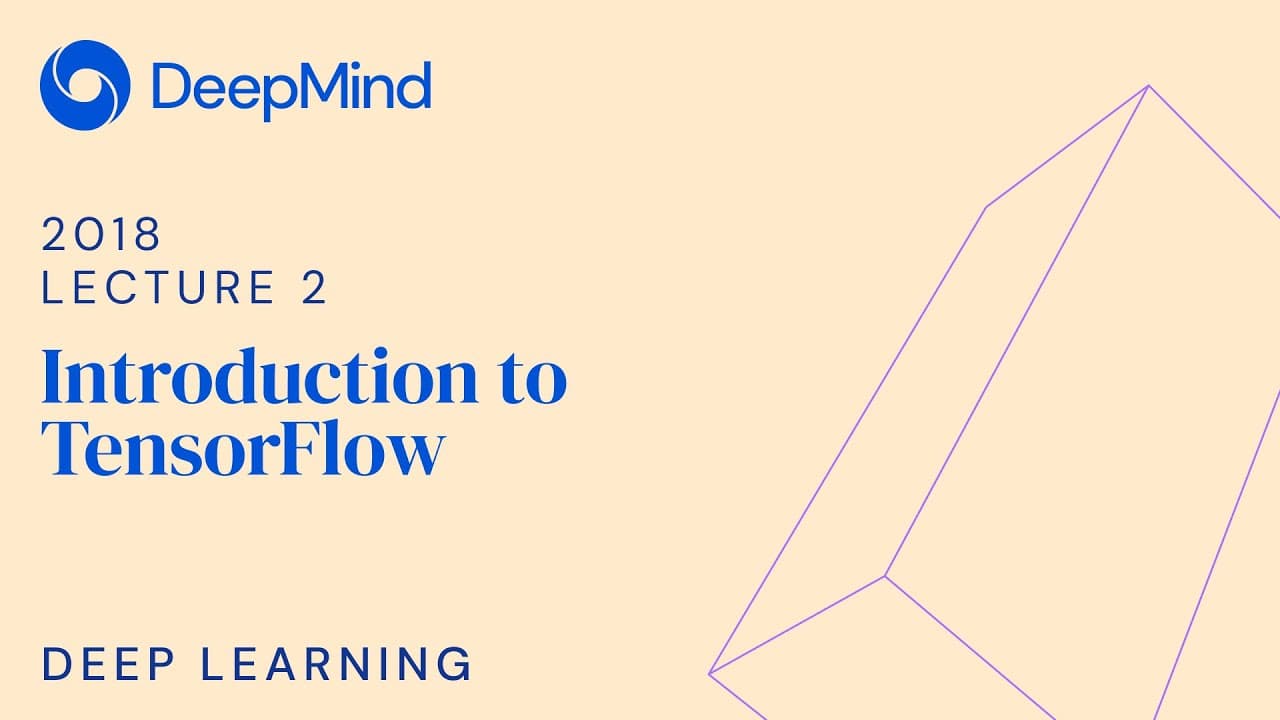
Deep Learning 2: Introduction to TensorFlow
TL;DR
TensorFlow defines computation as a directed graph of operations and tensors, then uses a separate runtime to execute that graph across different hardware. Because scheduling follows data dependencies, independent operations can run in parallel, for example, across the 8 to 16 cores described in the lecture. Read on to understand graph declaration, execution, ops, tensors, persistent variables, and the Kolob assignment environment.
Transcript
so hi i'm matteo the plant for today as she mention is to introduce you to the fundamental ideas behind tense flow as well as give you some examples and some tips that will help you while you are doing your assignments and also give you a demo of Kolob which is the environment you will be coding your assignments in and we will have some time at the... Read More
Key Insights
- 😑 TensorFlow utilizes computational graphs to clearly express the dependencies between data operations, boosting parallel processing capabilities.
- 👻 The distinction between the declaration of a graph and its execution helps manage complex computations efficiently, allowing for better performance optimizations.
- 🏃 Sessions are crucial for executing computations in TensorFlow, providing a controlled environment to manage variable states and resource utilization across multiple runs.
- 🤱 Placeholders enhance flexibility in handling diverse datasets, permitting dynamic data feeding during model training without rigid graph definitions.
- 🎮 Control dependencies in TensorFlow provide specified execution orders, improving the developer's control over the computational flow in the graph.
- 👻 The framework is hardware-agnostic, allowing computations to seamlessly utilize available CPU and GPU resources, optimizing performance based on system capabilities.
- 👨💻 Kolob facilitates a collaborative coding experience for TensorFlow projects, integrating resources for learners to develop expertise in handling machine learning models effectively.
Install to Summarize YouTube Videos and Get Transcripts
Explore YouTube Video Summarizer or Get YouTube Transcript Extractor
Questions & Answers
Q: What is TensorFlow and how does it work?
TensorFlow is a framework composed of two main parts: a library for defining computational graphs and a runtime for executing them across different hardware. The graph declares operations and their dependencies, while execution happens as a separate step.
Q: What is a computational graph in TensorFlow?
A computational graph describes computation as a directed graph. Its nodes are operations, called ops, and its edges carry tensors between those operations.
Q: What are tensors and ops in TensorFlow?
Ops are the nodes that create or manipulate data according to specific rules. Tensors are the data flowing between ops, generally represented as multidimensional arrays or tuples and nested tuples of such arrays.
Q: How do computational graphs differ from standard programs?
A standard program specifies primitive operations and the order in which they run. A computational graph instead specifies operations and their dependencies, describing how outputs flow from one operation to another without directly fixing the execution order.
Q: Why can TensorFlow computational graphs improve performance?
TensorFlow can schedule operations in parallel when they do not depend on each other. The lecture notes that a laptop may have 8 to 16 cores, allowing the backend to assign independent operations to different cores with minimal input from the programmer.
Q: Does defining a TensorFlow graph immediately perform the computation?
No. Defining constants such as 10 and 20 and declaring addition, multiplication, and division operations only builds the graph; it does not compute the final result. Executing the graph and retrieving results happens in a separate step.
Q: How does TensorFlow preserve state across graph executions?
Variable ops allocate space in memory and allow values in that space to be read and written. Those values persist across different executions of the computational graph.
Q: What is Kolob used for in Deep Learning 2?
Kolob is the environment in which students code their assignments. The session includes a demonstration, time to try it, and help with issues such as connecting to the backend that runs the computation.
Summary & Key Takeaways
-
The content introduces TensorFlow's structure, emphasizing computational graphs that define operations and data flow between them, which enhance parallel processing capabilities.
-
It explains the significance of graph declaration versus execution and the role of sessions in running computational graphs while maintaining state through variables.
-
The session segments also cover the coding environment, Kolob, demonstrating how to effectively work with TensorFlow for assignments, including data handling and utilizing graphical representations.
Read in Other Languages (beta)
Share This Summary 📚
Summarize YouTube Videos and Get Video Transcripts with 1-Click
Try YouTube Summary with ChatGPT & Claude or YouTube Transcript Generator
Explore More Summaries from Google DeepMind 📚


Summarize YouTube Videos and Get Video Transcripts with 1-Click
Try YouTube Summary with ChatGPT & Claude or YouTube Transcript Generator