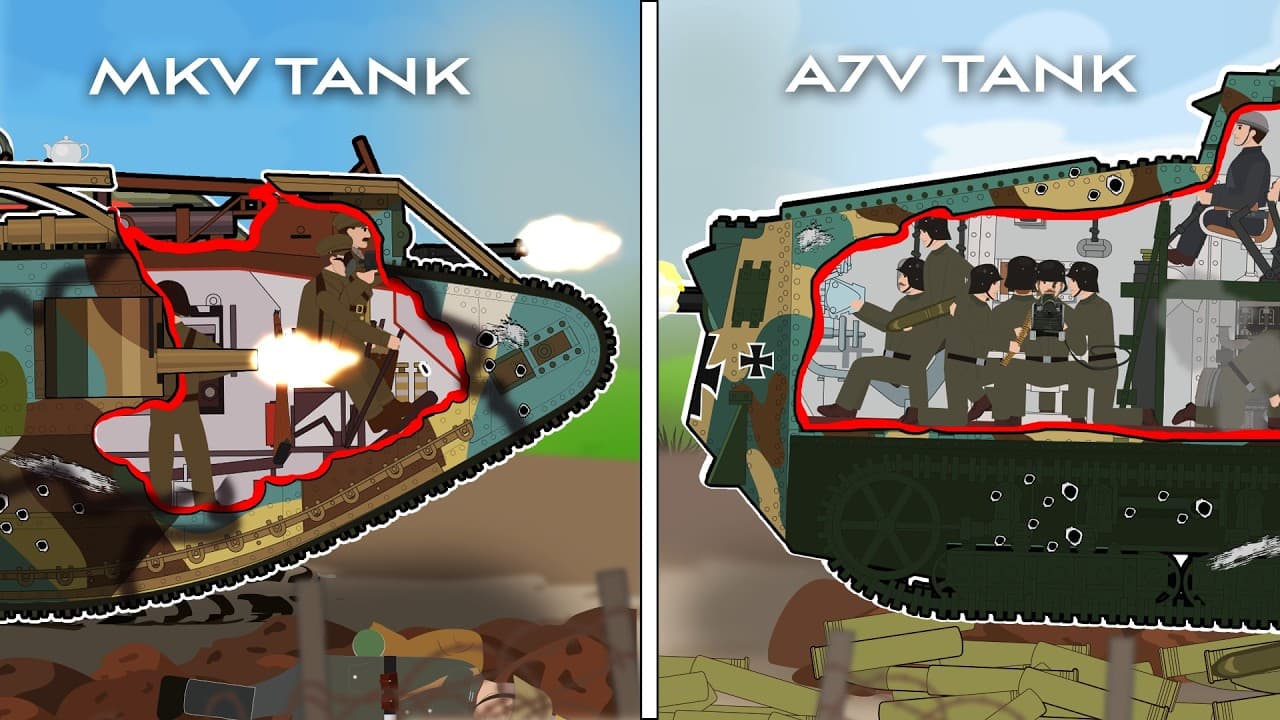
British WWI Tank VS. German WWI Tank
TL;DR
The Mark V tank revolutionized trench warfare but had severe design flaws impacting crew experience and safety.
Transcript
life inside a tank the mark 5 tank the arrival of the tank in World War I heralded a whole new kind of warfare that helped to break the bitter and bloody stalemate of trench warfare that had plagued the Western Front for years and it was the British who pioneered the way in the introduction development and use of these fearsome armored Fighting Mac... Read More
Key Insights
- ♍ The Mark V tank was a pivotal development in armored warfare, significantly altering tactics on the Western Front in World War I.
- 🪛 Innovative design elements, like the single-driver mechanism, were advancements but came with serious drawbacks, including poor crew conditions.
- 🥺 The cramped environment within the tank hampered communication, leading to operational challenges and impacting troop morale.
- 🚙 Despite its limitations, the Mark V's introduction of armored combat vehicles influenced future military strategies and tank designs.
- 🚒 The reliance on petrol engines created vulnerabilities, including limited range and risk of fire upon impact, significant issues for tank crews.
- 🎨 The A7V represented Germany’s initial effort in tank warfare but struggled compared to the more effective British designs like the Mark V.
- 🚙 Post-war, the lessons learned from tank deployment contributed to significant advancements in armored vehicle technology, shaping modern warfare vehicles.
Install to Summarize YouTube Videos and Get Transcripts
Explore YouTube Video Summarizer or Get YouTube Transcript Extractor
Questions & Answers
Q: How did the Mark V tank impact trench warfare during World War I?
The Mark V tank significantly impacted trench warfare by breaking the stalemate that had characterized the Western Front. Introduced in 1916, its armored design allowed for direct assaults on enemy trenches, providing mobile firepower that infantry could not match, thus offering a tactical advantage for British forces.
Q: What were the main design features of the Mark V tank?
The Mark V tank featured a crew compartment designed for eight soldiers, a revolutionary single-driver control system, and a varied armament setup between male and female variants. Its armor plates protected against small arms fire, but a key design flaw included its ventilation system, which exposed crews to dangerous carbon monoxide levels.
Q: What challenges did crew members face inside the Mark V tank?
Crew members of the Mark V tank faced extreme heat, cramped quarters, and poor ventilation. Communication was challenging due to noise, and the lack of onboard sanitation facilities led to unsanitary conditions during lengthy missions, severely impacting morale and operational effectiveness.
Q: How did the engine design of the Mark V influence its performance?
The Mark V was powered by a Ricardo petrol engine that produced 150 horsepower, allowing a top speed of 5 mph. However, its engine design posed a risk of carbon monoxide poisoning, and its fuel tank had a limited range of 45 miles, necessitating frequent refueling and exposing the crew to danger.
Q: What innovations did the Mark V introduce compared to earlier tanks?
Compared to its predecessors, the Mark V introduced a simplified driving mechanism with one driver instead of multiple gear men. This innovation reduced confusion during operations. It also adopted a new layout for weaponry and communication methods like semaphore signaling, setting a precedent for future armored vehicles.
Q: In what ways did the Mark V tank's crew interact during missions?
Due to the tank’s cramped quarters and noise, the crew communicated through shouting, hand signals, and note writing. This lack of a proper communication system complicated tactics during battle and emphasized the need for better internal communication methods in future military vehicles.
Q: What was the fate of the Mark V tanks after World War I?
After World War I, many Mark V tanks were phased out and scrapped, though some were used in conflicts like the Russian Civil War. Their designs laid the foundation for subsequent tank models, as military engineers incorporated lessons learned from their limitations into future developments.
Q: What role did the A7V tank play in comparison to the Mark V?
The A7V operated primarily in support of infantry forces, featuring a larger crew and multiple machine guns. Despite its heavy armor, it suffered from performance issues and limited success in combat, contrasting sharply with the more strategically effective and mobile design of the Mark V.
Summary & Key Takeaways
-
The Mark V tank, introduced in 1917, marked a significant advancement in armored warfare but was hampered by critical design flaws and cramped conditions for the crew.
-
Operating with a small crew and innovative engine layout, the Mark V struggled with communication, carbon monoxide exposure, and lacked basic amenities, resulting in a challenging environment for soldiers.
-
Despite its success during battles, the Mark V’s limitations laid the groundwork for future tank designs, influencing military innovations post-World War I.
Read in Other Languages (beta)
Share This Summary 📚
Summarize YouTube Videos and Get Video Transcripts with 1-Click
Try YouTube Summary with ChatGPT & Claude or YouTube Transcript Generator
Explore More Summaries from Simple History 📚




Summarize YouTube Videos and Get Video Transcripts with 1-Click
Try YouTube Summary with ChatGPT & Claude or YouTube Transcript Generator