Dalton's Law of Partial Pressure Problems, Mole Fraction, Chemistry Gas Laws
TL;DR
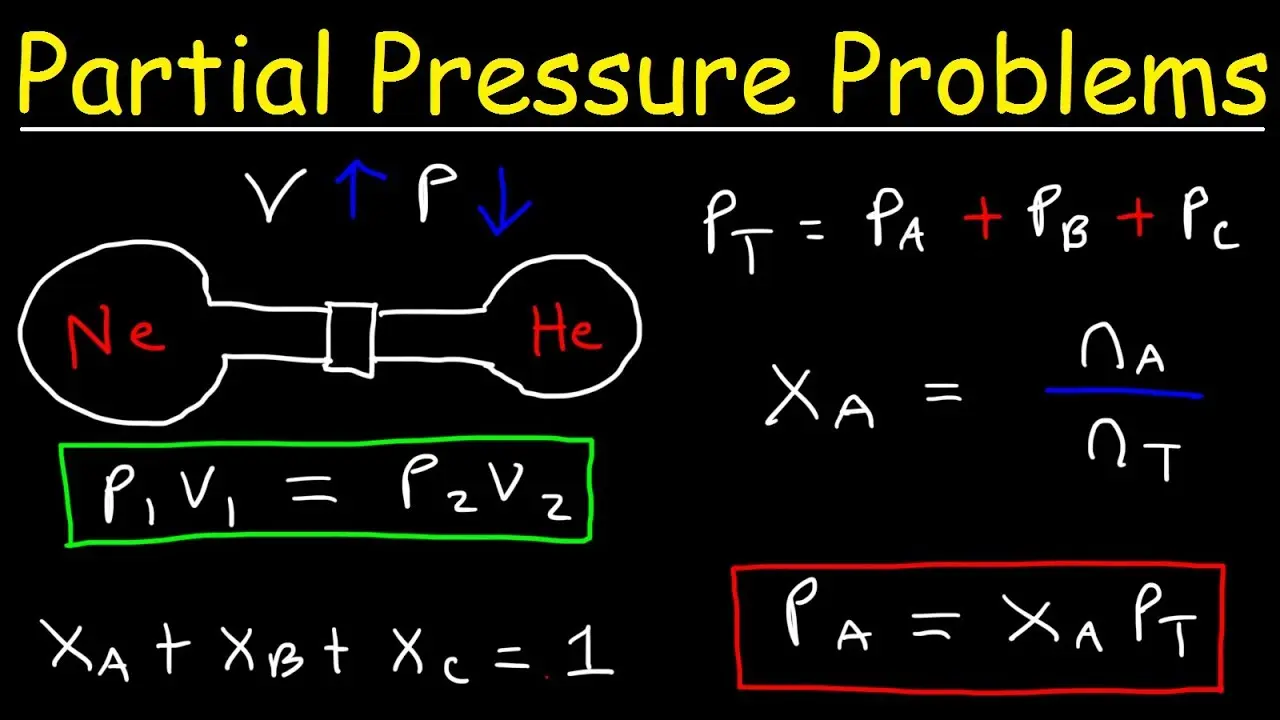
Dalton's Law of Partial Pressures states that the total pressure in a container is the sum of the individual partial pressures of all the gases present.
Transcript
consider this problem a container is filled with n2 o2 and argon gas the partial pressures of n2 and o2 are 615 and 125 torr respectively if the total pressure is 785 torr what is the partial pressure of argon now you need to be familiar with dalton's law of partial pressures which basically states that the total pressure is the sum of all of the i... Read More
Key Insights
- 🫢 Dalton's Law of Partial Pressures states that the total pressure in a container is the sum of the individual partial pressures of all the gases present.
- 🫢 Mole fractions represent the percentage of a specific gas in a mixture.
- 🫢 Mole fractions can be used to calculate the partial pressure of a gas by multiplying it by the total pressure.
Install to Summarize YouTube Videos and Get Transcripts
Explore YouTube Video Summarizer or Get YouTube Transcript Extractor
Questions & Answers
Q: What is Dalton's Law of Partial Pressures?
Dalton's Law of Partial Pressures states that the total pressure in a container is equal to the sum of the individual partial pressures of all the gases present.
Q: How can mole fractions be used to calculate the percentage of a gas in a mixture?
Mole fractions can be calculated by dividing the moles of a specific gas by the total moles in the mixture. This value can be expressed as a decimal and represents the percentage of that gas in the mixture.
Q: How can the partial pressure of a gas be calculated using the mole fraction and the total pressure?
To calculate the partial pressure of a gas, multiply the mole fraction of that gas by the total pressure. This will give the partial pressure of that gas in the mixture.
Q: How does Boyle's Law affect the partial pressure of a gas when the volume changes?
According to Boyle's Law, as the volume increases, the pressure of the gas decreases. This means that when the volume of a gas increases, its partial pressure will decrease.
Summary & Key Takeaways
-
Dalton's Law of Partial Pressures states that the total pressure in a container is the sum of the individual partial pressures of all the gases present.
-
Mole fractions can be used to calculate the percentage of a specific gas in a mixture.
-
The partial pressure of a gas can be calculated using the mole fraction and the total pressure.
Read in Other Languages (beta)
Share This Summary 📚
Summarize YouTube Videos and Get Video Transcripts with 1-Click
Try YouTube Summary with ChatGPT & Claude or YouTube Transcript Generator
Explore More Summaries from The Organic Chemistry Tutor 📚



Summarize YouTube Videos and Get Video Transcripts with 1-Click
Try YouTube Summary with ChatGPT & Claude or YouTube Transcript Generator