Definition of pH | Water, acids, and bases | Biology | Khan Academy
TL;DR
The pH scale measures the concentration of hydrogen ions in a solution, with values below 7 indicating acidity and values above 7 indicating alkalinity.
Transcript
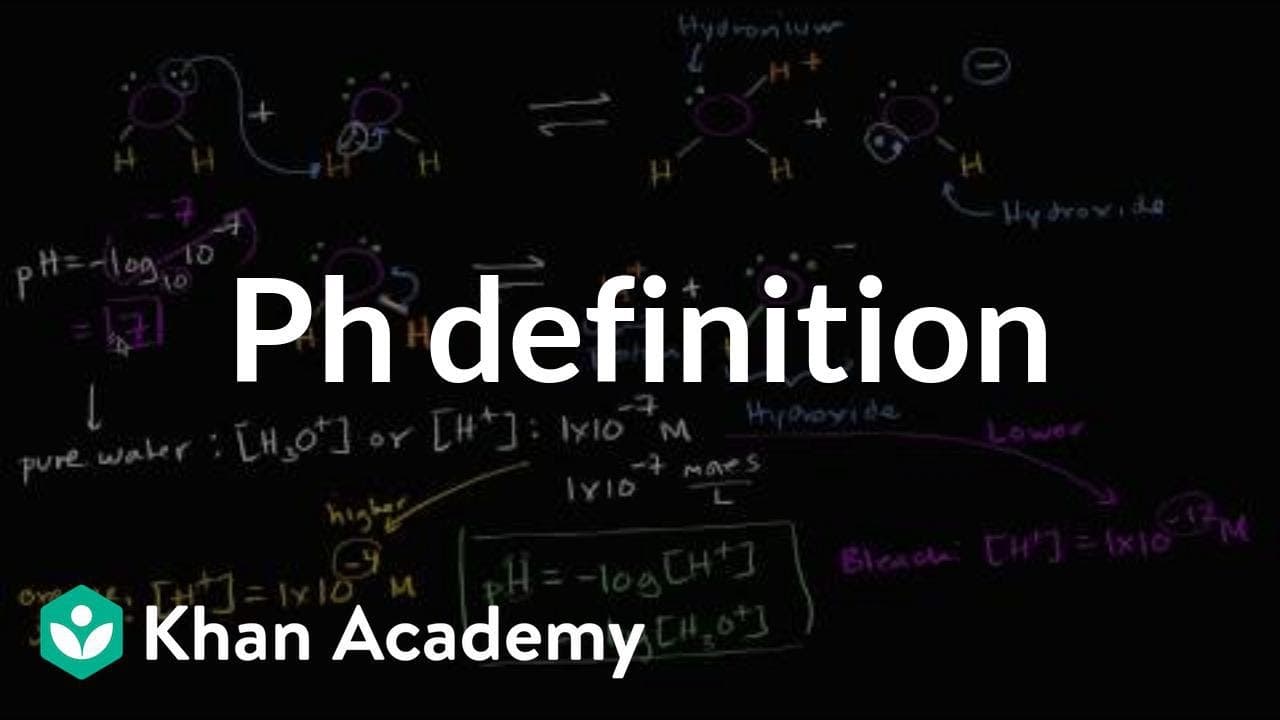
- [Voiceover] In the video on the auto-ionization of water we saw that you could have two neutral water molecules, but one of them could swipe a hydrogen ion from the other and then you could be left with a hydronium ion, and the one that had the hydrogen ion swiped from it, remember a hydrogen ion is really just a proton. This one actually gains a... Read More
Key Insights
- 💁 Auto-ionization of water results in the formation of hydronium ions (H3O+) and hydroxide ions (OH-).
- 😑 The concentration of hydrogen ions in a solution determines its acidity or alkalinity.
- 😑 The pH scale provides a logarithmic representation of the concentration of hydrogen ions.
- 😑 Different solutions have different hydrogen ion concentrations and therefore different pH values.
- 😥 Solutions with pH values below 7 are acidic, while those with pH values above 7 are alkaline.
- 😥 The pH value is influenced by temperature and the type of solution.
- 😑 The pH scale allows for a simplified representation of hydrogen ion concentration using a single numerical value.
Install to Summarize YouTube Videos and Get Transcripts
Explore YouTube Video Summarizer or Get YouTube Transcript Extractor
Questions & Answers
Q: What is the difference between hydronium ions and hydrogen ions?
Hydronium ions (H3O+) and hydrogen ions (H+) are essentially the same, with hydronium ions formed by the association of a hydrogen ion with a water molecule.
Q: How is pH calculated?
pH is calculated by taking the negative logarithm (base 10) of the hydrogen ion concentration. For example, a hydrogen ion concentration of one times ten to the negative seventh molar corresponds to a pH of 7.
Q: What does a pH value below 7 indicate?
A pH value below 7 indicates acidity, with lower pH values indicating higher concentrations of hydrogen ions.
Q: How does the concentration of hydrogen ions in bleach compare to that in pure water?
The concentration of hydrogen ions in bleach (approximately one times ten to the negative twelfth molar) is significantly lower than in pure water, resulting in a higher pH value for bleach.
Summary & Key Takeaways
-
Water molecules can undergo auto-ionization, resulting in the formation of hydronium ions (H3O+) and hydroxide ions (OH-).
-
The concentration of hydrogen ions (or hydronium ions) in pure water at 25 degrees Celsius is approximately one times ten to the negative seventh molar.
-
Different solutions, such as orange juice and bleach, have different concentrations of hydrogen ions, resulting in different pH values.
Read in Other Languages (beta)
Share This Summary 📚
Summarize YouTube Videos and Get Video Transcripts with 1-Click
Try YouTube Summary with ChatGPT & Claude or YouTube Transcript Generator
Explore More Summaries from Khan Academy 📚



Summarize YouTube Videos and Get Video Transcripts with 1-Click
Try YouTube Summary with ChatGPT & Claude or YouTube Transcript Generator