Evidence of evolution: anatomy | Evolution | Middle school biology | Khan Academy
TL;DR
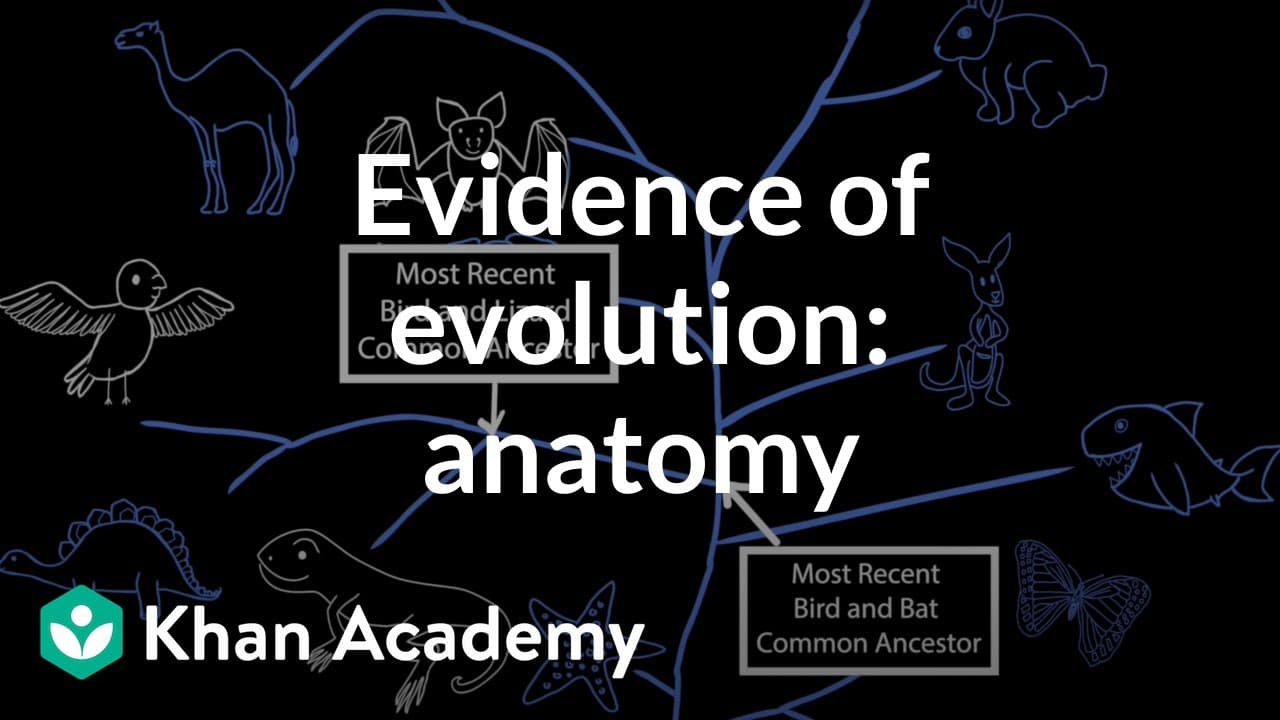
Organisms share common ancestry and scientists determine evolutionary relationship by analyzing similarities and differences in features and characteristics.
Transcript
- [Instructor] About 3.5 billion years ago, single-celled organisms were the only life forms that existed on Earth. These organisms passed on their genetic material with slight changes to their descendants. And over long periods of time, these genetic changes resulted in new species. And eventually, the vast diversity of modern organisms evolves. S... Read More
Key Insights
- 🫤 Single-celled organisms from 3.5 billion years ago passed on genetic material, leading to the evolution of new species and the diversity of modern organisms.
- 🧑🔬 Scientists determine evolutionary relationships by analyzing similarities and differences in features, such as examining the fossil record and comparing DNA.
- 😚 Homologous features are shared anatomical features inherited from a common ancestor, indicating a close evolutionary relationship.
- ❓ Analogous features are independently evolved features with different structures, suggesting different evolutionary origins.
- 🫀 Comparing anatomical features helps scientists understand how life on Earth has evolved from common ancestors.
- ❓ The presence of more homologous features between two species suggests a more recent common ancestor.
- ❓ The presence of fewer homologous features between two species indicates a more distant common ancestor.
Install to Summarize YouTube Videos and Get Transcripts
Explore YouTube Video Summarizer or Get YouTube Transcript Extractor
Questions & Answers
Q: How do scientists determine the evolutionary relationship between species?
Scientists analyze similarities and differences between species using methods such as examining the fossil record, DNA analysis, and comparing embryo development to determine evolutionary relationships.
Q: What are homologous features?
Homologous features are structurally similar anatomical features shared by two species that inherited them from a common ancestor.
Q: How can scientists find evidence for evolution without using microscopes or fossils?
Scientists can find evidence for evolution by studying the anatomical or physical features of organisms alive today, known as homologous features, which indicate shared ancestry.
Q: What are analogous features?
Analogous features are features that evolved independently along different species' lineages and may appear similar but have different structures or origins.
Summary & Key Takeaways
-
Single-celled organisms from 3.5 billion years ago passed on genetic material, resulting in new species and the diversity of modern organisms.
-
Scientists analyze similarities and differences between species through various methods like examining the fossil record, DNA analysis, and comparing embryo development.
-
Homologous features are structurally similar anatomical features inherited from a common ancestor, while analogous features are independently evolved features with different structures.
Read in Other Languages (beta)
Share This Summary 📚
Summarize YouTube Videos and Get Video Transcripts with 1-Click
Try YouTube Summary with ChatGPT & Claude or YouTube Transcript Generator
Explore More Summaries from Khan Academy 📚



Summarize YouTube Videos and Get Video Transcripts with 1-Click
Try YouTube Summary with ChatGPT & Claude or YouTube Transcript Generator