Probability Exponential Distribution Problems
TL;DR
This video explains how to solve probability exponential distribution problems, including calculating the rate parameter, creating the probability density function, graphing it, and finding probabilities for specific time intervals.
Transcript
in this video we're gonna focus on solving probability exponential distribution problems so let's start with this one number 1 laptops produce by company XYZ class on average for five years the lifespan of each laptop follows an exponential distribution Part A calculate the rate parameter the rate parameter is represented by the symbol lambda now i... Read More
Key Insights
- ☠️ The rate parameter in exponential distribution is the reciprocal of the average.
- ☠️ The probability density function (PDF) is calculated using the rate parameter and Euler's number.
- 🛀 Graphing the PDF shows how the probability decreases over time.
- ⌛ Probability calculations involve finding the area under the curve for specific time intervals.
- ⌛ The probability of an event occurring within a specific time interval can be calculated using the PDF and appropriate formulas.
- ❓ The exponential distribution is commonly used to model the lifespan of products or events.
- ⌛ The area under the curve represents the probability of an event occurring in a given time interval.
Install to Summarize YouTube Videos and Get Transcripts
Explore YouTube Video Summarizer or Get YouTube Transcript Extractor
Questions & Answers
Q: How do you calculate the rate parameter in probability exponential distribution?
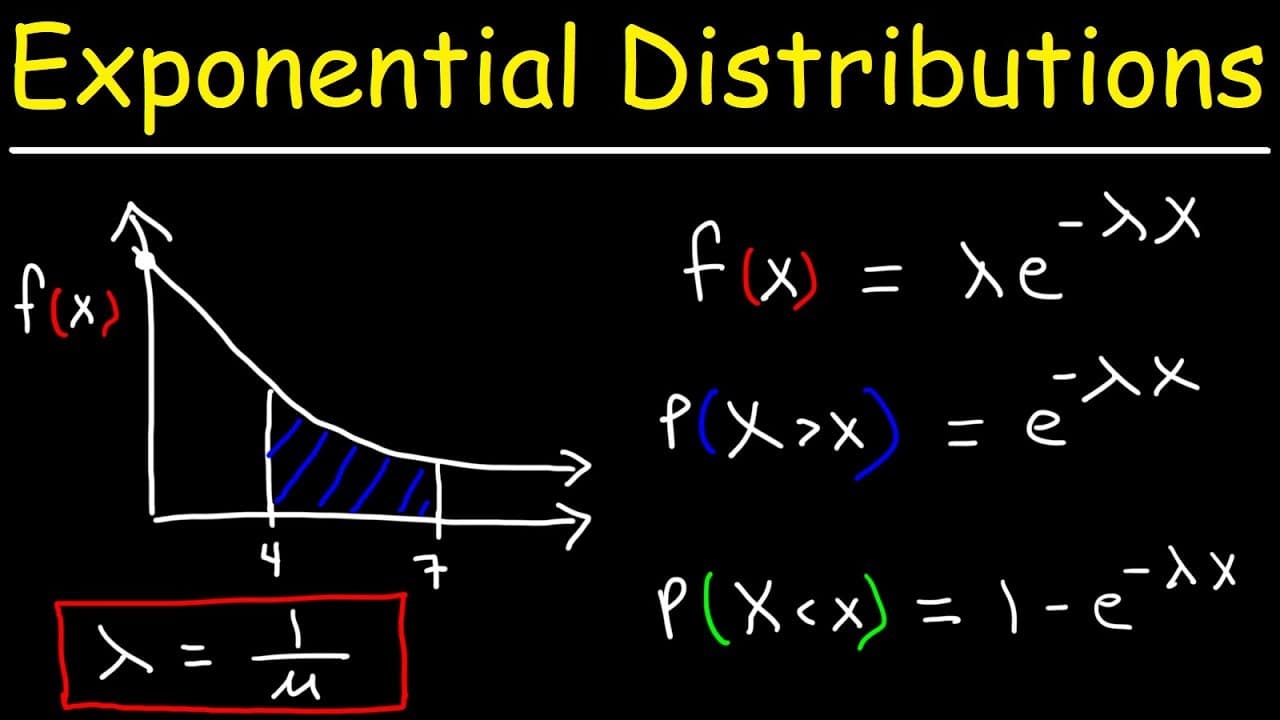
The rate parameter is the reciprocal of the average and is represented by the symbol lambda. In this case, the average lifespan of a laptop is 5 years, so the rate parameter would be 1/5 or 0.20 years^(-1).
Q: What is the probability density function (PDF) in exponential distribution?
The PDF is represented by f(X) and is equal to the rate parameter (lambda) multiplied by e^(-lambdaX), where e is Euler's number (~2.71828) and X is the time value. In this case, the PDF would be 0.20 * e^(-0.20X).
Q: How do you graph the probability density function (PDF)?
Start the graph from the y-axis and let it decrease over time. The y-intercept is the rate parameter (0.20 in this case). Substitute different values of X into the PDF equation to get the corresponding y-values for graphing.
Q: What is the probability that a laptop will last less than 3 years?
To find this probability, calculate the area under the curve from 0 to 3 (the left side of 3). Use the formula 1 - e^(-lambda*X) and substitute lambda (0.20) and X (3) to get the probability.
Q: What is the probability that a laptop will last more than 10 years?
To find this probability, calculate the area to the right of 10 on the graph. Use the formula e^(-lambda*X) and substitute lambda (0.20) and X (10) to get the probability.
Q: How do you find the probability that a laptop will last between four and seven years?
Find the difference between the probability that X is less than 7 and the probability that X is less than 4. Substitute lambda (0.20) and X values (7 and 4) into the formula to calculate both probabilities, and then subtract them to get the final probability.
Summary & Key Takeaways
-
The video focuses on solving probability exponential distribution problems.
-
It explains how to calculate the rate parameter using the average lifespan of a laptop.
-
The video discusses how to create the probability density function (PDF) and graph it.
-
It demonstrates how to find the probability that a laptop will last for a specific time interval.
Read in Other Languages (beta)
Share This Summary 📚
Summarize YouTube Videos and Get Video Transcripts with 1-Click
Try YouTube Summary with ChatGPT & Claude or YouTube Transcript Generator
Explore More Summaries from The Organic Chemistry Tutor 📚




Summarize YouTube Videos and Get Video Transcripts with 1-Click
Try YouTube Summary with ChatGPT & Claude or YouTube Transcript Generator