Oxidative phosphorylation and the electron transport chain | Khan Academy
TL;DR
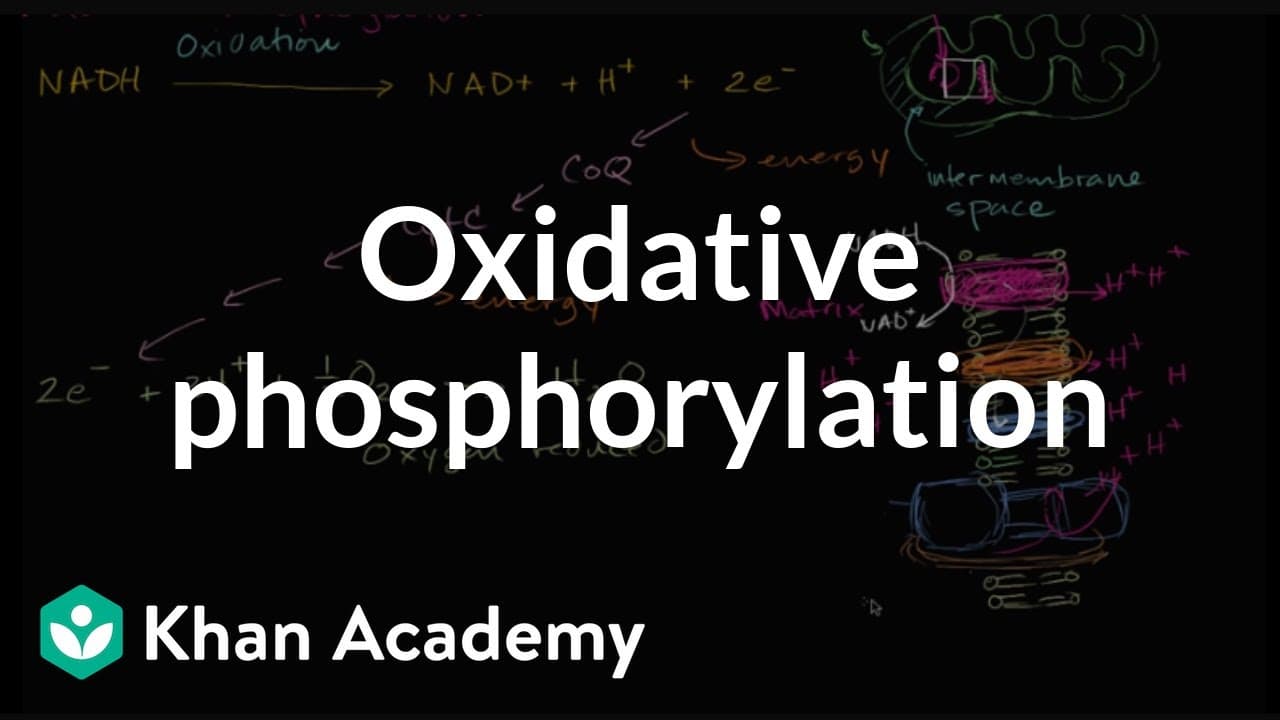
Oxidative Phosphorylation is a process in cellular respiration where NADH and other coenzymes are oxidized, creating a proton gradient that is used to produce ATP.
Transcript
- When we looked at glycolysis and the conversion of Pyruvate to Acetyl-CoA and then the Krebs or the Citric acid Cycle, we were sometimes directly producing ATPs but we were also doing a lot of reduction of NAD to NADH, and we later said that NADH, that that can later be oxidized, too, and that energy from that oxidation, that energy that's releas... Read More
Key Insights
- ❓ Oxidative phosphorylation is the main process in cellular respiration that produces the majority of ATP.
- 🖐️ NADH plays a crucial role in oxidative phosphorylation by getting oxidized and releasing energy.
- ⛓️ The electron transport chain, a series of proteins, facilitates the transfer of electrons from one acceptor to another.
- ✊ The proton gradient created during oxidative phosphorylation is used to power ATP synthesis through ATP synthase.
- 🫒 Cellular respiration and oxidative phosphorylation are essential for generating energy in living organisms.
- 🤙 The process of oxidative phosphorylation occurs in the mitochondria's inner membrane, which contains folds called cristae.
- ❓ Other coenzymes like FADH2 and QH2 can also participate in oxidative phosphorylation, but NADH is the primary player.
Install to Summarize YouTube Videos and Get Transcripts
Explore YouTube Video Summarizer or Get YouTube Transcript Extractor
Questions & Answers
Q: What is oxidative phosphorylation?
Oxidative Phosphorylation is the process in cellular respiration where coenzymes like NADH are oxidized, releasing energy that is used to produce ATP.
Q: How does NADH get oxidized in oxidative phosphorylation?
NADH gets oxidized by transferring its electrons to different electron acceptors, eventually leading to the reduction of oxygen to form water.
Q: What is the role of the proton gradient in oxidative phosphorylation?
The proton gradient is created by pumping hydrogen protons from the Matrix to the intermembrane space. This gradient is then used by ATP synthase to produce ATP.
Q: How does ATP synthase produce ATP?
ATP synthase is a protein complex that uses the energy from the proton gradient to rotate its axle, which in turn forces ADP and phosphate groups together to form ATP.
Summary & Key Takeaways
-
Oxidative Phosphorylation is a process that occurs in the mitochondria, where coenzymes like NADH are oxidized, releasing energy.
-
The released energy is used to pump hydrogen protons from the Matrix to the intermembrane space.
-
This proton gradient is then utilized by ATP synthase to produce ATP, which is the energy currency of cells.
Read in Other Languages (beta)
Share This Summary 📚
Summarize YouTube Videos and Get Video Transcripts with 1-Click
Try YouTube Summary with ChatGPT & Claude or YouTube Transcript Generator
Explore More Summaries from Khan Academy 📚



Summarize YouTube Videos and Get Video Transcripts with 1-Click
Try YouTube Summary with ChatGPT & Claude or YouTube Transcript Generator