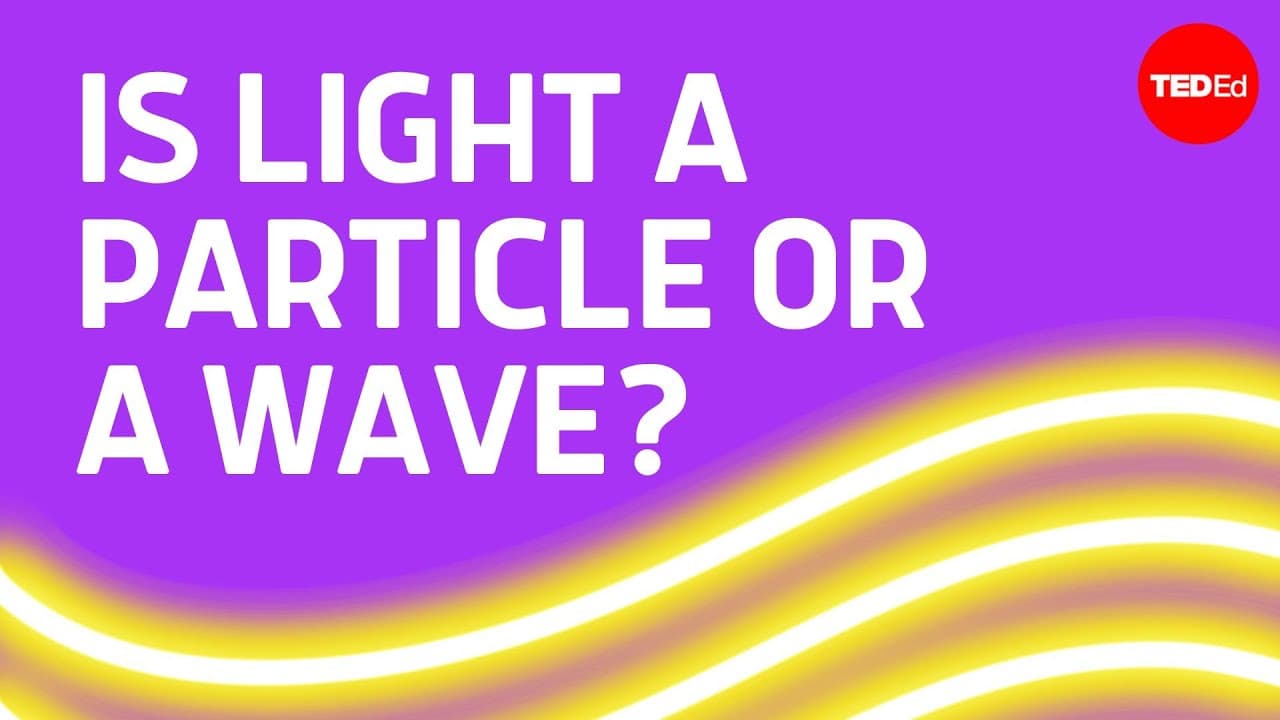
Is Light a Particle or a Wave? Understanding Its Nature
TL;DR
Light exhibits dual characteristics, behaving both as a particle and a wave. This realization led to the development of quantum mechanics, where light's particle-like quanta and wave-like interference patterns coexist. Understanding this duality is crucial for modern physics, as it challenges traditional views of light.
Transcript
Translator: Andrea McDonough Reviewer: Bedirhan Cinar You look down and see a yellow pencil lying on your desk. Your eyes, and then your brain, are collecting all sorts of information about the pencil: its size, color, shape, distance, and more. But, how exactly does this happen? The ancient Greeks were the first to think more or less scientificall... Read More
Key Insights
- 🙂 Ancient Greeks had varying theories about light and vision, from probes in eyes to light collection.
- 🙂 Alhazen's theory corrected Greek beliefs, explaining light reflection from objects.
- 🙂 Isaac Newton initially theorized light as particles, but 19th-century experiments showed light's wave-like behavior.
- 🙂 Light exhibits both particle-like and wave-like properties, leading to the development of quantum mechanics.
- 🙂 Understanding light's behavior as both a particle and a wave is crucial in modern physics.
- 💡 Light's unique properties, such as interference and particle behavior, challenge conventional ideas about its nature.
- 🚨 The revolutionary concept of quantum mechanics emerged from light's dual behavior as a particle and a wave.
Install to Summarize YouTube Videos and Get Transcripts
Explore YouTube Video Summarizer or Get YouTube Transcript Extractor
Questions & Answers
Q: How did ancient Greeks perceive light and vision?
Ancient Greek philosophers like Plato and Pythagoras believed light originated in eyes and vision involved invisible probes gathering information from objects.
Q: What did Alhazen's theory propose about light and vision?
Alhazen's theory stated that our eyes don't emit probes but collect light that falls into them, explaining why objects reflect light rather than produce their own.
Q: How did Isaac Newton explain the properties of light?
Isaac Newton proposed that light consists of tiny particles called corpuscles, which he believed explained phenomena like refraction as light moving from air into water.
Q: How did 19th-century experiments challenge Newton's theory of light?
19th-century experiments revealed that light couldn't be made up of tiny particles, as beams of light passed through each other without interacting and exhibited interference patterns typical of waves.
Summary & Key Takeaways
-
Ancient Greeks had theories about light and vision, ranging from probes in eyes to simply collecting light.
-
Alhazen's theory corrected the Greeks', explaining how objects reflect light.
-
Isaac Newton theorized light as particles, but 19th-century experiments revealed its wave-like behavior.
Read in Other Languages (beta)
Share This Summary 📚
Summarize YouTube Videos and Get Video Transcripts with 1-Click
Try YouTube Summary with ChatGPT & Claude or YouTube Transcript Generator
Explore More Summaries from TED-Ed 📚

Summarize YouTube Videos and Get Video Transcripts with 1-Click
Try YouTube Summary with ChatGPT & Claude or YouTube Transcript Generator