E2 reactions | Substitution and elimination reactions | Organic chemistry | Khan Academy
TL;DR
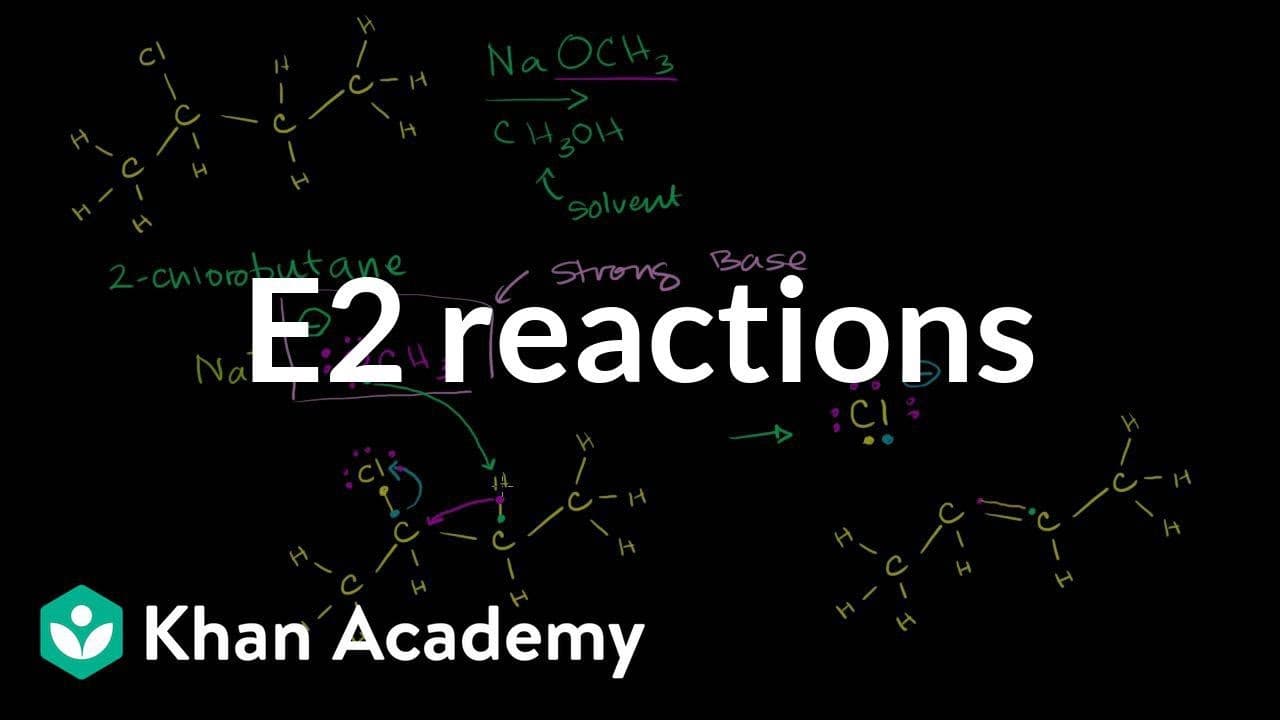
Sodium methoxide reacts with 2-chlorobutane in a methanol solution, resulting in the elimination of the chloro group and formation of but-2-ene.
Transcript
Let's try to come up with the reaction of when we have this molecule right here reacting with sodium methoxide in a methanol solution, or with methanol as the solvent. Just so we get a little practice with naming, let's see, this is one, two, three, four carbons. So it has but- as a prefix and no double bond or triple bonds, so it's butane. And we ... Read More
Key Insights
- 💪 Sodium methoxide in a methanol solution acts as a strong base and participates in an E2 reaction with 2-chlorobutane.
- 💁 The E2 reaction involves the elimination of a leaving group and the formation of a double bond.
- 👥 The chloro group acts as the leaving group in this reaction.
- ☠️ The E2 reaction follows a one-step mechanism, with both reactants participating in the rate-determining step.
- ⚾ The E2 reaction is favored when the substrate and the base are both suitable for elimination.
- 🏑 The E2 reaction is part of the broader field of organic chemistry and has similarities to the Sn2 reaction.
Install to Summarize YouTube Videos and Get Transcripts
Explore YouTube Video Summarizer or Get YouTube Transcript Extractor
Questions & Answers
Q: What is the role of sodium methoxide in the reaction?
Sodium methoxide acts as a strong base, abstracting a proton from 2-chlorobutane and facilitating the elimination of the chloro group.
Q: How does the E2 reaction differ from the Sn2 reaction?
The E2 reaction involves the elimination of a leaving group, while the Sn2 reaction involves the substitution of a leaving group by a nucleophile.
Q: Why is the E2 reaction the most likely reaction to occur in this case?
The E2 reaction occurs because sodium methoxide is a strong base and 2-chlorobutane is a suitable substrate for elimination.
Q: What is the significance of the rate-determining step in the E2 reaction?
The rate-determining step in the E2 reaction involves the simultaneous participation of both reactants, leading to the formation of but-2-ene and the elimination of the chloro group.
Summary & Key Takeaways
-
Sodium methoxide, a strong base, reacts with 2-chlorobutane in a methanol solution.
-
The reaction involves the elimination of the chloro group and the formation of a double bond, resulting in the formation of but-2-ene.
-
This reaction follows the E2 mechanism, where both reactants participate in the rate-determining step.
Read in Other Languages (beta)
Share This Summary 📚
Summarize YouTube Videos and Get Video Transcripts with 1-Click
Try YouTube Summary with ChatGPT & Claude or YouTube Transcript Generator
Explore More Summaries from Khan Academy 📚



Summarize YouTube Videos and Get Video Transcripts with 1-Click
Try YouTube Summary with ChatGPT & Claude or YouTube Transcript Generator