Stanford ENGR108: Introduction to Applied Linear Algebra | 2020 | Lecture 39-VMLS LS classification
TL;DR
Least squares can be used to build a classifier by fitting data points to +1 or -1 outcomes, and then taking the sign of the fitted values.
Transcript
we're now going to look and see how least squares can be used to build tune or fit a classifier so the way we'll do it it's actually pretty straightforward um what we're going to do is we're simply going to do standard least squares data fitting where the outcome is simply going to be a plus or minus 1. the number plus or minus one now remember the... Read More
Key Insights
- 🏛️ Least squares classification can be used to build a simple and effective classifier.
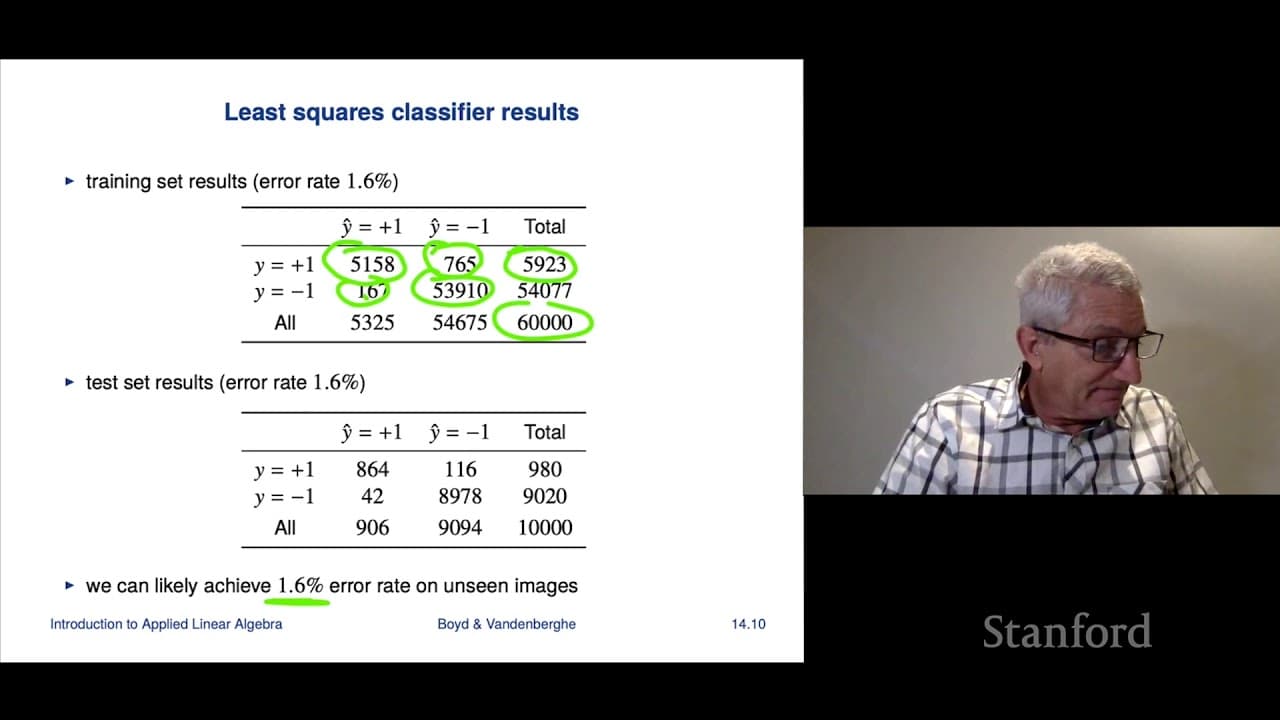
- ☠️ The error rate of least squares classification can be computed using a confusion matrix.
- ❎ Adding a decision threshold in least squares classification can trade off false positives and false negatives.
- 📞 The receiver operating characteristic (ROC) curve is a useful tool for analyzing the performance of classification methods.
- ❎ The choice of decision threshold in least squares classification depends on the specific application and the relative costs of false positives and false negatives.
- 😥 Least squares classification can be a good starting point for understanding classification methods, but there are more sophisticated classifiers available.
Install to Summarize YouTube Videos and Get Transcripts
Explore YouTube Video Summarizer or Get YouTube Transcript Extractor
Questions & Answers
Q: How does least squares classification work for building a classifier?
Least squares classification fits data points to +1 or -1 outcomes, and then uses the sign of the fitted values to classify new data points.
Q: What is the significance of using the sine function in least squares classification?
The sine function helps to determine the classification based on the sign of the fitted values, with positive values corresponding to one class and negative values to the other class.
Q: What is the error rate in classifying handwritten digits as 0 or not 0 using least squares?
The error rate for classifying handwritten digits as 0 or not 0 using least squares is approximately 1.6%, both in the training set and the test set.
Q: Can least squares classification outperform human performance in classification tasks?
Least squares classification, while simple, may not outperform more advanced methods in machine learning, which have achieved better error rates than humans in classification tasks.
Summary & Key Takeaways
-
Least squares can be used to fit data points to +1 or -1 outcomes to build a classifier.
-
The sine function is used to determine the classification based on whether the fitted value is greater than or equal to zero.
-
The error rate in classifying handwritten digits as 0 or not 0 using least squares is approximately 1.6%.
Read in Other Languages (beta)
Share This Summary 📚
Summarize YouTube Videos and Get Video Transcripts with 1-Click
Try YouTube Summary with ChatGPT & Claude or YouTube Transcript Generator
Explore More Summaries from Stanford Online 📚

Summarize YouTube Videos and Get Video Transcripts with 1-Click
Try YouTube Summary with ChatGPT & Claude or YouTube Transcript Generator