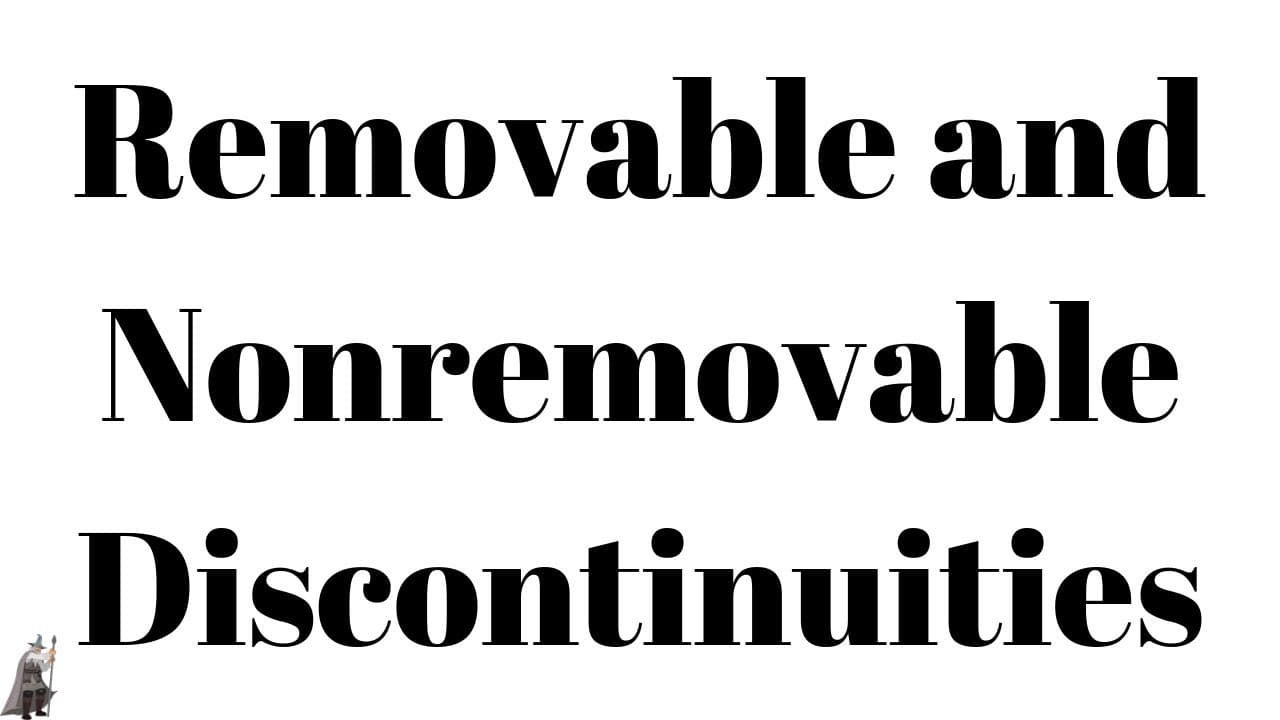
Introduction to Removable and Nonremovable Discontinuities
TL;DR
Learn about removable and non-removable discontinuities in functions and how to identify them.
Transcript
hey everyone in this video we're going to talk about two different types of discontinuities so a discontinuity is a number where a function is not continuous so for example if you have 1 over X minus 2 so this function is not defined at 2 so x equals 2 this would be a discontinuity so disk on Genuity okay because if you plug in 2 on the bottom you ... Read More
Key Insights
- ➗ Discontinuities occur where functions are not continuous, often due to division by zero.
- 🤑 Removable discontinuities can be fixed by redefining the function, while non-removable ones cannot.
- ⛔ Criteria involving the existence of limits help determine if a discontinuity is removable.
- 🚦 Vertical asymptotes in rational and trigonometric functions are typically non-removable discontinuities.
- 🧑🏭 Canceling out factors causing the discontinuity can help in identifying removable discontinuities.
- 🚱 Understanding the distinction between removable and non-removable discontinuities is crucial in function analysis.
- 🕳️ Holes in the graph are indicative of removable discontinuities, while vertical asymptotes are non-removable.
Install to Summarize YouTube Videos and Get Transcripts
Explore YouTube Video Summarizer or Get YouTube Transcript Extractor
Questions & Answers
Q: What is a removable discontinuity?
A removable discontinuity is a point where a function is not continuous but can be made continuous by redefining it at that point, often by canceling out factors causing the discontinuity.
Q: How do you differentiate between removable and non-removable discontinuities?
Removable discontinuities can be removed by manipulation or cancellation, resulting in a continuous function at that point, while non-removable discontinuities cannot be removed or fixed.
Q: What is the criteria for identifying removable discontinuities?
The criteria involve checking if the limit as x approaches the discontinuity point exists and is a real number, indicating that the discontinuity is removable and can be fixed.
Q: In what cases are vertical asymptotes considered non-removable discontinuities?
Vertical asymptotes in rational functions and trigonometric functions are considered non-removable discontinuities, contrasting with holes in the graph, which are typically removable.
Summary & Key Takeaways
-
Discontinuities occur where functions are not continuous, like when the denominator becomes zero.
-
Removable discontinuities can be fixed, while non-removable discontinuities cannot.
-
The criteria for identifying removable discontinuities involves checking if the limit exists.
Read in Other Languages (beta)
Share This Summary 📚
Summarize YouTube Videos and Get Video Transcripts with 1-Click
Try YouTube Summary with ChatGPT & Claude or YouTube Transcript Generator
Explore More Summaries from The Math Sorcerer 📚

Summarize YouTube Videos and Get Video Transcripts with 1-Click
Try YouTube Summary with ChatGPT & Claude or YouTube Transcript Generator