U-substitution and back substitution
TL;DR
By making a substitution and simplifying the expression, we can easily integrate complex polynomials.
Transcript
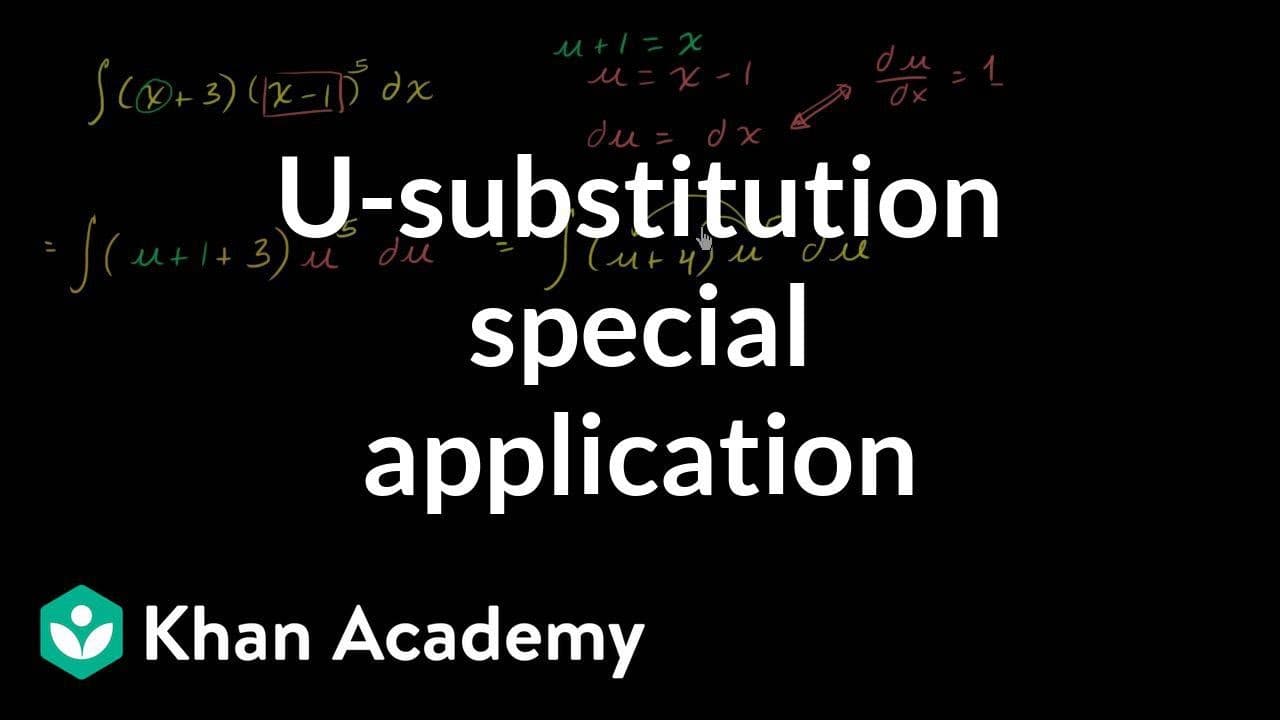
We're faced with the indefinite integral of x plus 3, times x minus 1 to the fifth dx. Now, we could solve this by literally multiplying out what x minus 1 to the fifth is. Maybe using the binomial theorem, that would take a while. And then we'd multiply that times x plus 3, and we'd end up with some polynomial. And we could take the antiderivative... Read More
Key Insights
- 💄 Making a substitution in integration can simplify complex expressions, making them easier to integrate.
- 😑 The choice of substitution may require some trial and error, with a focus on finding a form that simplifies the expression the most.
- 🥺 Substituting u for a term can often lead to cancelations or simplification, leading to a more manageable integral.
- 😑 After performing the substitution, the final result can be obtained by integrating the simplified expression and undoing the substitution.
- ❓ Understanding how to simplify and integrate complex polynomials is an important skill in calculus.
- 😫 The process of u substitution involves setting u equal to a term and adjusting the expression accordingly.
- 😫 This u substitution technique is a form of substitution, but not the traditional u substitution where we set u equal to the derivative of a term.
Install to Summarize YouTube Videos and Get Transcripts
Explore YouTube Video Summarizer or Get YouTube Transcript Extractor
Questions & Answers
Q: How can we simplify the integral of a complex polynomial?
One approach is to make a substitution, like setting u=x-1, to simplify the expression and make it easier to integrate.
Q: What is the advantage of using a substitution in integration?
A substitution allows us to transform the integral into a simpler form, making the integration process more straightforward and manageable.
Q: How did the substitution u=x-1 simplify the expression?
By substituting u for x-1, the polynomial x-1 to the fifth becomes u to the fifth, simplifying the expression and making it easier to integrate.
Q: How did the expression change after the substitution?
The expression changed to (u+4)u^5 du, where u represents x-1. This form is simpler and more conducive to integration.
Summary & Key Takeaways
-
Instead of expanding a complex polynomial, we can simplify it by making a substitution, which makes it easier to integrate.
-
By setting u=x-1, we can rewrite the expression as a simpler form: (u+4)u^5 du.
-
After distributing and integrating, the final result is (x-1)^7/7 + 2/3(x-1)^6 + C.
Read in Other Languages (beta)
Share This Summary 📚
Summarize YouTube Videos and Get Video Transcripts with 1-Click
Try YouTube Summary with ChatGPT & Claude or YouTube Transcript Generator
Explore More Summaries from Khan Academy 📚



Summarize YouTube Videos and Get Video Transcripts with 1-Click
Try YouTube Summary with ChatGPT & Claude or YouTube Transcript Generator