Deducing with logarithmic and exponential form | Logarithms | Algebra II | Khan Academy
TL;DR
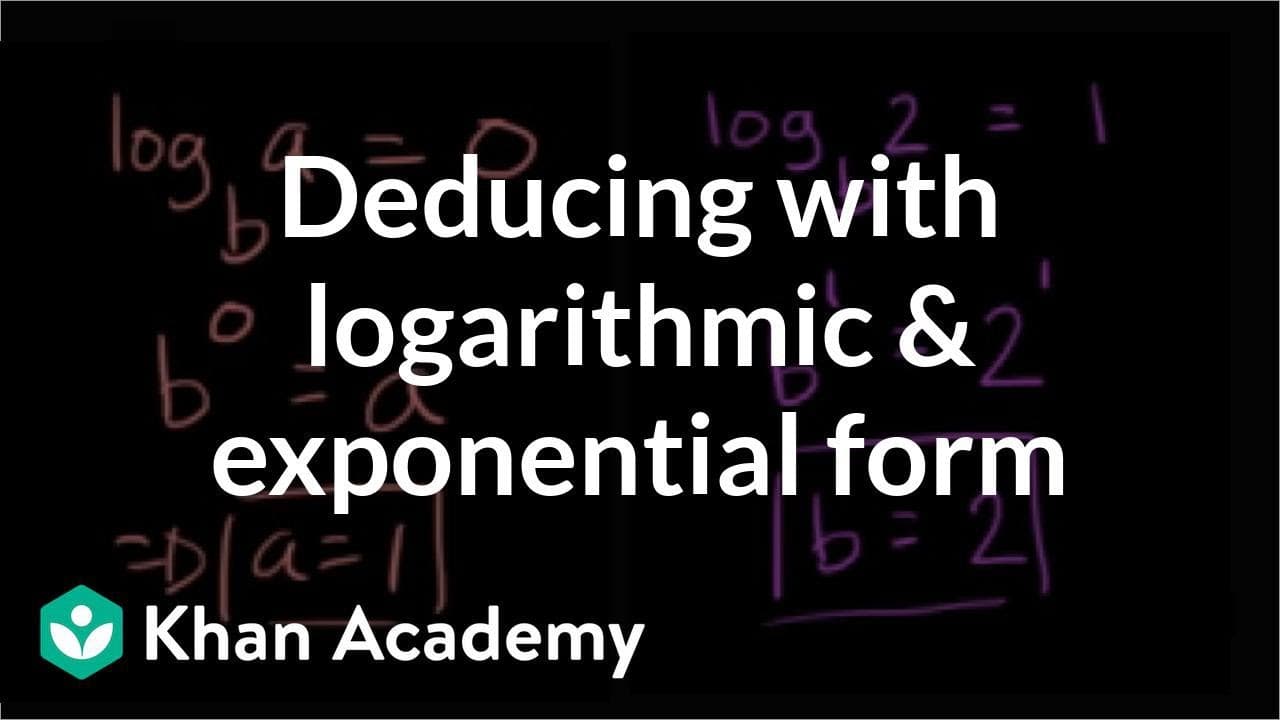
This video explains how to solve exponential equations without a calculator by using reasoning and logic.
Transcript
Voiceover:We've got 2 tables over here. This first table tells us that for any given value of X, what is the value of b to the x? For example, if we look right over here, if x is 1.585, b to the 1.585 is 3. This is telling us that b to the 1.585 is equal to 3. Similarly ... I can never say that ... it is telling us that b to the 2.322 is 5. b to th... Read More
Key Insights
- 🤨 The first table shows b raised to various powers, helping determine the value of b to a given exponent.
- ⚾ The second table shows logarithms base b of different values, useful for finding log base b of a given number.
- 💁 By comparing the information in both tables and using reasoning, it is possible to solve for unknown variables.
- 🚰 The given equations and tables offer an alternative method to solve exponential equations without relying on a calculator.
Install to Summarize YouTube Videos and Get Transcripts
Explore YouTube Video Summarizer or Get YouTube Transcript Extractor
Questions & Answers
Q: How can we find the value of b raised to a given power without a calculator?
By using the first table provided in the video, we can determine the value of b to any power of x without a calculator. For example, to find b to the power of 1.585, we look for the corresponding value in the table, which is 3.
Q: What does log base b represent?
Log base b represents the exponent to which we need to raise b to obtain a given value. In the second table, log base b of 2 equals 1, meaning that b raised to the power of 1 equals 2. This helps us find the value of b.
Q: How can we determine the value of c?
Looking at the second table, we find that log base b of 2c equals 1.585. Since we know that b equals 2, we can substitute the value and solve the equation for c. Dividing both sides by 2 gives us c equals 1.5.
Q: How do we find the value of d?
Examining the purple column in the second table, we see that log base b of 10d equals 2.322. Using the value of b (which is 2) from the previous deduction, we can substitute and solve for d. Dividing both sides by 10 gives us d equals 0.5.
Summary & Key Takeaways
-
The first table shows the value of b raised to a given power of x, allowing us to find the value of b to the x.
-
The second table shows the logarithm base b of a given value of y, helping us find log base b of y.
-
The video challenges viewers to figure out the values of a, b, c, and d using only the information provided and reasoning.
-
By analyzing the tables and equations, it is possible to deduce that a=1, b=2, c=1.5, and d=0.5.
Read in Other Languages (beta)
Share This Summary 📚
Summarize YouTube Videos and Get Video Transcripts with 1-Click
Try YouTube Summary with ChatGPT & Claude or YouTube Transcript Generator
Explore More Summaries from Khan Academy 📚



Summarize YouTube Videos and Get Video Transcripts with 1-Click
Try YouTube Summary with ChatGPT & Claude or YouTube Transcript Generator