What Is the Mean Value Theorem for Integrals?
TL;DR
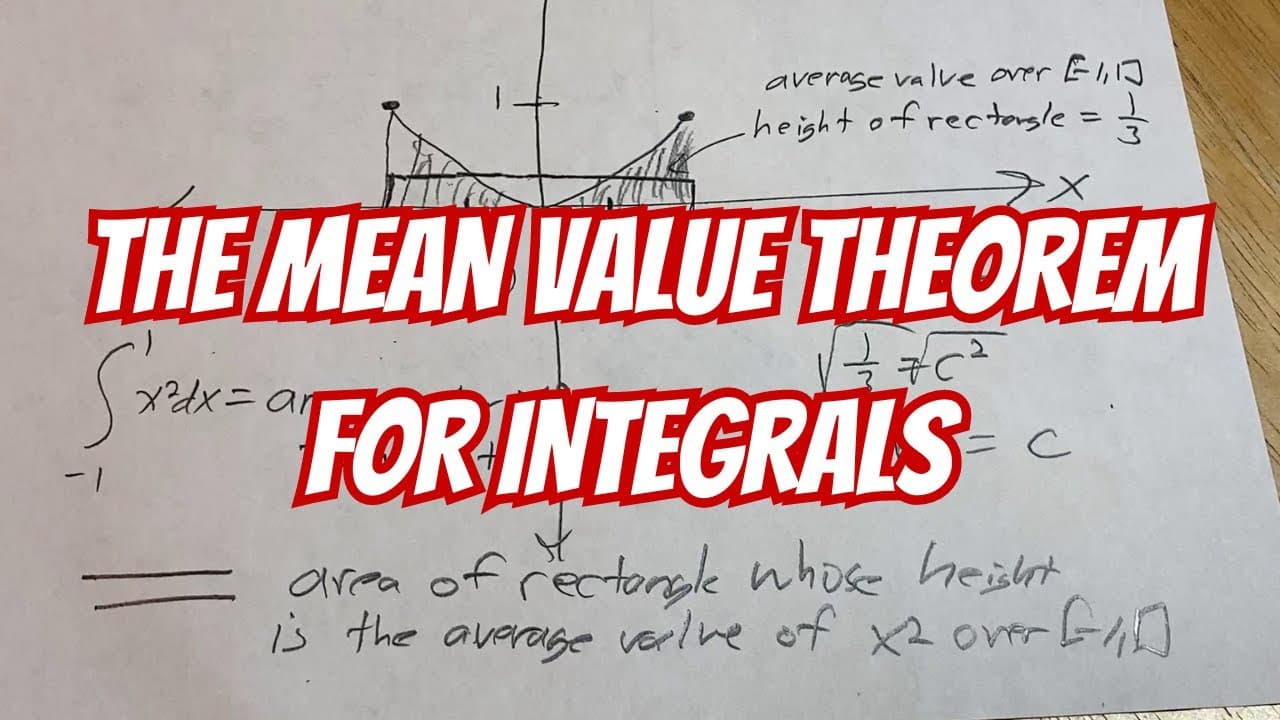
The Mean Value Theorem for Integrals states that for a continuous function on a closed interval, there exists a number C such that the definite integral over that interval equals the function value at C multiplied by the interval's length. Graphically, this means the area under the curve is equal to the area of a rectangle whose height is the average value of the function.
Transcript
hello in this video we're going to discuss the mean value theorem for integrals and how it relates to something called the average value of a function over an interval because it's really interesting and then we're going to do an example and actually apply it so you can see what it means intuitively and learn how to use the formula so the mean valu... Read More
Key Insights
- ❓ Mean Value Theorem establishes a relationship between a continuous function and its integral within a defined interval.
- 🛀 Graphical representation shows the equality between the area under the curve and the area of a corresponding rectangle with the height as the average value.
- ❓ The example using f(x) = x^2 from -1 to 1 demonstrates applying the Mean Value Theorem to find the average value and corresponding values of C.
- 🖐️ Mean Value Theorem plays a crucial role in calculus problems by helping identify specific numbers within an interval satisfying a particular integral relationship.
- 😚 Understanding the concept behind the Mean Value Theorem enhances comprehension of the behavior of functions over closed intervals.
- ❓ The Mean Value Theorem is a fundamental concept in calculus that provides insights into the relationship between functions and their integrals.
- ❓ The graphical representation of the Mean Value Theorem visually demonstrates the equality between the area under the curve and the area of a corresponding rectangle's height as the average value.
Install to Summarize YouTube Videos and Get Transcripts
Explore YouTube Video Summarizer or Get YouTube Transcript Extractor
Questions & Answers
Q: What does the Mean Value Theorem for integrals state?
The Mean Value Theorem asserts that a continuous function in a closed interval has a specific number where the integral equals the function times the interval length.
Q: How does the graphical representation of the Mean Value Theorem work?
Graphically, the Mean Value Theorem illustrates that the area under the curve equals the area of a rectangle with the height as the average value of the function over the interval.
Q: How can the Mean Value Theorem be applied in calculus problems?
In calculus problems, the Mean Value Theorem helps find specific values within an interval where the function's integral equals the function at that point times the interval length.
Q: What is the significance of finding the average value of a function over an interval?
Finding the average value of a function over an interval provides insight into the function's behavior within that range and helps understand the relationship between the function and its integral.
Summary & Key Takeaways
-
Mean Value Theorem states for a continuous function in an interval, a number exists where the integral equals the function at that number times interval length.
-
The graphical representation shows the area under the curve equals the area of a corresponding rectangle with the height as the average value.
-
An example using f(x) = x^2 from -1 to 1 illustrates finding the average value and the corresponding values of C.
Read in Other Languages (beta)
Share This Summary 📚
Summarize YouTube Videos and Get Video Transcripts with 1-Click
Try YouTube Summary with ChatGPT & Claude or YouTube Transcript Generator
Explore More Summaries from The Math Sorcerer 📚


Summarize YouTube Videos and Get Video Transcripts with 1-Click
Try YouTube Summary with ChatGPT & Claude or YouTube Transcript Generator