Using matrices to represent data: Networks | Matrices | Precalculus | Khan Academy
TL;DR
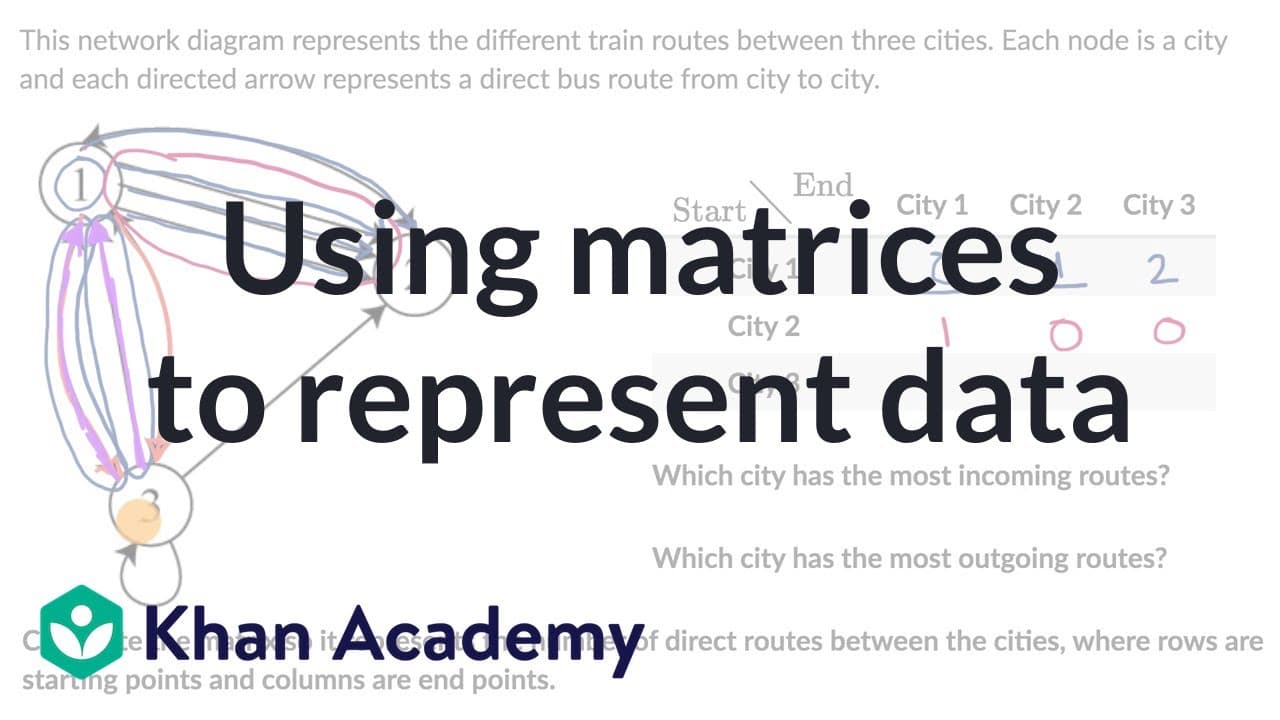
Complete a matrix to represent the number of direct routes between three cities based on a given train route network diagram.
Transcript
- [Instructor] We're told this network diagram represents the different train routes between three cities. Each node is a city and each directed arrow represents a direct bus route from city to city. So for example, this arrow right over here, I guess would represent a direct bus route that starts in city three and ends in city one, while this arro... Read More
Key Insights
- 🏙️ The network diagram represents direct train routes between three cities.
- ❤️🩹 Filling in the matrix helps visualize the number of direct routes between each combination of starting and ending cities.
- 🇻🇦 City Two has the most incoming routes, while City One has the most outgoing routes.
Install to Summarize YouTube Videos and Get Transcripts
Explore YouTube Video Summarizer or Get YouTube Transcript Extractor
Questions & Answers
Q: How do you complete the matrix to represent the number of direct routes between the cities?
To complete the matrix, you need to identify direct routes between each city as starting points and ending points. Count the number of arrows that connect the two cities in each combination, and fill in the corresponding entry in the matrix.
Q: Which city has the most incoming routes?
City Two has the most incoming routes with a total of five routes. This is calculated by adding the incoming routes from each city: City One (0+1+3), City Two (4+1), and City Three (2+0+1).
Q: Which city has the most outgoing routes?
City One has the most outgoing routes with a total of six routes. This is determined by adding the outgoing routes from City One (0+4+2), City Two (1), and City Three (5).
Q: How are the direct routes between cities represented in the matrix?
Each entry in the matrix represents the number of direct routes between a starting city (row) and an ending city (column). If there is a direct route between the cities, the entry is the count of the routes. If there are no direct routes, the entry is zero.
Summary & Key Takeaways
-
The video provides a network diagram representing train routes between three cities.
-
The task is to complete a matrix that represents the number of direct routes between the cities, with rows representing starting points and columns representing end points.
-
The analysis includes filling in the matrix, determining the cities with the most incoming and outgoing routes.
Read in Other Languages (beta)
Share This Summary 📚
Summarize YouTube Videos and Get Video Transcripts with 1-Click
Try YouTube Summary with ChatGPT & Claude or YouTube Transcript Generator
Explore More Summaries from Khan Academy 📚



Summarize YouTube Videos and Get Video Transcripts with 1-Click
Try YouTube Summary with ChatGPT & Claude or YouTube Transcript Generator