The Geopolitics of Critical Minerals—Risks, Resilience, and Resource Control
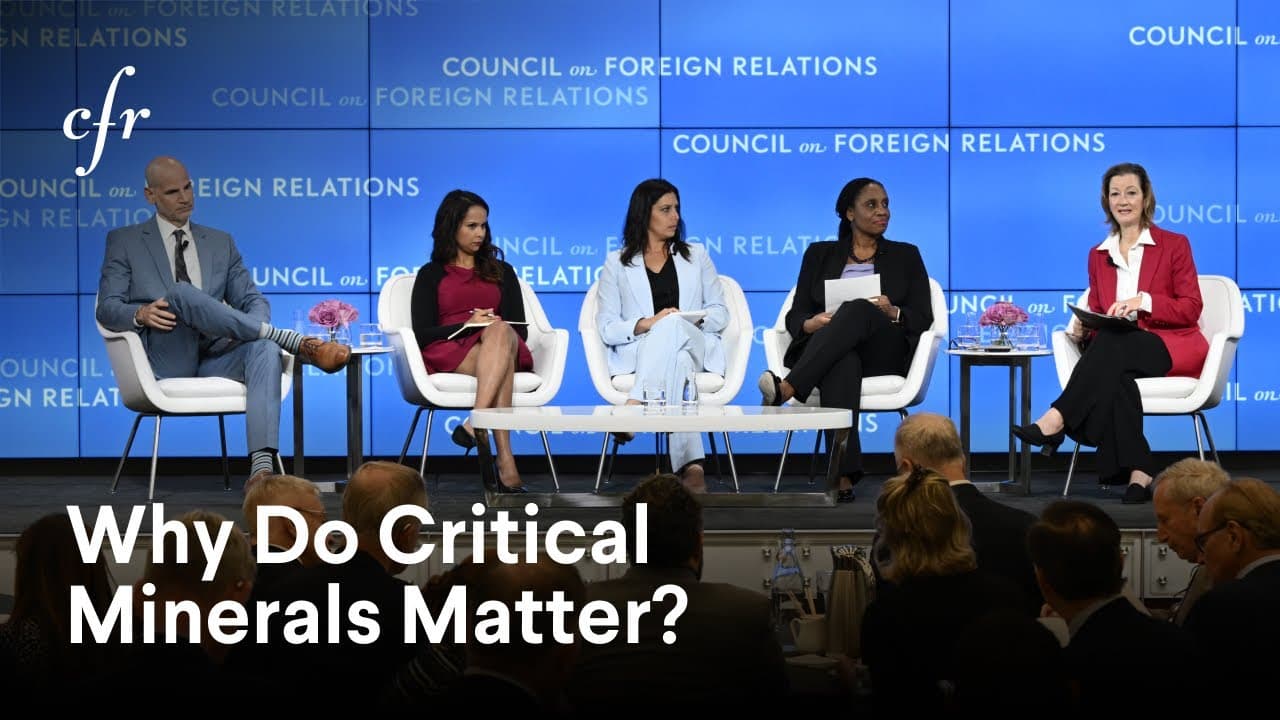
TL;DR
Panel discusses global critical minerals supply chain and geopolitical implications.
Transcript
CREBO-REDIKER: So it’s 12:15. So I’d like to kick it off today and welcome you all here to our CFR meeting on “The Geopolitics of Critical Minerals: Risk, Resilience, and Resource Control.” And we have an amazing, amazing panel of speakers here today. In addition to all of you in Washington, D.C., we have about 300 members that are online joi... Read More
Key Insights
- China's dominance in critical minerals supply chain poses significant geopolitical challenges, affecting the U.S. and its allies.
- The U.S. Department of Defense (DOD) is actively investing in securing critical minerals for defense systems, leveraging the Defense Production Act.
- International partnerships, such as those with Canada, Australia, and the U.K., are crucial for the U.S. to secure critical mineral supply chains.
- Technological innovations and recycling are key opportunities for the U.S. to leapfrog current challenges in critical mineral dependency.
- The U.S. faces significant workforce challenges in mining and processing critical minerals, necessitating investment in education and training.
- The DRC presents untapped opportunities for U.S. companies in critical minerals, with potential for exploration and infrastructure development.
- A clear strategy is needed to align U.S. resources, allies, and technological capabilities to reduce dependence on China for critical minerals.
- Battery energy storage and electric vehicle industries are critical demand drivers for rare earths and other critical minerals.
Install to Summarize YouTube Videos and Get Transcripts
Explore YouTube Video Summarizer or Get YouTube Transcript Extractor
Questions & Answers
Q: What role does China play in the global critical minerals supply chain?
China has heavily invested in the entire supply chain of critical minerals and rare earths, establishing a significant chokehold on global supply. This dominance allows China to exert geopolitical influence, as seen in past export restrictions against Japan and potential retaliatory measures against the U.S. and its allies.
Q: How is the U.S. Department of Defense addressing critical minerals supply chain challenges?
The DOD is using the Defense Production Act to invest in the critical minerals supply chain, focusing on securing resources for defense systems. This includes funding new mines and refineries and expanding partnerships with allies like Canada, Australia, and the U.K. to treat them as domestic sources under the Act.
Q: What opportunities exist for U.S. companies in the DRC's critical minerals sector?
The DRC holds significant untapped potential, with only 20% of its land mapped. U.S. companies can engage in early-stage exploration and infrastructure development, leveraging strategic investments in energy and transport to overcome challenges like low electrification and complex logistics.
Q: Why is a clear strategy important for the U.S. in critical minerals?
A clear strategy helps align U.S. resources, allies, and technological capabilities to ensure a secure supply of critical minerals. It allows for targeted investments and partnerships, ensuring the U.S. can develop industries and technologies necessary for economic and national security.
Q: What are the key challenges in the U.S. workforce related to critical minerals?
The U.S. faces a shortage of skilled workers in mining and processing critical minerals. There is a need for increased investment in education and training programs to develop expertise in these areas, which are crucial for supporting domestic supply chain resilience.
Q: How can technological innovations help the U.S. reduce dependency on foreign critical minerals?
Innovations in material engineering, recycling, and alternative materials can help the U.S. reduce dependency on foreign critical minerals. These technologies can provide new ways to extract, process, and replace critical minerals, offering a pathway to greater supply chain independence.
Q: What role do international partnerships play in the U.S. critical minerals strategy?
International partnerships are essential for securing critical minerals supply chains. Collaborations with allies like Canada, Australia, and the U.K. allow the U.S. to access resources and share technologies, enhancing resilience against geopolitical disruptions.
Q: What is the significance of battery energy storage in the critical minerals discussion?
Battery energy storage is a critical driver of demand for minerals like lithium and cobalt. Developing a robust battery industry is essential for the U.S. to support electric vehicles and renewable energy technologies, reducing dependency on foreign sources and enhancing energy security.
Summary & Key Takeaways
-
The panel highlights China’s significant control over the critical minerals supply chain, posing challenges to the U.S. and its allies. The discussion emphasizes the importance of international partnerships and strategic investments by the U.S. Department of Defense to secure these resources.
-
Technological innovations, including recycling and alternative materials, offer the U.S. opportunities to overcome its dependency on foreign critical minerals. Workforce development is crucial to support these efforts, requiring investment in education and training programs.
-
The panel underscores the need for a comprehensive strategy to address the U.S.'s critical minerals supply chain vulnerabilities, including leveraging international alliances and fostering domestic technological advancements to reduce reliance on China.
Read in Other Languages (beta)
Share This Summary 📚
Summarize YouTube Videos and Get Video Transcripts with 1-Click
Try YouTube Summary with ChatGPT & Claude or YouTube Transcript Generator
Explore More Summaries from Council on Foreign Relations 📚


Summarize YouTube Videos and Get Video Transcripts with 1-Click
Try YouTube Summary with ChatGPT & Claude or YouTube Transcript Generator