MD5 and SHA | Cryptography and System Security
TL;DR
This section covers the MD5 and SHA1 hash algorithms, their technical aspects, and their use in providing message security.
Transcript
hello and welcome back to the course and this section we are going to study about the md5 and sha1 okay now uh as uh earlier we have seen about the hash algorithm uh and hash function that uh performs uh um some kind of um when we when we apply the hash function for the plain text or the message then it is going to provide a single uh fixed size uh... Read More
Key Insights
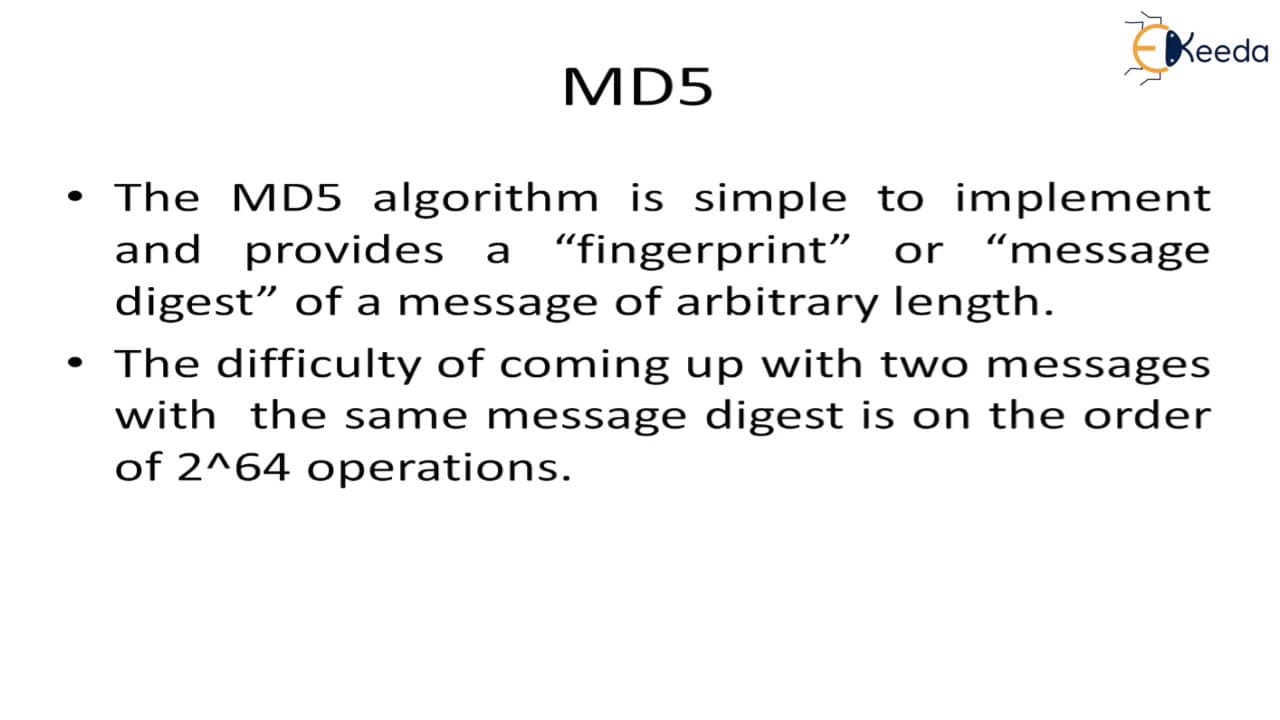
- 💄 MD5 is a hash algorithm that provides a fixed-size fingerprint of a message, ensuring its integrity and making it difficult to produce two messages with the same fingerprint.
- #️⃣ SHA1 is a widely used hash function designed to produce a 160-bit hash value for improved security.
- 🔒 SHA1 has different versions, such as SHA-256, SHA-384, and SHA-512, with varying parameters to enhance security.
- 🖐️ The MD5 and SHA1 algorithms play crucial roles in ensuring message security and integrity.
- 🫦 MD5 and SHA1 algorithms involve several steps, including padding, appending bits, and initializing buffers.
- ⚾ SHA1 is based on the hash function MD4 and is designed to closely model its behavior.
- 💪 The weaknesses discovered in SHA resulted in revised versions that address the vulnerabilities and provide stronger hash functions.
Install to Summarize YouTube Videos and Get Transcripts
Explore YouTube Video Summarizer or Get YouTube Transcript Extractor
Questions & Answers
Q: What is the purpose of the MD5 algorithm?
The MD5 algorithm is used to provide a fixed-size fingerprint of a message, ensuring message integrity and making it difficult to produce two messages with the same fingerprint.
Q: How does the MD5 algorithm work?
The MD5 algorithm involves padding the message length, appending bits, and initializing the MD buffer. It then processes the message in blocks and uses auxiliary functions to compute the message digest.
Q: What weaknesses were discovered in SHA, leading to revised versions?
Weaknesses in SHA led to the development of revised versions, such as SHA-256, SHA-384, and SHA-512. These versions address the vulnerabilities and provide stronger hash functions.
Q: What is the purpose of SHA1?
SHA1 is a hash function that provides a 160-bit hash value. It is commonly used in various cryptographic applications for data integrity and authentication purposes.
Summary & Key Takeaways
-
The MD5 algorithm is a digital signature mechanism that provides a fixed-length fingerprint of a message, making it computationally infeasible to produce two messages with the same fingerprint.
-
MD5 requires several steps, including padding the message length, appending bits, and initializing the MD buffer.
-
SHA1 is a widely used hash function that produces a 160-bit hash value. It has different versions with varying parameters to improve security.
Read in Other Languages (beta)
Share This Summary 📚
Summarize YouTube Videos and Get Video Transcripts with 1-Click
Try YouTube Summary with ChatGPT & Claude or YouTube Transcript Generator
Explore More Summaries from Ekeeda 📚






Summarize YouTube Videos and Get Video Transcripts with 1-Click
Try YouTube Summary with ChatGPT & Claude or YouTube Transcript Generator