Classification Of Inverters 4 types - Phase Controlled Rectifiers and Bridge Inverters
TL;DR
This video discusses the different types of inverters based on source, configuration, output waveform, power semiconductor devices used, and commutation circuit.
Transcript
click the Bell icon to get latest videos from Ikeda hello friends in this video we are going to classify different types of inverter in previous video we have seen what are the inverters how they are categorized and what basically the use of the inverters and what is the basic difference between the rectifier and inverters so in this video we are g... Read More
Key Insights
- ✊ Inverters can be categorized based on the nature of the source, configuration, output waveform, power semiconductor devices used, and commutation circuit.
- ℹ️ Voltage source inverters (VSI) use a DC voltage source, while current source inverters (CSI) convert voltage into current for use as a source.
- 💨 Series, parallel, and bridge inverters differ in the way thyristors are connected.
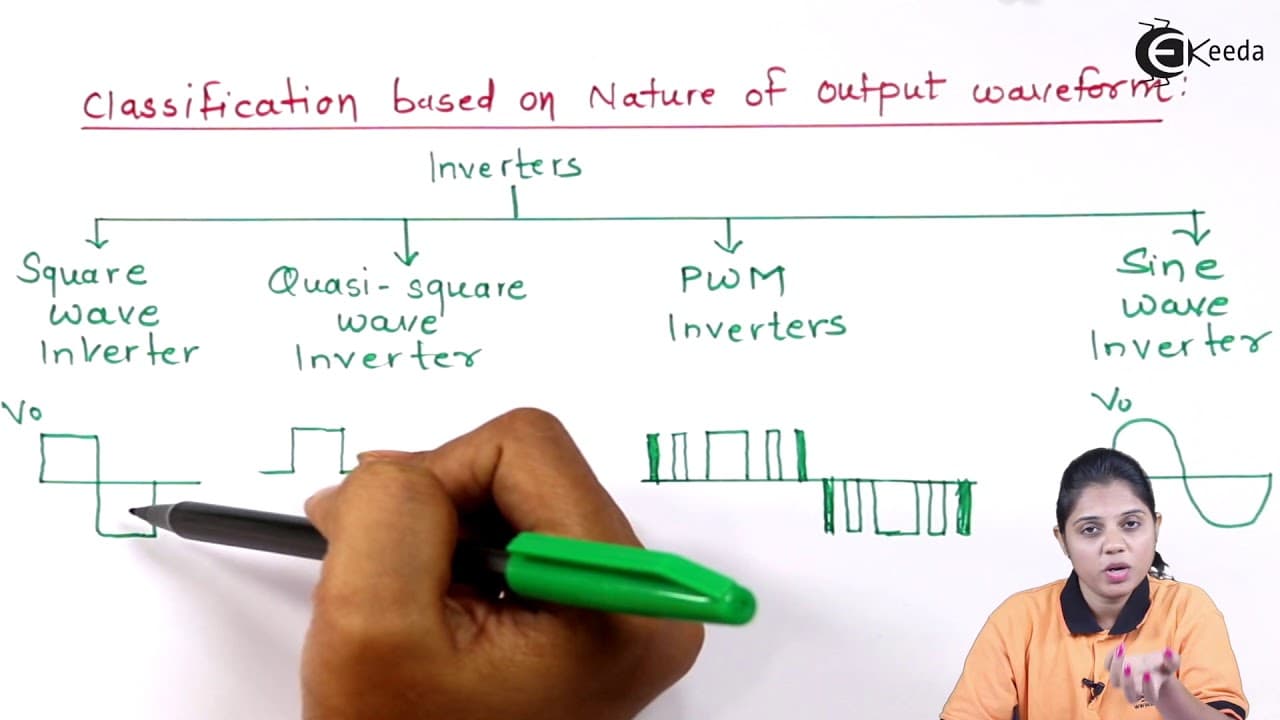
- 👋 Inverters can generate various output waveforms, including square wave, sine wave, cosine square wave, and pulse width modulated (PWM).
- ✊ SCR, transistor, power BJT, MOSFET, and IGBT are commonly used power semiconductor devices in inverters.
- ❓ The commutation circuit in inverters determines how the thyristors are switched and can be categorized as either series or parallel.
- 🅰️ The choice of inverter type depends on the application requirements and desired output.
Install to Summarize YouTube Videos and Get Transcripts
Explore YouTube Video Summarizer or Get YouTube Transcript Extractor
Questions & Answers
Q: What are the different types of inverters based on the nature of the source?
There are voltage source inverters (VSI) and current source inverters (CSI). VSI uses a ripple-free DC voltage source, while CSI converts voltage into current and applies it as a current source.
Q: How can inverters be classified based on their configuration?
Inverters can be series, parallel, or bridge inverters. Series inverters connect thyristors in series, parallel inverters have a push-pull configuration, and bridge inverters connect thyristors in an anti-parallel arrangement.
Q: What are the different types of output waveforms in inverters?
Inverters can have square wave output, which can be converted to sine wave or other forms. Other types include cosine square wave and pulse width modulated (PWM) output waveforms.
Q: What power semiconductor devices can be used in inverters?
Inverters can utilize SCR, transistor, power BJT, MOSFET, or IGBT. The choice depends on factors like frequency requirement, power application, and switching speed.
Summary & Key Takeaways
-
Inverters can be classified based on the nature of the source, such as voltage source inverters (VSI) or current source inverters (CSI).
-
Classification can also be based on the configuration of the inverter, including series, parallel, or bridge inverters.
-
Inverters can vary in terms of the nature of the output waveform, ranging from square wave inverters to sine wave inverters.
-
The power semiconductor devices used in the inverter, such as SCR, transistor, power BJT, MOSFET, or IGBT, can determine its performance.
-
Lastly, the commutation circuit used to switch the thyristors in the inverter can be categorized as either series or parallel.
Read in Other Languages (beta)
Share This Summary 📚
Summarize YouTube Videos and Get Video Transcripts with 1-Click
Try YouTube Summary with ChatGPT & Claude or YouTube Transcript Generator
Explore More Summaries from Ekeeda 📚





Summarize YouTube Videos and Get Video Transcripts with 1-Click
Try YouTube Summary with ChatGPT & Claude or YouTube Transcript Generator