What Are Key Formulas for Soil Consolidation in Geotechnical Engineering?
TL;DR
The key formulas for soil consolidation include the coefficient of compressibility, coefficient of volume change, compression index, expansion index, and recompression index. A numerical example calculates the coefficient of volume change and coefficient of consolidation using initial and final void ratios, pressure increase, and soil permeability. These formulas are essential for understanding soil behavior under stress in geotechnical engineering.
Transcript
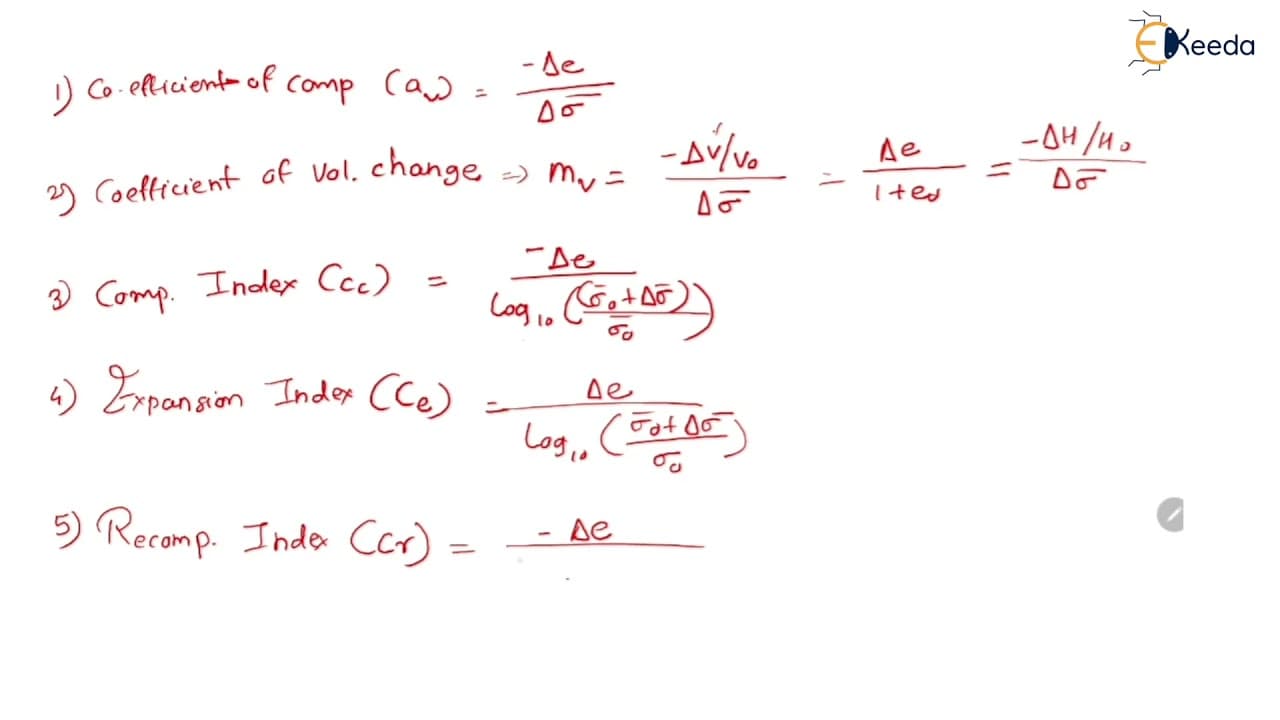
hello everyone in this video we are going to discuss first numerical based on basic definition from the chapter consolidation of soils so before starting the numerical we will be discussing the formula which we have already discussed in the video of basic definitions so first formula we have discussed is coefficient of compressibility denoted as av... Read More
Key Insights
- 🫰 The video discusses important formulas related to basic definitions in soil consolidation, including coefficient of compressibility, coefficient of volume change, compression index, expansion index, and recompression index.
- 🎮 The numerical analysis in the video provides a practical application of these formulas, calculating the coefficient of volume change and coefficient of consolidation.
- 🥳 The numerical example involves a laboratory consolidation test and provides input data such as initial and final void ratios, pressure increase, and permeability of the soil.
- ❓ Understanding these formulas is crucial for analyzing the behavior and consolidation of soils in geotechnical engineering.
- 💱 Coefficient of compressibility measures the deformability of soils under increased stress, while coefficient of volume change quantifies volumetric strain with respect to changes in effective stress.
- 🫰 Compression index, expansion index, and recompression index provide insights into the nature and behavior of soils during consolidation.
- 🈸 The numerical example demonstrates the practical application of the formulas for solving engineering problems related to soil consolidation.
Install to Summarize YouTube Videos and Get Transcripts
Explore YouTube Video Summarizer or Get YouTube Transcript Extractor
Questions & Answers
Q: What is the formula for coefficient of compressibility?
The formula for coefficient of compressibility (av) is the decrease in void ratio (delta e) divided by the increasing effective stress (delta sigma bar): av = (delta e) / (delta sigma bar).
Q: How is coefficient of volume change (mv) calculated?
Coefficient of volume change (mv) is calculated as the volumetric strain (minus delta v upon v naught) divided by the unit increase in effective stress (delta sigma bar), or alternatively as delta e divided by 1 plus e naught: mv = (minus delta v / v naught) / (delta sigma bar) = delta e / (1 + e naught).
Q: What is the relationship between compression index (cc) and the curve e versus log sigma bar?
Compression index (cc) is the slope of the curve e versus log sigma bar. It can be calculated using the formula: cc = -(delta e) / (log(sigma naught bar) + delta sigma bar / sigma naught bar).
Q: What is the significance of the expansion index (ce)?
The expansion index (ce) is similar to the compression index, but with the elimination of the minus sign in the formula. It represents the slope of the curve e versus log sigma bar for overconsolidated soils.
Summary & Key Takeaways
-
The video introduces formulas for coefficient of compressibility, coefficient of volume change, compression index, expansion index, and recompression index in soil consolidation.
-
It then presents a numerical analysis of a laboratory consolidation test, calculating the coefficient of volume change and the coefficient of consolidation.
-
The initial and final void ratios, increase in pressure, and soil permeability are given as input data for the numerical analysis.
Read in Other Languages (beta)
Share This Summary 📚
Summarize YouTube Videos and Get Video Transcripts with 1-Click
Try YouTube Summary with ChatGPT & Claude or YouTube Transcript Generator
Explore More Summaries from Ekeeda 📚


Summarize YouTube Videos and Get Video Transcripts with 1-Click
Try YouTube Summary with ChatGPT & Claude or YouTube Transcript Generator