CRISPR-Cas9 Genome Editing Technology
TL;DR
The CRISPR-Cas9 system is a genome editing technology that allows for precise manipulation of genetic information, with various applications in fields like cancer immunotherapy and disease prevention.
Transcript
We’ve examined a handful of biotechnology concepts in previous tutorials, but now it’s time to introduce what is undoubtedly the most promising technique in biotechnology of the past decade. The CRISPR-Cas9 system represents genome editing technology that has revolutionized molecular biology, due to its precise and site-specific gene edit... Read More
Key Insights
- 🧬 CRISPR-Cas9 system is a revolutionary genome editing technology that offers precise gene editing capabilities in organisms, allowing for unprecedented control in manipulating genetic information.
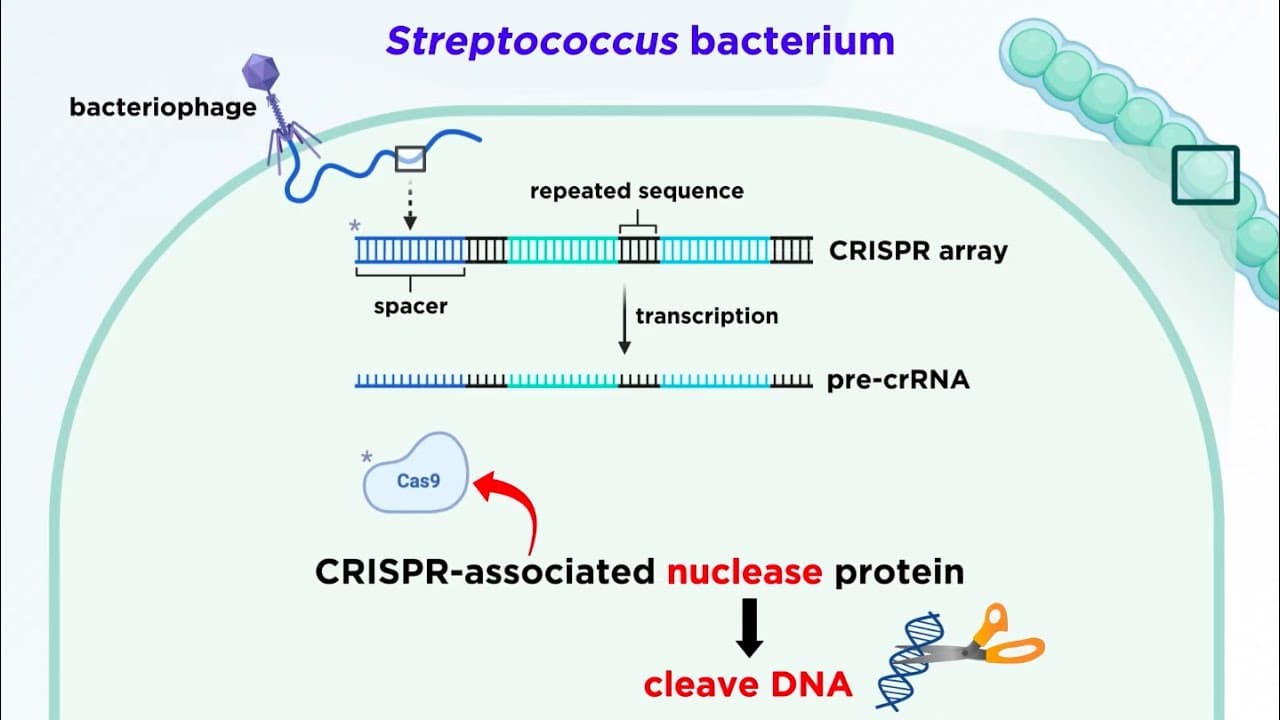
- 🦠 CRISPR was first discovered in prokaryotes and serves as a defense mechanism against viral DNA, bacteriophages, and plasmids.
- 🔬 Jennifer Doudna and Emmanuelle Charpentier proposed using CRISPR as a programmable toolkit for genome editing in humans and animals, leading to the Nobel prize in chemistry in 2020.
- 🧬 Genome editing using CRISPR can be achieved by synthesizing single guide RNA (sgRNA) that complexes with Cas9 protein to cleave DNA at desired locations.
- 💉 CRISPR has potential applications in cancer immunotherapy, modifying immune T cells to recognize and kill cancer cells more efficiently.
- 💊 It can also be used in the therapeutic management of AIDS, targeting the proviral latent reservoir that conventional therapies fail to address.
- 🧪 CRISPR is valuable in developing assays to detect SARS-CoV-2 infection and has vast potential in disease cures and prevention of gene-linked diseases.
- 🌱 CRISPR technology can be used to improve plant traits, enhance disease resistance, and increase crop yield.
Install to Summarize YouTube Videos and Get Transcripts
Explore YouTube Video Summarizer or Get YouTube Transcript Extractor
Questions & Answers
Q: How does the CRISPR-Cas9 system work in prokaryotic organisms as a defense mechanism?
The CRISPR-Cas9 system in prokaryotes involves the incorporation of viral DNA sequences (spacers) into the CRISPR locus, forming a memory of past viral infections. When encountering a viral DNA with a sequence complementary to the CRISPR RNA (crRNA), the Cas9 protein cleaves the virus DNA, neutralizing the infection.
Q: What is the role of the Cas9 protein in the CRISPR-Cas9 system?
The Cas9 protein is a nuclease enzyme capable of cleaving DNA at specific nucleotide linkages. In the CRISPR-Cas9 system, it binds to the complex formed by the crRNA, tracrRNA, and spacer sequences, and it cleaves the DNA at a precise location determined by the crRNA sequence, effectively disabling the targeted gene or viral DNA.
Q: What are some potential applications of the CRISPR-Cas9 system?
The CRISPR-Cas9 system has various applications, including genetic screens, cancer immunotherapy, AIDS management, SARS-CoV-2 detection, genome editing in human embryos, genetic editing of somatic cells, and genome editing in plants. It has the potential to cure diseases, prevent the inheritance of gene-linked diseases, and improve crop yield and characteristics.
Q: What are the two routes of DNA repair after the Cas9 protein cleaves the DNA?
After the Cas9 protein cleaves the target DNA, the repair can occur through homology-directed repair (HDR) or non-homologous end joining (NHEJ). HDR uses a homologous DNA template to guide repair and maintain uniformity in the size of the resulting DNA, while NHEJ repairs without a homologous template, sometimes resulting in indels (insertions or deletions) and non-uniformity in size.
Summary & Key Takeaways
-
The CRISPR-Cas9 system was first discovered in bacteria and archaea as a defense mechanism against viral DNA, but it has since been applied to genome editing in eukaryotic species.
-
The system involves the use of CRISPR arrays, CRISPR RNA (crRNA), tracrRNA, and the Cas9 protein to target and cleave specific DNA sequences.
-
CRISPR-Cas9 has a wide range of potential applications, including genetic screens, cancer immunotherapy, AIDS management, detection of SARS-CoV-2 infection, and genome editing in plants.
Read in Other Languages (beta)
Share This Summary 📚
Summarize YouTube Videos and Get Video Transcripts with 1-Click
Try YouTube Summary with ChatGPT & Claude or YouTube Transcript Generator
Explore More Summaries from Professor Dave Explains 📚


Summarize YouTube Videos and Get Video Transcripts with 1-Click
Try YouTube Summary with ChatGPT & Claude or YouTube Transcript Generator