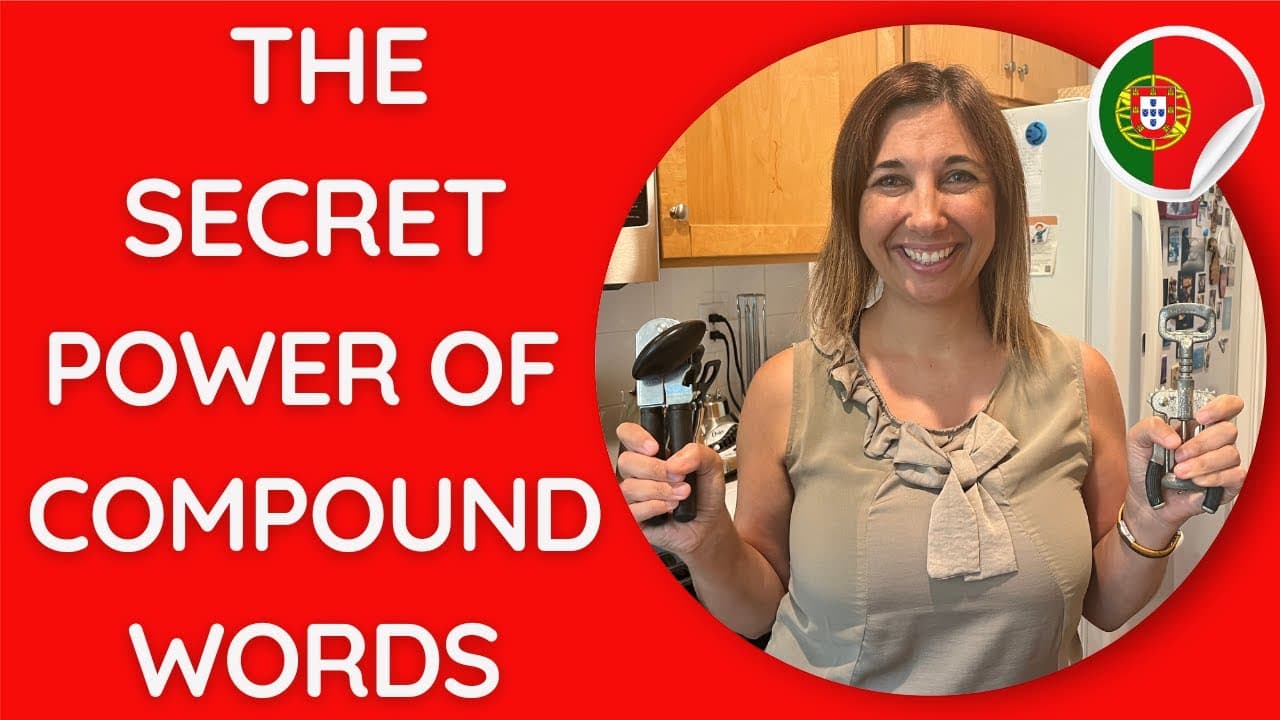
Supercharge your Portuguese 🇵🇹 with Compound Words!
TL;DR
Learn Portuguese compound words to enhance vocabulary.
Transcript
You have probably noticed that in Portuguese, as in English, there are many compound words, formed by the combination of two words that when put together form a new one with a totally different meaning. This video will be a fun way to learn new vocabulary, that many times trick students. Before we start, I wanted to share some exciting news. I ... Read More
Key Insights
- Compound words in Portuguese, like in English, are formed by combining two words to create a new meaning. These words enhance vocabulary and understanding of the language.
- The video introduces a free A2 sample exam for the CIPLE, providing students with practice materials including audios, transcripts, and questions.
- Noun-Noun compounds in Portuguese combine two nouns to form a new word, such as 'cão-guia' (guide dog) and 'couve-flor' (cauliflower).
- Verb-Noun compounds involve a verb and a noun, often indicating an action and an object, like 'porta-moedas' (coin purse) and 'guarda-chuva' (umbrella).
- Noun-Adjective compounds pair descriptive words with nouns to capture specific qualities, such as 'obra-prima' (masterpiece).
- Adjective-Adjective compounds often describe colors or nationalities, such as 'azul-escuro' (dark blue) and 'luso-americano' (Portuguese-American).
- Numeral-Noun compounds create ordinal relationships, like 'primeiro-ministro' (prime minister) and 'segunda-feira' (Monday).
- Nouns joined by prepositions require two hyphens, seen in words like 'mão-de-obra' (labor) and 'cor-de-rosa' (pink).
Install to Summarize YouTube Videos and Get Transcripts
Explore YouTube Video Summarizer or Get YouTube Transcript Extractor
Questions & Answers
Q: What are compound words in Portuguese?
Compound words in Portuguese are formed by combining two words to create a new word with a distinct meaning. They can be noun-noun, verb-noun, adjective-noun, adjective-adjective, or numeral-noun combinations, and they play a significant role in enriching the Portuguese language.
Q: What is the purpose of the free A2 sample exam mentioned?
The free A2 sample exam is designed to help students prepare for the CIPLE exam by providing them with practice materials. It includes audios, transcripts, and questions that follow the CIPLE typology, addressing the lack of available practice exams for students aiming to improve their Portuguese proficiency.
Q: Can you give examples of noun-noun compound words in Portuguese?
Yes, noun-noun compound words in Portuguese involve combining two nouns to create a new meaning. Examples include 'cão-guia' (guide dog), 'couve-flor' (cauliflower), 'palavra-chave' (keyword), 'beira-mar' (seaside), and 'cara-metade' (better half). These compounds enrich the language by conveying specific concepts.
Q: What are verb-noun compound words and their significance?
Verb-noun compound words in Portuguese combine a verb and a noun, often indicating an action and an object. Examples include 'porta-moedas' (coin purse) and 'guarda-chuva' (umbrella). These compounds are significant as they convey specific actions or functions, enhancing clarity and precision in communication.
Q: How do adjective-adjective compounds function in Portuguese?
Adjective-adjective compounds in Portuguese typically describe colors or nationalities. For instance, 'azul-escuro' means dark blue, and 'verde-claro' means light green. These compounds allow for nuanced descriptions, conveying specific shades or combinations of qualities, thereby enriching the language's descriptive capacity.
Q: What role do numeral-noun compounds play in Portuguese?
Numeral-noun compounds in Portuguese establish ordinal relationships, linking numbers with specific nouns. Examples include 'primeiro-ministro' (prime minister) and 'segunda-feira' (Monday). These compounds are crucial for conveying order, sequence, or ranking, adding structure and clarity to expressions involving numbers.
Q: What is unique about compound words joined by prepositions?
Compound words joined by prepositions in Portuguese require two hyphens and often involve a noun and a preposition. Examples include 'mão-de-obra' (labor) and 'cor-de-rosa' (pink). These compounds are unique as they integrate prepositions to convey specific relationships or characteristics, enhancing linguistic precision.
Q: How does the video help learners of Portuguese?
The video aids Portuguese learners by explaining the formation and usage of compound words, providing examples across various categories. It enhances vocabulary, understanding, and appreciation of the language's complexity. Additionally, it offers a free A2 sample exam, supporting students in their preparation for the CIPLE.
Summary & Key Takeaways
-
The video explores the formation and usage of compound words in Portuguese, providing examples across different categories such as noun-noun, verb-noun, and adjective-adjective compounds.
-
A free A2 sample exam for the CIPLE is introduced, offering valuable practice resources for students, including audios, transcripts, and questions for all exam components.
-
Various types of compound words are explained, showcasing how they enhance the richness of the Portuguese language and help learners expand their vocabulary effectively.
Read in Other Languages (beta)
Share This Summary 📚
Summarize YouTube Videos and Get Video Transcripts with 1-Click
Try YouTube Summary with ChatGPT & Claude or YouTube Transcript Generator
Explore More Summaries from Learn European Portuguese Online 📚


Summarize YouTube Videos and Get Video Transcripts with 1-Click
Try YouTube Summary with ChatGPT & Claude or YouTube Transcript Generator