How to Implement Captcha Recognition with PyTorch
TL;DR
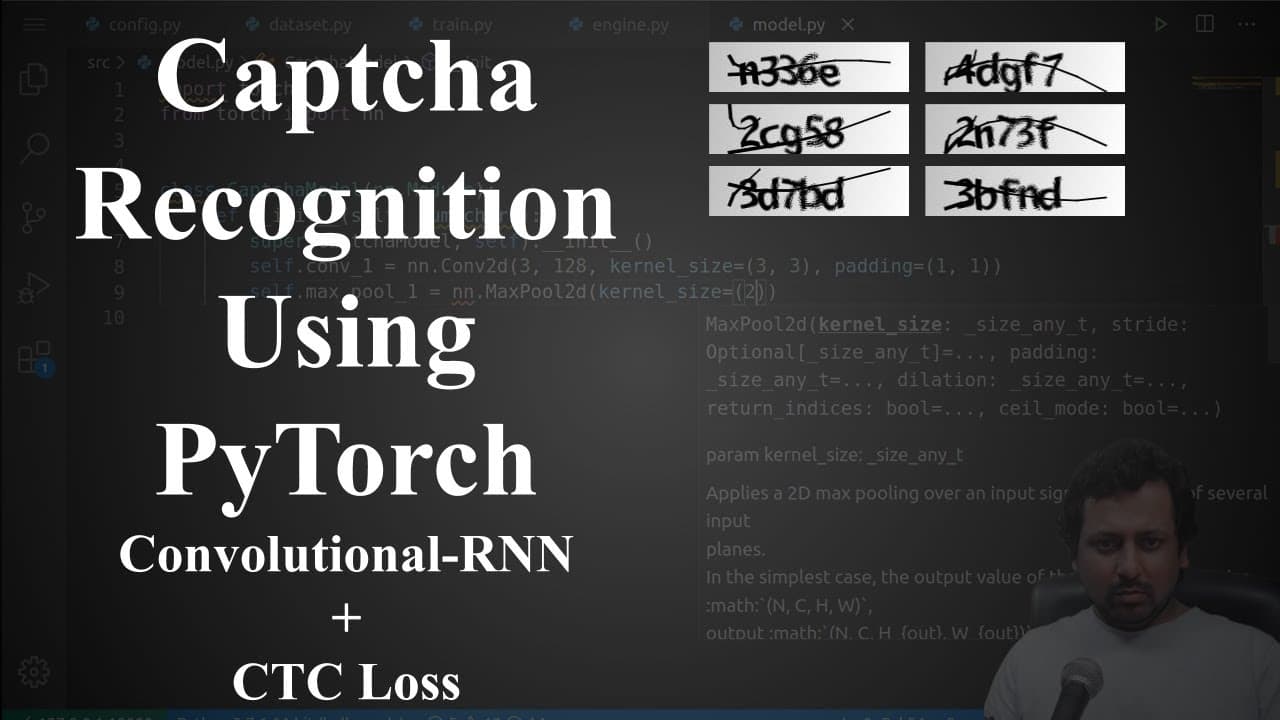
To implement captcha recognition using PyTorch, create a Convolutional RNN that combines convolutional layers for feature extraction and a GRU layer for sequence prediction. Preprocess the dataset by resizing and normalizing captcha images, and use CTC Loss for evaluating the model's performance. The tutorial provides a step-by-step code guide for building and training the model.
Transcript
hello everyone welcome to my new video in case you are interested in my book you can buy it from the link provided in the description box in this video i'm going to show you how to implement convolutional rnn for a problem like captcha recognition recently very good data scientist and also a good friend akash nan published a tutorial on capture rec... Read More
Key Insights
- ❓ This tutorial demonstrates how to implement a Convolutional RNN model for captcha recognition using PyTorch.
- ❓ The model combines convolutional layers and a GRU layer to process captcha images and make predictions.
- ❓ The dataset is preprocessed by resizing, augmenting, and normalizing the images.
- 🌸 CTC Loss is used to compute the loss between predicted and actual character sequences.
- 👨💻 The tutorial provides code examples and explanations for each step of the process.
Install to Summarize YouTube Videos and Get Transcripts
Explore YouTube Video Summarizer or Get YouTube Transcript Extractor
Questions & Answers
Q: What is the purpose of captcha recognition?
Captcha recognition is used to identify and verify whether a user submitting a form or accessing a website is human, as captchas often require the user to type in characters displayed in an image.
Q: How is the data loaded and preprocessed in this tutorial?
The tutorial uses a custom dataset class that reads the captcha images and their corresponding labels from a specified directory. The images are then resized and transformed into PyTorch tensors. Augmentation techniques and normalization are also applied to the images.
Q: What is the structure of the Convolutional RNN model used in this tutorial?
The model consists of two sets of convolutional layers followed by max pooling layers. The output is then flattened and passed through a linear layer and a GRU layer. Finally, another linear layer is used for classification.
Q: What is CTC Loss and why is it used in this tutorial?
CTC (Connectionist Temporal Classification) Loss is a loss function commonly used in sequence recognition tasks. It is used in this tutorial to compute the loss between the predicted and actual sequence of characters in the captcha images, taking into account potential blanks and unknown characters.
Summary & Key Takeaways
-
The tutorial is based on the work of a data scientist named Akash Nan, who published a tutorial on captcha recognition using TensorFlow and Keras. The tutorial in this video is heavily inspired by that, with the key difference being the use of PyTorch.
-
The tutorial covers the process of obtaining and preprocessing the captcha image dataset, creating a custom dataset and data loader, building a Convolutional RNN model, training the model, and evaluating the predictions.
-
The model uses a combination of convolutional layers, max pooling, and a GRU layer to process the captcha images and make predictions on the characters.
Read in Other Languages (beta)
Share This Summary 📚
Summarize YouTube Videos and Get Video Transcripts with 1-Click
Try YouTube Summary with ChatGPT & Claude or YouTube Transcript Generator
Explore More Summaries from Abhishek Thakur 📚



Summarize YouTube Videos and Get Video Transcripts with 1-Click
Try YouTube Summary with ChatGPT & Claude or YouTube Transcript Generator