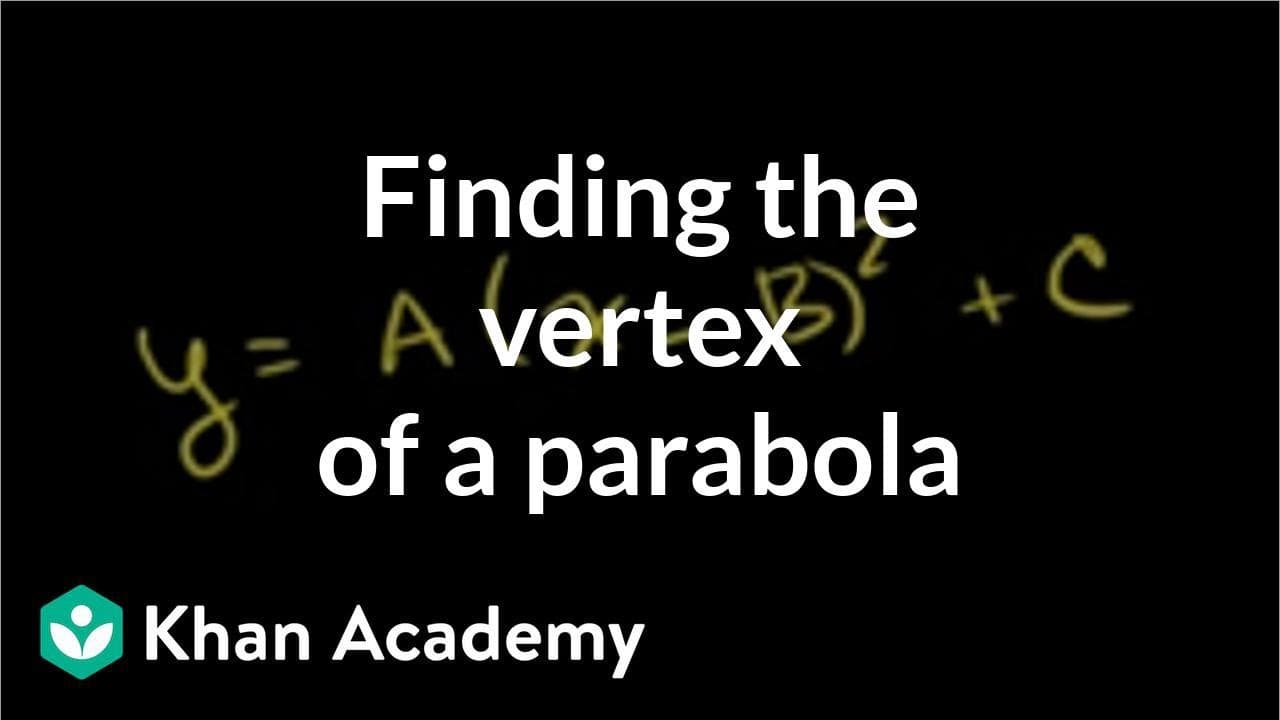
Finding the vertex of a parabola example | Quadratic equations | Algebra I | Khan Academy
TL;DR
Learn how to find the vertex of a quadratic equation by using the formula for the x-coordinate or by completing the square.
Transcript
I have an equation right here. It's a second degree equation. It's a quadratic. And I know its graph is going to be a parabola. Just as a review, that means it looks something like this or it looks something like that. Because the coefficient on the x squared term here is positive, I know it's going to be an upward opening parabola. And I am curiou... Read More
Key Insights
- ❎ The vertex of a quadratic equation can be found using the formula -b/2a or by completing the square.
- ☺️ The x-coordinate of the vertex is the value halfway between the roots of the equation.
- ❎ Completing the square involves adding a term to the equation to convert it into a perfect square trinomial.
- 💁 The vertex form of a quadratic equation is in the form (x-h)^2 + k, where (h, k) represents the vertex coordinates.
- ❣️ The y-coordinate of the vertex can be calculated by substituting the x-value of the vertex back into the equation.
- 😥 The vertex represents the minimum or maximum point of the parabola, depending on its concavity.
- ☺️ The quadratic formula can also be used to find the x-intercepts of a quadratic equation.
Install to Summarize YouTube Videos and Get Transcripts
Explore YouTube Video Summarizer or Get YouTube Transcript Extractor
Questions & Answers
Q: How can you determine whether the graph of a quadratic equation is an upward or downward opening parabola?
The coefficient of the x squared term determines the concavity of the parabola. If it is positive, the parabola opens upward; if it is negative, the parabola opens downward.
Q: What is the formula for finding the x-coordinate of the vertex of a quadratic equation?
The x-coordinate of the vertex is given by the formula -b/2a, where b is the coefficient of the x term and a is the coefficient of the x squared term.
Q: How can the y-coordinate of the vertex be calculated?
The y-coordinate of the vertex can be found by substituting the x-value of the vertex back into the equation.
Q: What is completing the square, and how does it help in finding the vertex of a quadratic equation?
Completing the square involves manipulating the quadratic equation to create a perfect square trinomial. By doing this, the vertex form of the equation is obtained, which allows for easy identification of the vertex.
Summary & Key Takeaways
-
The graph of a quadratic equation is a parabola that can open upwards or downwards.
-
The vertex of an upward-opening parabola is the minimum point, while for a downward-opening parabola, it is the maximum point.
-
The x-coordinate of the vertex can be found using the formula -b/2a, and the y-coordinate can be calculated by substituting the x-value back into the equation.
Read in Other Languages (beta)
Share This Summary 📚
Summarize YouTube Videos and Get Video Transcripts with 1-Click
Try YouTube Summary with ChatGPT & Claude or YouTube Transcript Generator
Explore More Summaries from Khan Academy 📚



Summarize YouTube Videos and Get Video Transcripts with 1-Click
Try YouTube Summary with ChatGPT & Claude or YouTube Transcript Generator