Status word of Programmable Communication Interface PIC 8251
TL;DR
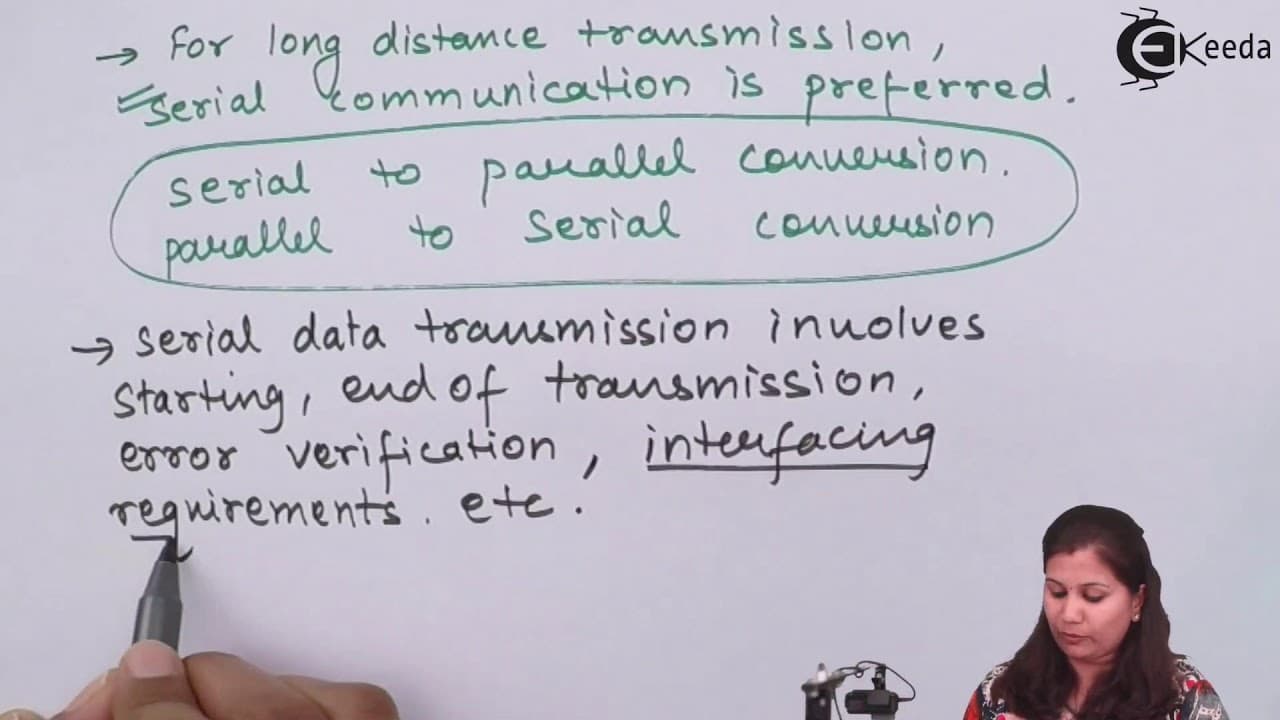
This video provides an overview of serial communication interfacing standards, explaining the difference between serial and parallel communication and discussing the need for standards in long-distance data transmission.
Transcript
hello friends in this video we will get an introduction about the serial communication interfacing standards so let us start with our topic now in this world there are many devices and these devices they communicate with each other when we call communication it means that the two devices they are transmitting the data between each other like one de... Read More
Key Insights
- 🫦 Serial communication involves transmitting one bit at a time, while parallel communication transmits all bits simultaneously.
- 😘 Serial communication is preferred for long-distance transmission due to its lower hardware requirements.
- 🐎 Interfacing standards specify voltage levels, data transfer speed, cable length, and other requirements for effective communication between devices.
- ❓ Commonly used serial communication interfacing standards include RS232, Universal Serial Bus (USB), and Ethernet.
- 🪡 The need for interfacing standards arises from the desire for a common understanding among manufacturers and technologies across different countries.
- ❓ Interfacing standards can be defined by organizations such as the IEEE.
- 🥶 Serial data transmission can be done using either current or voltage, with current loop methods being relatively noise-free and suitable for long-distance transmission.
Install to Summarize YouTube Videos and Get Transcripts
Explore YouTube Video Summarizer or Get YouTube Transcript Extractor
Questions & Answers
Q: What are the two types of data transmission?
The two types of data transmission are serial and parallel. Serial transmission involves transmitting one bit at a time, while parallel transmission transmits all bits simultaneously.
Q: Why is serial communication preferred for long-distance transmission?
Serial communication requires less hardware and is more cost-effective for long-distance transmission, as it uses a single line for data transmission compared to parallel communication, which requires multiple cables.
Q: What are interfacing standards?
Interfacing standards are a set of rules and specifications that ensure proper communication between devices. They specify voltage levels, data transfer speed, cable length, and other requirements for effective data transmission.
Q: Who defines and provides interfacing standards?
Interfacing standards are typically defined and provided by organizations like the IEEE (Institute of Electrical and Electronics Engineers) or other professional institutes specializing in engineering standards.
Summary & Key Takeaways
-
Serial communication involves transmitting one bit at a time, while parallel communication transmits all bits simultaneously, requiring more cables and hardware.
-
Serial communication is preferred for long-distance transmission due to its lower hardware requirements, even though it is slower than parallel communication.
-
Interfacing standards are necessary to ensure proper communication between devices, specifying requirements such as voltage levels, data transfer speed, and cable length.
Read in Other Languages (beta)
Share This Summary 📚
Summarize YouTube Videos and Get Video Transcripts with 1-Click
Try YouTube Summary with ChatGPT & Claude or YouTube Transcript Generator
Explore More Summaries from Ekeeda 📚






Summarize YouTube Videos and Get Video Transcripts with 1-Click
Try YouTube Summary with ChatGPT & Claude or YouTube Transcript Generator