Problem 1 Linear Prediction and Optimum Linear Filters
TL;DR
This video discusses a problem related to linear prediction and optimum linear filters in the context of autoregressive (AR) processes.
Transcript
hello friends and welcome to this video in this video we are going to solve a problem based on to the understanding that we have made into the chapter titled linear prediction and optimum linear filters hence the topic name is problem linear prediction and optimum linear filters in this current chapter we have understood various concepts in order t... Read More
Key Insights
- 🎮 The video focuses on a problem related to linear prediction and optimum linear filters within the context of AR processes.
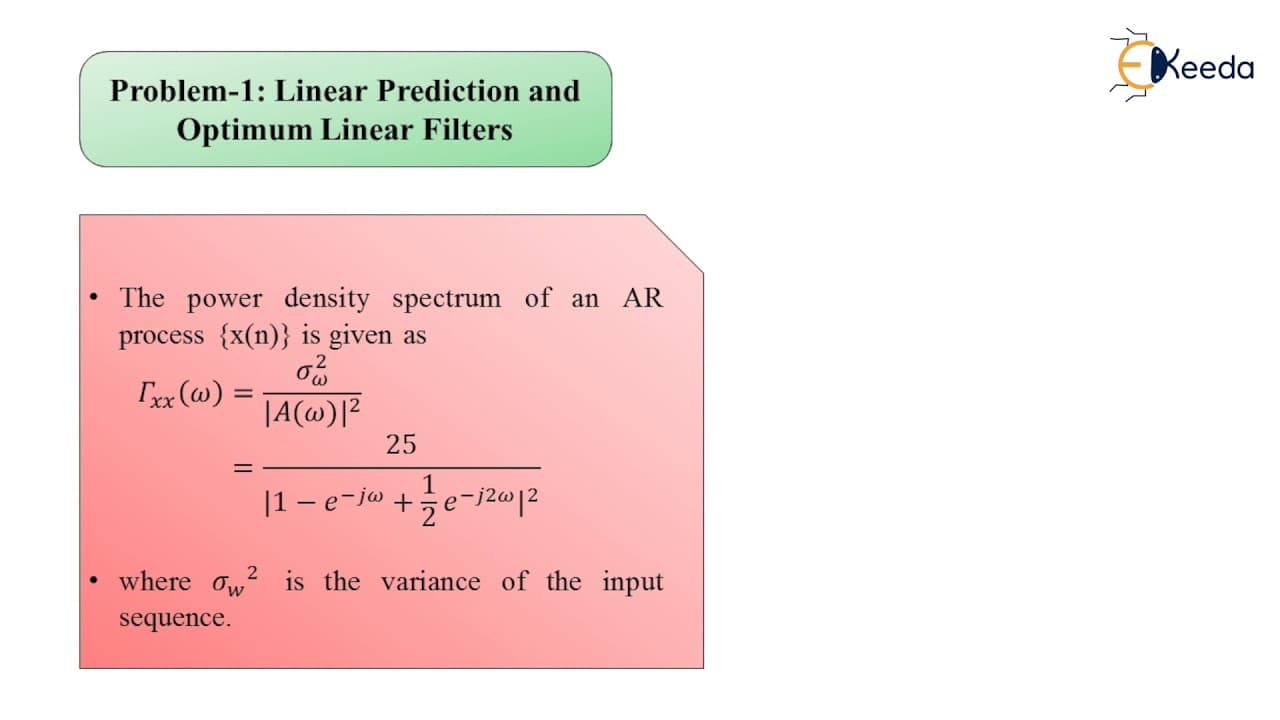
- ✊ The power density spectrum of the AR process is given by a specific equation involving angular frequency and variance.
- 🤍 Part a of the problem involves determining the difference equation for generating the AR process input from white noise excitation.
- 😃 Part b of the problem requires finding the system function for the whitening filter.
- 🔠 The solution to part a involves expressing the AR process input as a difference equation, while the solution to part b provides the system function for the whitening filter.
- 🎮 The video mentions that the next video will cover another problem related to linear prediction and optimum linear filters.
Install to Summarize YouTube Videos and Get Transcripts
Explore YouTube Video Summarizer or Get YouTube Transcript Extractor
Questions & Answers
Q: What is the problem statement in this video?
The problem statement involves finding the difference equation for generating an AR process and determining the system function for the whitening filter.
Q: How is the power density spectrum of the AR process described?
The power density spectrum, denoted by gamma_xx(w), is given by 25 divided by the modulus squared of (1 - e^(-jw))/(1 - 2e^(-jw) + e^(-2jw)).
Q: What is the solution to part a of the problem statement?
The solution involves expressing the AR process input, x(n), as x(n-1) - 1/2x(n-2) + w(n), where w(n) is the white noise excitation.
Q: How is the whitening filter system function determined?
The whitening filter system function, denoted by H_inverse(z), is given by 1 - z^(-1) + 1/2z^(-2).
Summary & Key Takeaways
-
The video introduces the topic of solving a problem in linear prediction and optimum linear filters within the context of AR processes.
-
The problem statement involves determining the difference equation for generating the AR process and finding the system function for the whitening filter.
-
The solution to part a involves expressing the AR process input as a difference equation, while part b involves determining the whitening filter.
Read in Other Languages (beta)
Share This Summary 📚
Summarize YouTube Videos and Get Video Transcripts with 1-Click
Try YouTube Summary with ChatGPT & Claude or YouTube Transcript Generator
Explore More Summaries from Ekeeda 📚


Summarize YouTube Videos and Get Video Transcripts with 1-Click
Try YouTube Summary with ChatGPT & Claude or YouTube Transcript Generator