Are your fingerprints really unique?
TL;DR
AI reveals new insights into fingerprint similarities.
Transcript
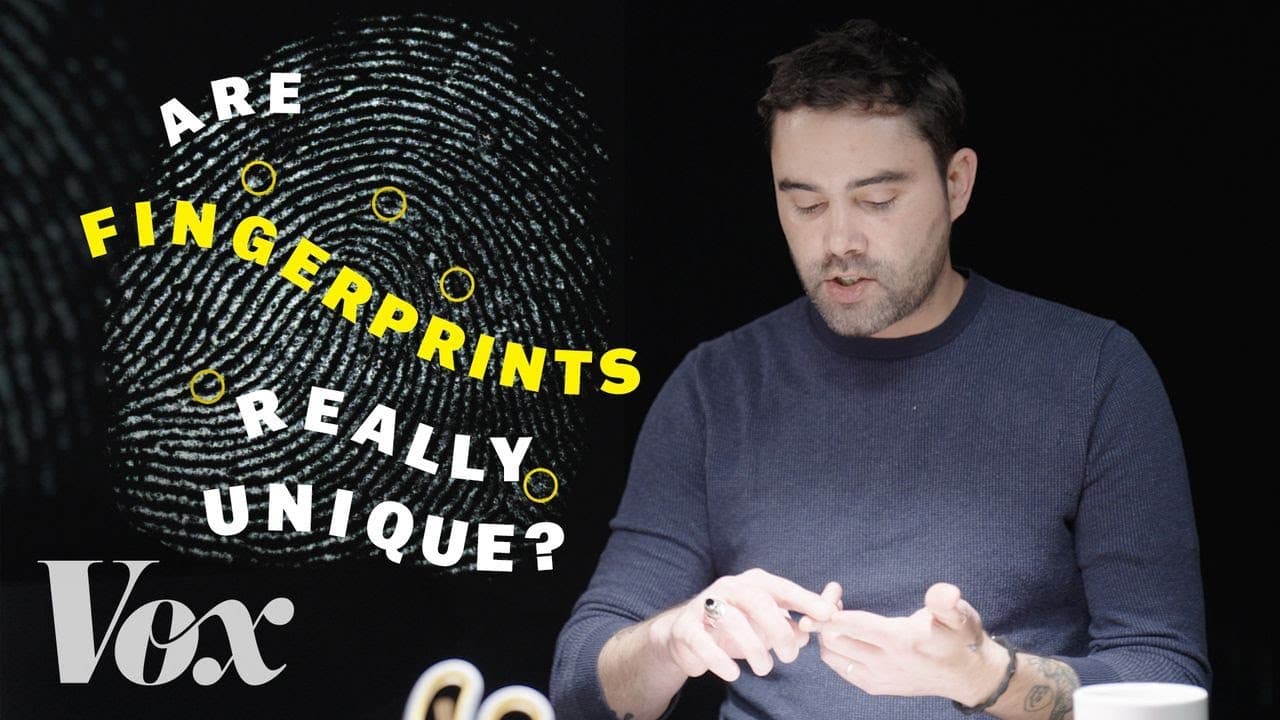
So, Kim I’m going to have you try a little amateur forensic work here. I've collected fingerprints from a few of our colleagues. And what you see here is four fingerprints I took, two of which are from the exact same finger. So I want to see if you can match which two prints are from the same finger. This is Explainer Club, where video producers li... Read More
Key Insights
- Fingerprints are traditionally considered unique, formed in the womb and remain unchanged throughout life, making them reliable for identification.
- A new AI tool from Columbia University suggests there are more similarities in fingerprints from the same person than previously thought.
- The AI tool analyzes subtle ridge shapes and angles, achieving an 80% accuracy in identifying if fingerprints belong to the same person.
- Traditional fingerprint analysis focuses on minutiae, but the AI approach shows potential in identifying similarities without relying on these details.
- The FBI's fingerprint archive contains 165 million records, highlighting the importance of fingerprints in forensic science.
- AI's role in fingerprint analysis may revolutionize forensic practices, though experts caution against immediate changes without further research.
- The concept of Turing patterns explains the unique formation of fingerprints, similar to patterns found in nature like zebra stripes.
- AI is seen as a tool to enhance human capabilities in various fields, including medical diagnostics, rather than replacing professionals.
Install to Summarize YouTube Videos and Get Transcripts
Explore YouTube Video Summarizer or Get YouTube Transcript Extractor
Questions & Answers
Q: How are fingerprints traditionally analyzed for uniqueness?
Traditionally, fingerprints are analyzed by examining minutiae, which are the small details and variations in ridge patterns. Analysts look for ridge endings, bifurcations, and other unique features to determine the individuality of a fingerprint. This method has been used for over a century and relies on the assumption that no two fingerprints are identical.
Q: What new insights does the AI tool provide about fingerprints?
The AI tool developed by students at Columbia University provides new insights by identifying similarities in fingerprints from the same person. Unlike traditional methods focusing on minutiae, the AI analyzes the subtle curved shapes and angles of ridge lines. This approach has shown an 80% accuracy in determining whether fingerprints belong to the same individual, suggesting more intra-person similarities than previously recognized.
Q: What challenges exist in changing forensic practices with AI?
Integrating AI into forensic practices faces challenges such as the need for comprehensive validation and acceptance by the forensic community. Experts caution that while the AI tool shows promise, more research is necessary to ensure its reliability and accuracy. Additionally, there are concerns about the tool's ability to match exact fingerprints without minutiae, which remains crucial for precise identification.
Q: How do fingerprints form, and why are they unique?
Fingerprints form in the womb, influenced by genetic factors and the unique conditions within the uterus. They develop as waves of skin cells grow in random patterns, creating ridges under the skin's surface. This random growth process results in unique patterns for each individual, making fingerprints a reliable biometric identifier. The concept of Turing patterns helps explain how these unique formations occur.
Q: What is the significance of the FBI's fingerprint archive?
The FBI's fingerprint archive, housing approximately 165 million records, underscores the importance of fingerprints in forensic science and criminal identification. Fingerprints are collected during arrests and stored for future reference, even if the individual is not proven guilty. This extensive database highlights the role of fingerprints as a critical tool in law enforcement and security.
Q: How does AI's role in fingerprint analysis compare to its use in other fields?
AI's role in fingerprint analysis parallels its use in other fields, such as medical diagnostics, where it assists rather than replaces professionals. In both contexts, AI enhances human capabilities by providing new insights and improving accuracy. The potential for AI to revolutionize practices like fingerprint analysis and cancer diagnosis reflects its growing importance as a tool for innovation and efficiency.
Q: What are Turing patterns, and how do they relate to fingerprint formation?
Turing patterns, proposed by mathematician Alan Turing, describe how natural patterns, such as leopard spots and zebra stripes, form through reaction-diffusion processes. In fingerprints, Turing patterns explain the growth of ridges in waves, influenced by genetic and environmental factors. This concept helps elucidate the unique and random formation of fingerprint patterns in the womb.
Q: What are the potential benefits and concerns of using AI in fingerprint analysis?
The potential benefits of using AI in fingerprint analysis include increased accuracy in identifying intra-person similarities and reducing reliance on minutiae. However, concerns remain about the tool's reliability without comprehensive validation. Experts emphasize the need for further research and caution against immediate changes to forensic practices without a thorough understanding of the AI's capabilities and limitations.
Summary & Key Takeaways
-
Fingerprints have long been considered unique identifiers, formed in the womb and remaining unchanged throughout life. They are used extensively in forensics for identification purposes. However, recent developments in AI suggest that there might be more similarities within a person's fingerprints than previously understood.
-
A new AI tool developed by students at Columbia University has demonstrated the ability to identify similarities in fingerprints from the same person. This tool analyzes the subtle shapes and angles of fingerprint ridges, achieving significant accuracy without relying on traditional minutiae analysis.
-
The study's findings have sparked discussions in the forensic community about the potential for AI to enhance fingerprint analysis. While the AI tool shows promise, experts emphasize the need for further research before it can be integrated into standard forensic practices.
Read in Other Languages (beta)
Share This Summary 📚
Summarize YouTube Videos and Get Video Transcripts with 1-Click
Try YouTube Summary with ChatGPT & Claude or YouTube Transcript Generator
Explore More Summaries from Vox 📚




Summarize YouTube Videos and Get Video Transcripts with 1-Click
Try YouTube Summary with ChatGPT & Claude or YouTube Transcript Generator