Modeling population with simple differential equation | Khan Academy
TL;DR
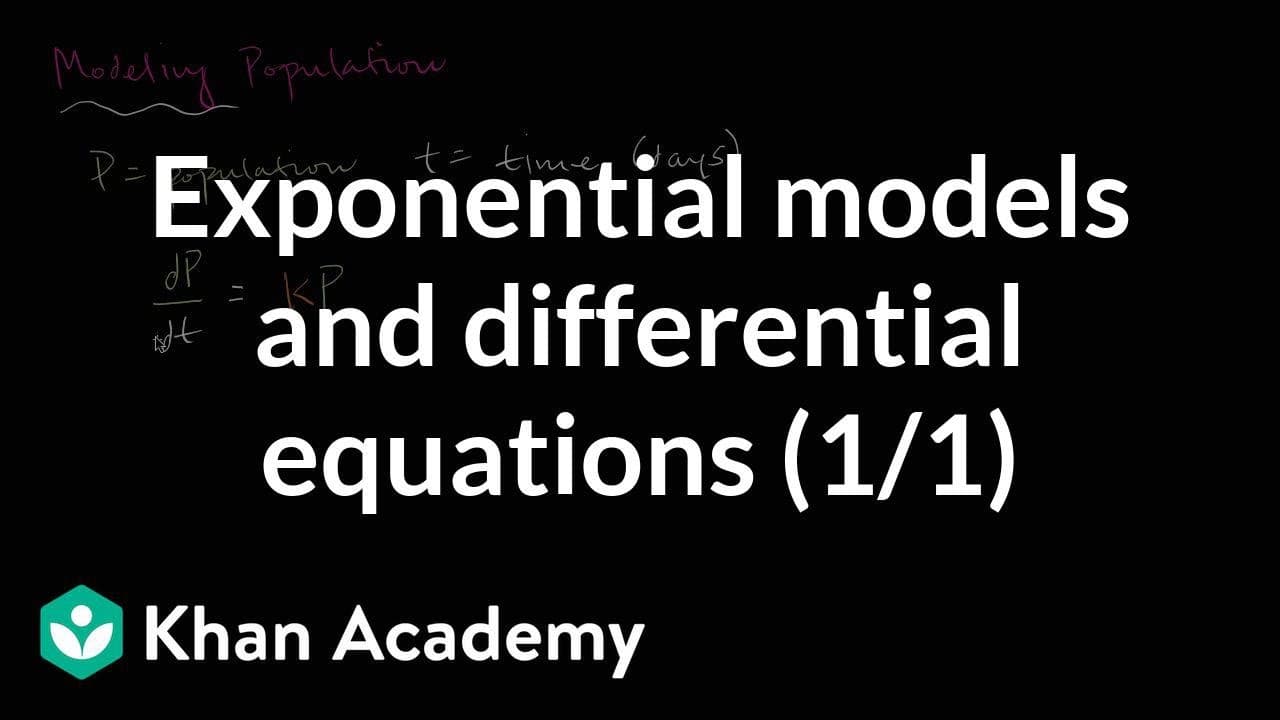
This video explores how to model population using differential equations, with a focus on simpler models and the logic behind them.
Transcript
- What I'd like to do in this video is start exploring how we can model things with the differential equations. And in this video in particular, we will explore modeling population. Modeling population. We're actually going to go into some depth on this eventually, but here we're going to start with simpler models. And we'll see, we will stumble on... Read More
Key Insights
- 😑 Modeling population using differential equations involves expressing the rate of change of population as proportional to the population.
- ❓ Separable differential equations and integration are used to solve the differential equation for population modeling.
- 😜 The general solution for population modeling is an exponential function, P = Ce^(kt), where C is a constant and k represents the proportionality constant.
Install to Summarize YouTube Videos and Get Transcripts
Explore YouTube Video Summarizer or Get YouTube Transcript Extractor
Questions & Answers
Q: Why is it reasonable to say that the rate of change of population is proportional to the population?
It makes sense because a larger population would have a higher rate of growth at any given time compared to a smaller population. Proportional growth fits this logic.
Q: How do you solve the differential equation for population modeling?
The differential equation is a separable differential equation, meaning we can separate the variables and integrate both sides. Dividing both sides by population and multiplying by dt allows us to integrate and find the general solution.
Q: How do you express the general solution for population modeling using exponential functions?
Assuming a positive population, the general solution is expressed as P = Ce^(kt), where C is a constant and k represents the proportionality constant.
Q: What role do initial conditions play in finding a particular solution?
Initial conditions, such as specific population states, allow us to determine the values of the constants in the general solution and find a particular solution that fits those conditions.
Summary & Key Takeaways
-
The video introduces the concept of modeling population using differential equations, starting with simpler models.
-
The rate of change of population with respect to time is proportional to the actual population.
-
The video explains how to solve the differential equation using separable differential equations and integration to find a general solution.
Read in Other Languages (beta)
Share This Summary 📚
Summarize YouTube Videos and Get Video Transcripts with 1-Click
Try YouTube Summary with ChatGPT & Claude or YouTube Transcript Generator
Explore More Summaries from Khan Academy 📚



Summarize YouTube Videos and Get Video Transcripts with 1-Click
Try YouTube Summary with ChatGPT & Claude or YouTube Transcript Generator