Limit of xsin(x)/(1 - cos(x)) Calculus Limits Involving sin(x)/x with the Mayan Statue
TL;DR
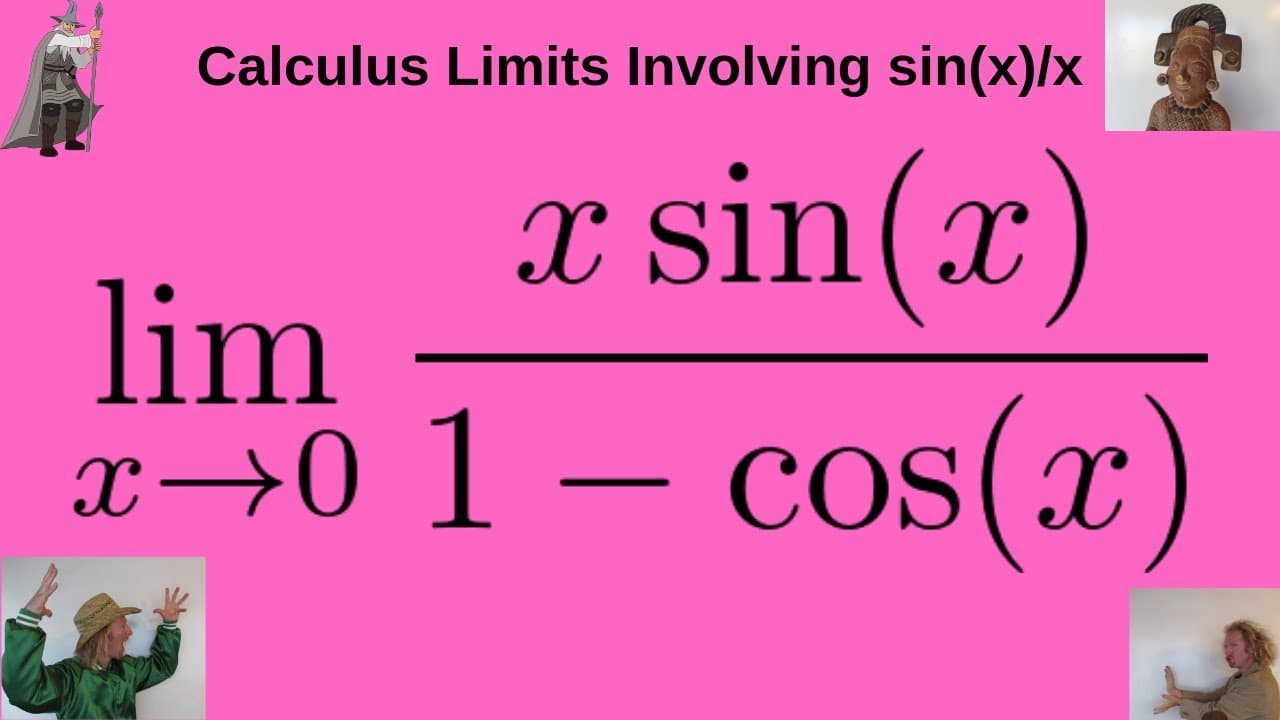
Solving the limit of X times sine of X over 1 minus cosine X as X approaches zero leads to a final answer of 2.
Transcript
I am NOT my n statue and I am the God of God who knows hey what's up YouTube this is probably do a really cool women okay so we have to limit as X approaches zero okay of X times the sine of X all over 1 minus cosine X ok so 1 minus cosine X whenever you're taking limits the first thing you should always do is plug in the number right it's just to ... Read More
Key Insights
- 📁 Initial attempts at solving limits by direct substitution may fail, necessitating alternative strategies.
- 😑 The application of the conjugate method can simplify complex expressions involving limits and trigonometric functions.
- ⛔ Understanding limit properties and known limit formulas is essential in accurately evaluating mathematical expressions.
- 😑 Rewriting expressions and utilizing reciprocal relationships can lead to more manageable calculations.
- 🖐️ Trigonometric identities like the sine squared formula play a significant role in simplifying limit problems.
- ⛔ The concept of dividing by a fraction is equivalent to multiplying by its reciprocal, facilitating limit evaluations.
- 🦻 Familiarity with limit calculation techniques and patterns aids in efficiently solving mathematical problems.
Install to Summarize YouTube Videos and Get Transcripts
Explore YouTube Video Summarizer or Get YouTube Transcript Extractor
Questions & Answers
Q: How does plugging in X=0 initially result in a fail when calculating the limit?
When plugging in zero for X in the expression X times sine of X over 1 minus cosine X, it yields 0 in the numerator and 0 in the denominator, leading to a fail in solving the limit.
Q: What is the significance of using the conjugate when faced with the expression 1 minus cosine X in the denominator?
Multiplying the expression by the conjugate 1 plus cosine X over 1 plus cosine X allows for the difference of squares formula to be applied, simplifying the calculation of the limit.
Q: Why is the strategy of rewriting the expression as x/sin X and using a limit property crucial in determining the final answer?
By rewriting the expression as x/sin X and invoking a limit property where sin X over X tends to 1 as X approaches zero, the calculation streamlines to the final answer effectively.
Q: How does the final answer of 2 reveal the solution to the limit problem?
The final answer of 2 is derived by correctly manipulating the terms in the limit expression with the conjugate method and utilizing known limit properties, resulting in the resolution of the problem.
Summary & Key Takeaways
-
The initial attempt to plug in zero for X gives a 0 result when calculating the limit of X times sine of X over 1 minus cosine X.
-
To solve the limit, the method of multiplying by the conjugate 1 plus cosine X over 1 plus cosine X is employed.
-
By applying the limit properties and a famous limit formula, the final answer of 2 is achieved as X approaches zero.
Read in Other Languages (beta)
Share This Summary 📚
Summarize YouTube Videos and Get Video Transcripts with 1-Click
Try YouTube Summary with ChatGPT & Claude or YouTube Transcript Generator
Explore More Summaries from The Math Sorcerer 📚


Summarize YouTube Videos and Get Video Transcripts with 1-Click
Try YouTube Summary with ChatGPT & Claude or YouTube Transcript Generator