Neural IR, part 2 | Stanford CS224U Natural Language Understanding | Spring 2021
TL;DR
This content discusses different paradigms for building efficient neural information retrieval (IR) models and highlights the trade-off between quality and latency.
Transcript
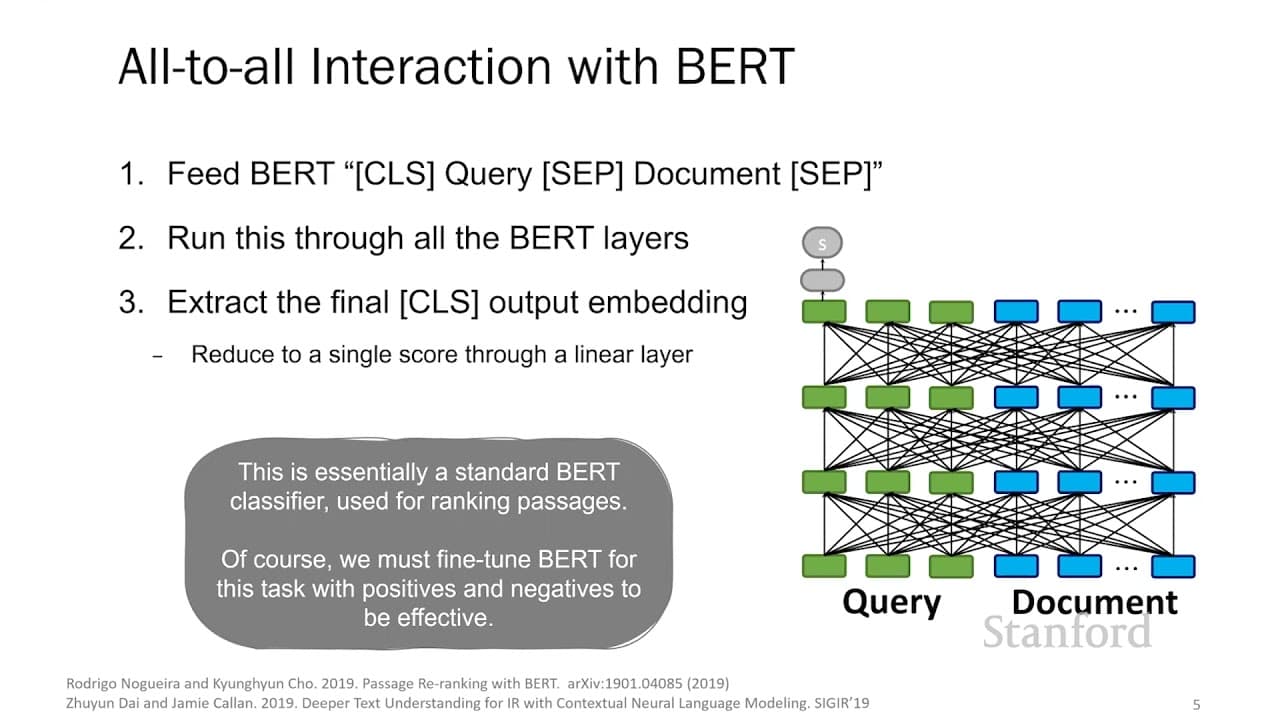
hello everyone welcome to part four of our series on nlu nir the screencast will be the second among three of our videos on neural information retrieval just to recap this is the functional view of neural ir that we left in the previous screencast our model will take a query and a document and will then output a score that will estimate the relevan... Read More
Key Insights
- 🍉 Query-document interaction models outperform bag-of-words models in terms of quality with a moderate increase in computational cost.
- 👨🔬 BERT-based models have shown significant improvements in ranking and have been used by major search engines.
- 😑 Pre-computing document representations and learning term weights are two approaches to reduce computational latency in BERT-based models.
Install to Summarize YouTube Videos and Get Transcripts
Explore YouTube Video Summarizer or Get YouTube Transcript Extractor
Questions & Answers
Q: What is the purpose of a query-document interaction matrix in neural IR models?
The query-document interaction matrix is used to calculate the relevance score between each pair of words in the query and document. It provides a measure of similarity, which is then used to estimate the overall relevance of the document to the query.
Q: How does BERT contribute to ranking in neural IR models?
BERT is used to generate contextualized representation of both the query and the document. By fine-tuning the BERT model with appropriate training data, it can be used as a classifier to rank passages based on their relevance to the query.
Q: What were the gains achieved with BERT-based models in the ms marco passage ranking task?
BERT-based models demonstrated significant gains in quality compared to previous state-of-the-art models. They increased MRR (Mean Reciprocal Rank) by over eight points. However, these gains came at the cost of increased computational latency.
Q: How can computational latency be reduced in BERT-based models?
One approach to reduce latency is to pre-compute document representations using BERT and store them offline. Another approach is learning term weights to decompose the score of a document into term weights, which can be looked up quickly during query answering.
Summary & Key Takeaways
-
This screencast is part of a series on neural IR, focusing on query-document interaction and the use of neural layers to estimate document relevance to a query.
-
Query-document interaction models, when trained with enough data, can achieve better quality than traditional bag-of-words models at a moderate increase in computational cost.
-
More recently, the power of BERT (Bidirectional Encoder Representations from Transformers) has been discovered for ranking, where the query and document are fed as one sequence for classification.
Read in Other Languages (beta)
Share This Summary 📚
Summarize YouTube Videos and Get Video Transcripts with 1-Click
Try YouTube Summary with ChatGPT & Claude or YouTube Transcript Generator
Explore More Summaries from Stanford Online 📚


Summarize YouTube Videos and Get Video Transcripts with 1-Click
Try YouTube Summary with ChatGPT & Claude or YouTube Transcript Generator