Geometric random variables introduction | Random variables | AP Statistics | Khan Academy
TL;DR
Binomial random variables have a fixed number of trials with a certain number of successes, while geometric random variables focus on how many trials are needed until success.
Transcript
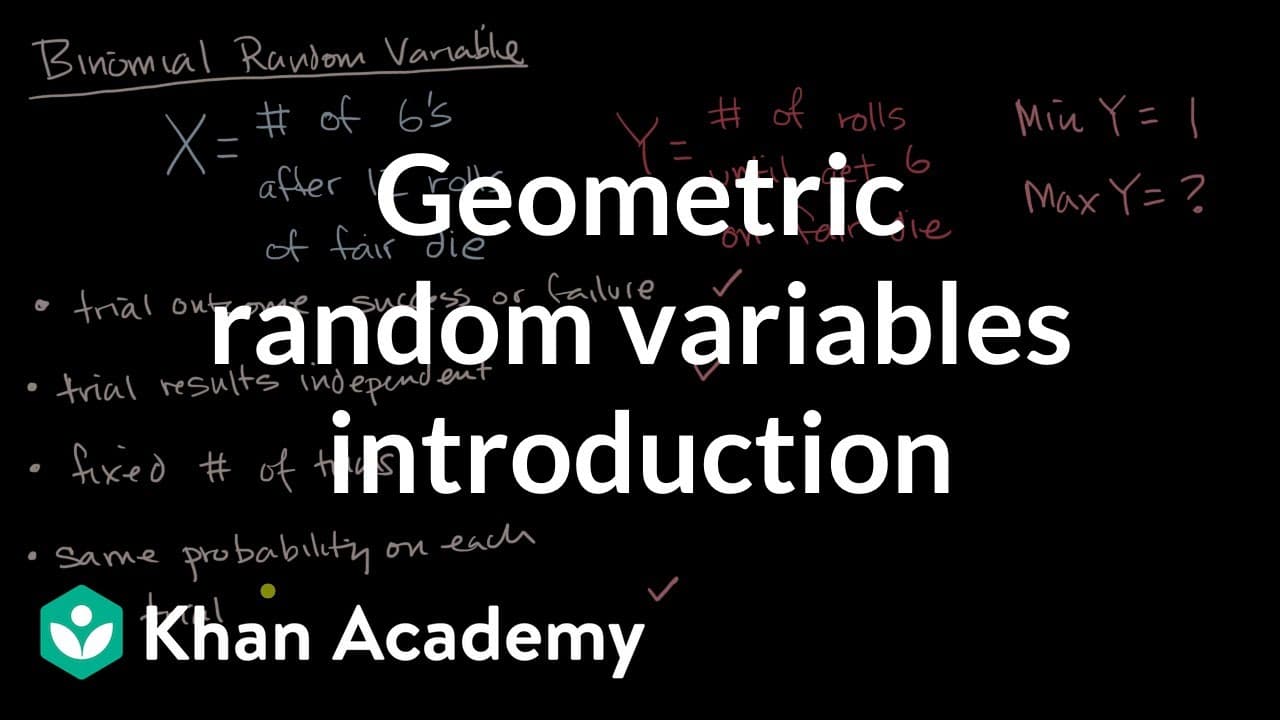
- [Narrator] So I have two, different random variables here. And what I wanna do is think about what type of random variables they are. So this first random variable, x, is equal to the number of sixes after 12 rolls of a fair die. Well this looks pretty much like a binomial random variable. In fact, I'm pretty confident it is a binomial random var... Read More
Key Insights
- 🕕 Random variable x is a binomial random variable, representing the number of successes (sixes) in a fixed number of trials (12 rolls).
- 💉 Random variable y is a geometric random variable, representing the number of trials needed until a success (six) occurs.
- ❓ Both random variables have independent trial results and a constant probability of success.
- #️⃣ The main difference is that binomial random variables have a fixed number of trials, while geometric random variables do not.
- #️⃣ Geometric random variables can take an infinite number of trials until success, while the number of trials for binomial random variables is predetermined.
- ❓ Binomial random variables are associated with binomial coefficients and combinatorics.
Install to Summarize YouTube Videos and Get Transcripts
Explore YouTube Video Summarizer or Get YouTube Transcript Extractor
Questions & Answers
Q: What defines a binomial random variable?
A binomial random variable has a fixed number of trials, independent trial results, and a constant probability of success on each trial. It represents the number of successes in a given number of trials.
Q: How is a geometric random variable different from a binomial random variable?
A geometric random variable also has independent trial results and a constant probability of success. However, it focuses on the number of trials needed until a success occurs, rather than the number of successes in a fixed number of trials.
Q: Can a geometric random variable have a maximum value?
No, a geometric random variable does not have a maximum value. It is possible for it to take an infinite number of trials until a success occurs, although the probability decreases significantly as the number of trials increases.
Q: Why are binomial random variables called binomial?
Binomial random variables are named after the binomial coefficients, which arise from combinatorics and Pascal's Triangle. These coefficients represent the probabilities of different outcomes when a binomial is raised to an increasing power.
Summary & Key Takeaways
-
Random variable x is a binomial random variable that represents the number of sixes after 12 rolls of a fair die.
-
Random variable y is a geometric random variable that represents the number of rolls needed until a six appears on a fair die.
-
Binomial random variables have a fixed number of trials, independent trial results, and constant probability of success on each trial. Geometric random variables also have independent trial results and constant probability of success, but there is no fixed number of trials.
Read in Other Languages (beta)
Share This Summary 📚
Summarize YouTube Videos and Get Video Transcripts with 1-Click
Try YouTube Summary with ChatGPT & Claude or YouTube Transcript Generator
Explore More Summaries from Khan Academy 📚



Summarize YouTube Videos and Get Video Transcripts with 1-Click
Try YouTube Summary with ChatGPT & Claude or YouTube Transcript Generator