How to Use Unsupervised Machine Learning
TL;DR
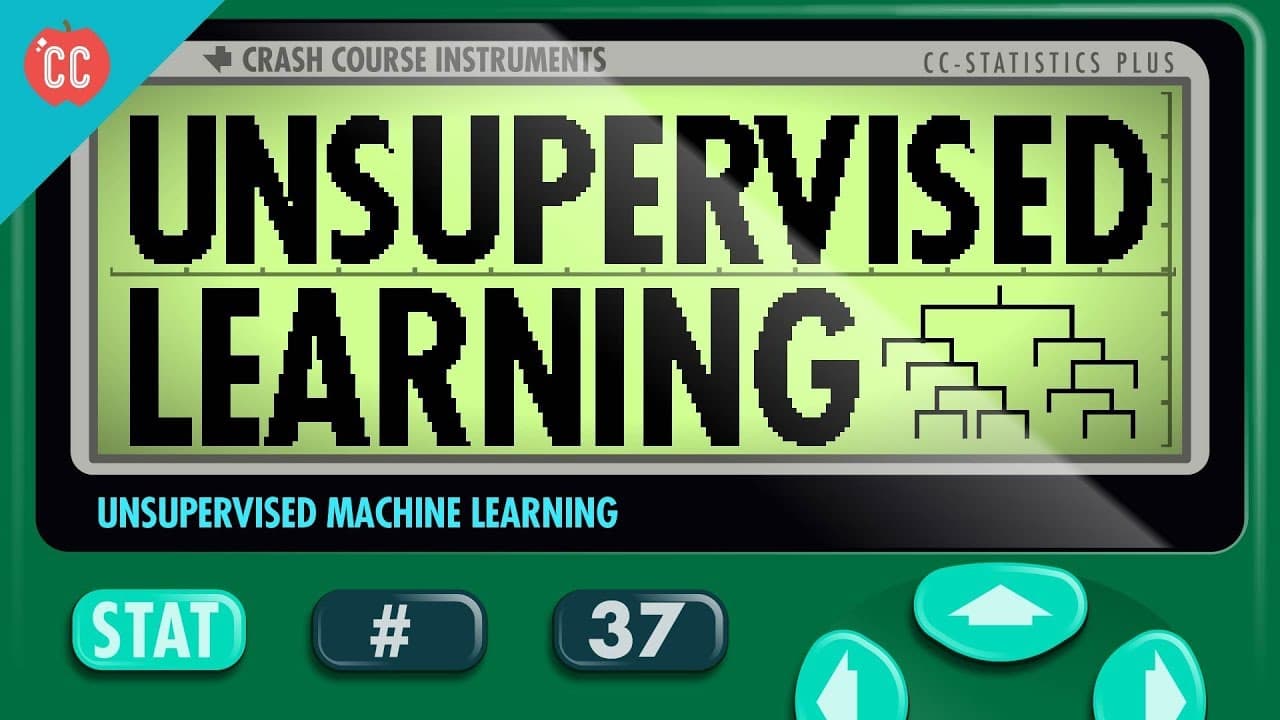
Unsupervised Machine Learning groups data without predefined labels, using techniques like k-means and hierarchical clustering. These methods help create meaningful clusters for applications such as personalized marketing, improved medical treatments, and better book recommendations. Clustering evaluates data cohesion and separation, optimizing group distinctions and insights.
Transcript
Hi, I’m Adriene Hill, and welcome back to Crash Course Statistics. In the last episode, we talked about using Machine Learning with data that already has categories that we want to predict. Like teaching a computer to tell whether an image contains a hotdog or not. Or using health information to predict whether someone has diabetes. But sometimes w... Read More
Key Insights
- Unsupervised Machine Learning is used when data lacks predefined labels, allowing for the creation of new categories.
- K-means clustering groups data points by selecting random centroids and iteratively assigning data to the nearest centroid until convergence.
- Hierarchical clustering builds a tree of clusters, starting with each data point as its own cluster and merging them based on similarity.
- Silhouette scores measure cluster cohesion and separation, indicating how well data points fit within their assigned clusters.
- Hierarchical clustering can reveal subgroup structures within data, offering deeper insights into relationships.
- Applications include personalized marketing, such as targeted coupons, and medical interventions, like tailored therapy for ASD.
- K-means clustering is flexible, allowing for different numbers of clusters based on specific needs or data characteristics.
- Unsupervised learning helps in creating profiles of similar data points, enhancing recommendations and interventions.
Install to Summarize YouTube Videos and Get Transcripts
Explore YouTube Video Summarizer or Get YouTube Transcript Extractor
Questions & Answers
Q: How does k-means clustering work?
K-means clustering works by selecting a specified number of random centroids, which act as the centers of clusters. Data points are assigned to the nearest centroid, forming initial groups. The centroids are then recalculated based on the mean of points in each group. This process repeats until the centroids stabilize, resulting in distinct clusters.
Q: What is hierarchical clustering?
Hierarchical clustering is a method that organizes data into a tree-like structure of clusters. It starts with each data point as its own cluster and merges them based on similarity, forming larger clusters. This process continues until all data points are grouped into a single cluster, revealing subgroup structures and relationships within the data.
Q: What is the silhouette score in clustering?
The silhouette score is a metric used to evaluate the quality of clusters in terms of cohesion and separation. It measures how similar a data point is to its own cluster compared to other clusters. High silhouette scores indicate well-defined, distinct clusters, while low scores suggest overlapping or poorly defined clusters.
Q: How can unsupervised learning be applied in marketing?
Unsupervised learning can be applied in marketing by using clustering techniques to segment customers into groups based on purchasing behavior or preferences. This segmentation allows for personalized marketing strategies, such as targeted promotions or offers, which can increase customer engagement and improve marketing effectiveness.
Q: How does hierarchical clustering help in understanding Autism Spectrum Disorder?
Hierarchical clustering helps in understanding Autism Spectrum Disorder by grouping individuals based on developmental domain scores, revealing subgroups within the spectrum. This allows for more targeted and effective therapy plans tailored to the specific needs of each subgroup, improving treatment outcomes and resource allocation.
Q: Why is unsupervised learning important in data analysis?
Unsupervised learning is important in data analysis because it allows for the discovery of hidden patterns or structures in data without predefined labels. It enables the creation of new categories and insights, facilitating better decision-making and personalized approaches in various fields, such as marketing, healthcare, and recommendation systems.
Q: What are the key differences between k-means and hierarchical clustering?
The key differences between k-means and hierarchical clustering lie in their approach and output. K-means clustering requires specifying the number of clusters beforehand and iteratively adjusts centroids to form clusters. Hierarchical clustering does not require a predefined number of clusters and organizes data into a dendrogram, revealing nested subgroup structures.
Q: How can clustering improve medical interventions?
Clustering can improve medical interventions by grouping patients based on similar characteristics or responses to treatments, allowing for personalized therapy plans. This approach ensures that patients receive the most effective and targeted care, optimizing treatment outcomes and resource allocation, particularly in complex conditions like Autism Spectrum Disorder.
Summary & Key Takeaways
-
Unsupervised Machine Learning is a method used to organize data into groups without predefined labels. Techniques such as k-means and hierarchical clustering allow for the creation of meaningful clusters that can be used in various applications, including marketing and healthcare. These clusters help in providing personalized recommendations and interventions.
-
K-means clustering works by selecting random centroids and assigning data points to the nearest centroid, repeating the process until the clusters stabilize. Hierarchical clustering builds a tree of clusters, starting with individual data points and merging them based on similarity, revealing subgroup structures within the data.
-
Silhouette scores are used to evaluate the cohesion and separation of clusters, indicating the quality of the clustering. These methods enable the creation of profiles for personalized marketing, such as targeted coupons, and medical interventions, like tailored therapy plans for Autism Spectrum Disorder, enhancing effectiveness and efficiency.
Read in Other Languages (beta)
Share This Summary 📚
Summarize YouTube Videos and Get Video Transcripts with 1-Click
Try YouTube Summary with ChatGPT & Claude or YouTube Transcript Generator
Explore More Summaries from CrashCourse 📚


Summarize YouTube Videos and Get Video Transcripts with 1-Click
Try YouTube Summary with ChatGPT & Claude or YouTube Transcript Generator