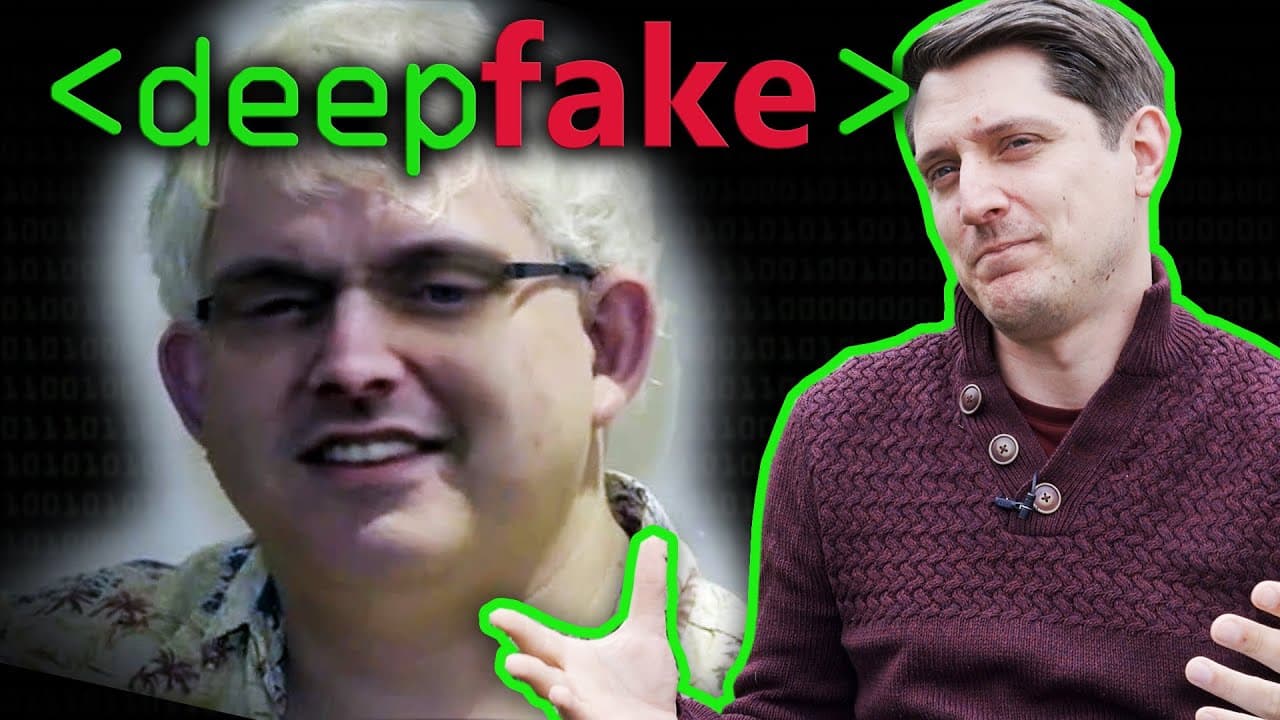
Is DeepFake Really All That? - Computerphile
TL;DR
Deepfake technology is not yet convincing but has the potential to be in the future, raising concerns about its impact.
Transcript
let's get out and say straight away that most of what you see online that's claiming to be deep fake isn't deep fake right it's some kind of visual effects of some description right people being made to look younger in movies that isn't at the moment done with deep networks they're not that good yet you know there's been some very impress... Read More
Key Insights
- 🛄 Most content claiming to be deepfake is actually visual effects or other types of manipulation.
- 😒 Deepfake technology primarily uses encoder-decoder networks, such as auto encoders, to convert and generate realistic face swaps.
- 😀 Deepfake technology has potential applications beyond faces, such as in satellite imagery.
- 🕵️ The rapid improvement of deep learning poses challenges in detecting and preventing the spread of convincing deepfakes.
- 🎮 Cryptographic techniques and authentication codes may play a role in ensuring the integrity of video content.
- 🪡 The ethical implications of deepfake technology, such as the potential for misuse and trust issues, need to be addressed.
Install to Summarize YouTube Videos and Get Transcripts
Explore YouTube Video Summarizer or Get YouTube Transcript Extractor
Questions & Answers
Q: What is deepfake technology?
Deepfake technology involves using encoder-decoder networks to convert one person's face into another, allowing for the realistic replacement of faces in videos.
Q: Why are deepfakes not yet convincing?
Deepfakes are not yet convincing due to limitations in network resolution and training data. They struggle with high-resolution videos and require more varied and extensive training data for better results.
Q: Can deepfake technology be used for purposes other than faces?
Yes, deepfake technology can be applied to other domains, such as satellite imagery and style transfer, making it a broad area of research.
Q: How can we detect and prevent the spread of deepfakes?
One approach is using deep learning classifiers to identify deepfakes. However, as deepfake technology improves, better detection techniques and cryptographic methods may be required.
Summary & Key Takeaways
-
Most of what is claimed as deepfake online is actually visual effects, but deepfake technology has the potential to become convincing in the next five to ten years.
-
Deepfakes are usually generated using encoder-decoder networks, which aim to convert one person's face into another's.
-
Auto encoders, a type of deep network, are commonly used in training deepfakes by extracting and generating features.
Read in Other Languages (beta)
Share This Summary 📚
Summarize YouTube Videos and Get Video Transcripts with 1-Click
Try YouTube Summary with ChatGPT & Claude or YouTube Transcript Generator
Explore More Summaries from Computerphile 📚




Summarize YouTube Videos and Get Video Transcripts with 1-Click
Try YouTube Summary with ChatGPT & Claude or YouTube Transcript Generator