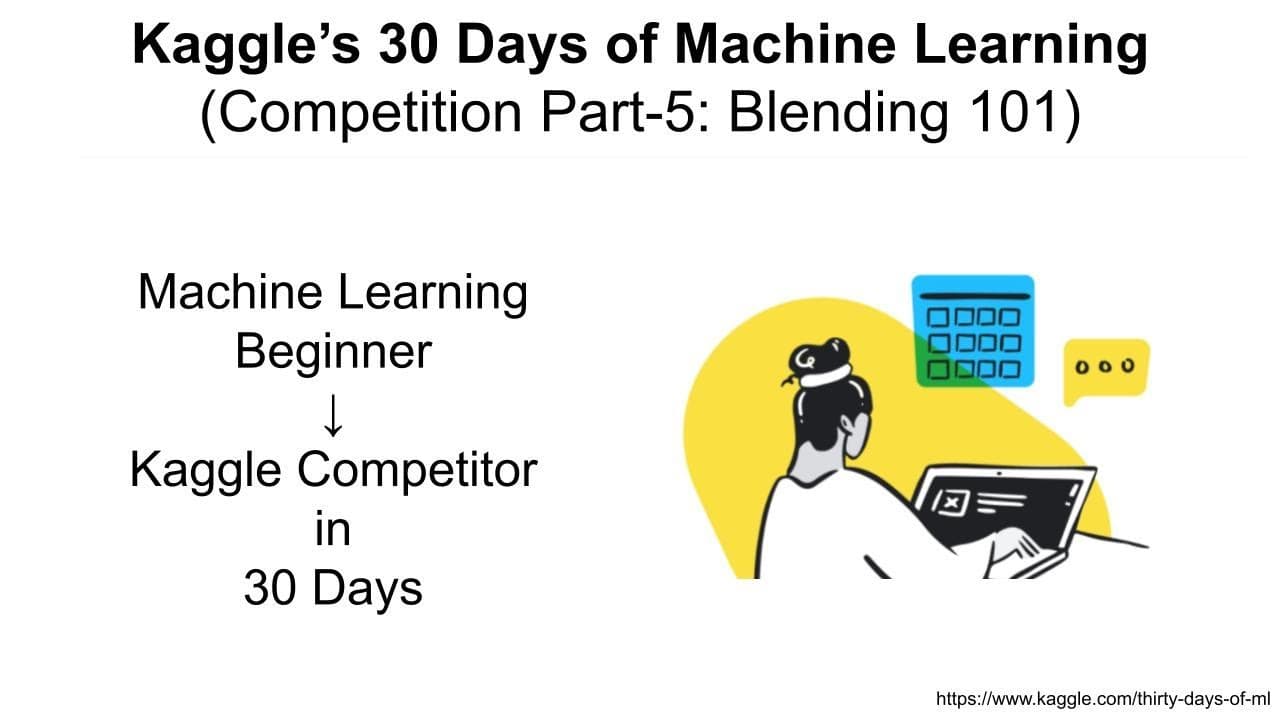
Kaggle's 30 Days Of ML (Competition Part-5): Model Blending 101
TL;DR
Blending is an important strategy in machine learning competitions that involves combining predictions from multiple models to improve performance.
Transcript
hello everyone and welcome to my youtube channel this is part 5 of competition days and 30 days of machine learning by kaggle and today we are going to learn about blending so blending is probably going to help you a lot in this competition because the data is seems to be designed in that way and there is not much you can do when it comes to pictur... Read More
Key Insights
- 🎰 Blending is a powerful technique in machine learning competitions that combines predictions from multiple models to improve performance.
- 🙏 It involves dividing the dataset into folds, training models on different folds, and merging the predictions using weights.
- 🙏 Consistency in fold assignments and alignment of predictions with the original dataset are crucial for accurate blending.
- 🪜 Blending can be improved by adding more models, optimizing hyperparameters, and experimenting with different features.
- ❓ The performance of the blended model can be further enhanced by using techniques like hyperparameter optimization and feature engineering.
- 💁 Blending is a form of ensemble learning that leverages the diversity of models to create a more robust and accurate prediction.
- ❓ Careful evaluation and validation are essential to ensure that blending does not result in overfitting or biased predictions.
Install to Summarize YouTube Videos and Get Transcripts
Explore YouTube Video Summarizer or Get YouTube Transcript Extractor
Questions & Answers
Q: What is blending in machine learning competitions?
Blending is a strategy where predictions from multiple models are combined to improve overall performance in machine learning competitions. It involves dividing the dataset into folds, training models on different folds, and then merging the predictions using weights.
Q: How are predictions generated in blending?
Predictions are generated by training models on different folds of the dataset. Each trained model produces predictions on the validation set and test set. The predictions from each fold are then combined using weights to create a final prediction.
Q: Why is it important to keep the fold assignments consistent?
Consistent fold assignments ensure that the models are trained and evaluated on the same data partitions, enabling fair comparison and accurate blending. It helps prevent overfitting and aligns the predictions with the correct target values.
Q: How can blending be improved in machine learning competitions?
Blending can be improved by experimenting with different models, hyperparameters, and features. Adding more models to the blend and optimizing the weights used to merge predictions can also enhance performance.
Summary & Key Takeaways
-
Blending in machine learning competitions involves dividing the dataset into folds and training models on different folds to generate predictions.
-
The predictions from each model are then combined using weights to create a final prediction for the test dataset.
-
The process of blending requires consistent fold assignments across models and ensuring that the predictions align with the original dataset.
Read in Other Languages (beta)
Share This Summary 📚
Summarize YouTube Videos and Get Video Transcripts with 1-Click
Try YouTube Summary with ChatGPT & Claude or YouTube Transcript Generator
Explore More Summaries from Abhishek Thakur 📚



Summarize YouTube Videos and Get Video Transcripts with 1-Click
Try YouTube Summary with ChatGPT & Claude or YouTube Transcript Generator