How to Code a Policy Gradient Agent in Keras
TL;DR
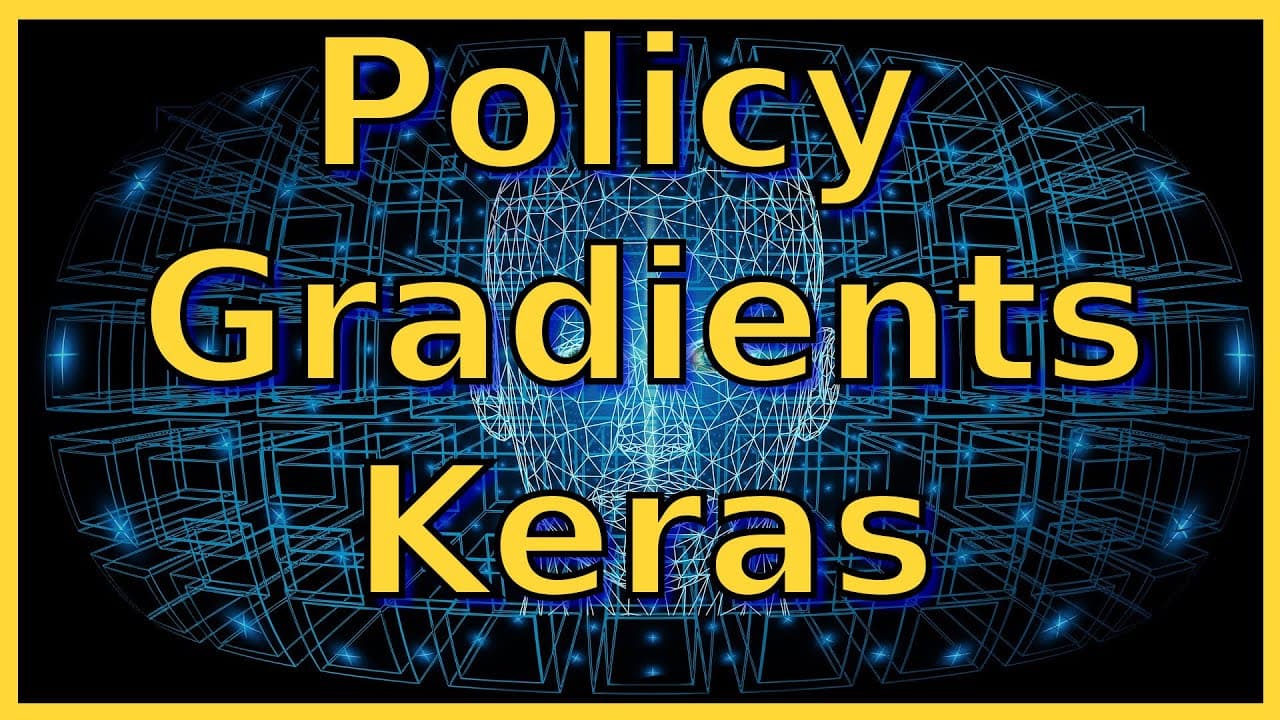
To code a policy gradient agent in Keras for the Lunar Lander environment, initialize the agent with parameters like learning rate and discount factor, build a policy network using custom loss functions, choose actions based on probability distributions, and learn from stored transitions. This method highlights the importance of custom loss in Keras and the sensitivity of policy gradients to parameter changes.
Transcript
what's up everybody in today's tutorial you were gonna code up a policy gradient agent in the Charis tutorial we're gonna tackle the lunar lander environment and as a bonus you're gonna get to see how to code your own custom Karras loss functions which is a non trivial affair let's get started so we start as usual with our imports we want to import... Read More
Key Insights
- 👾 Policy gradient agents are a powerful approach to reinforcement learning, particularly for tasks with continuous action spaces.
- 🌸 Custom loss functions are necessary in Keras for policy gradient agents since they are not built-in.
- 🍉 Discount factors like gamma allow agents to balance short-term and long-term rewards in reinforcement learning.
- 👾 Policy gradient methods can handle stochastic policies and are more flexible with continuous action spaces.
- 🚱 Policy gradient agents can be sensitive to parameter changes due to the non-linear relationship between parameters and policy outputs.
- 🇶🇦 Reinforcement learning with policy gradients requires more episodes to converge compared to Q-learning.
- 🧑🏭 Deep reinforcement learning algorithms, such as actor-critic and deep deterministic policy gradients, build upon policy gradient methods.
Install to Summarize YouTube Videos and Get Transcripts
Explore YouTube Video Summarizer or Get YouTube Transcript Extractor
Questions & Answers
Q: What is the purpose of the custom loss function in this policy gradient agent?
The custom loss function is necessary because Keras does not have an appropriate loss function built-in for policy gradient agents. It is used to calculate the loss based on the predicted probabilities and advantages, allowing the agent to update its policy.
Q: Why is the discount factor gamma used in reinforcement learning?
The discount factor gamma determines how much importance the agent places on future rewards. By discounting future rewards, the agent learns to prioritize immediate rewards and balance short-term gains with long-term goals.
Q: How is the policy gradient agent different from Q-learning?
The policy gradient agent is a model-free approach that directly optimizes the policy, while Q-learning is a value-based method that approximates the action-value function. Policy gradient methods can handle continuous action spaces more easily and have the advantage of learning stochastic policies.
Q: Why is the policy gradient agent sensitive to parameter changes?
The policy gradient agent is sensitive to parameter changes because small perturbations in the network parameters can result in large changes in parameter space. This instability can be attributed to the probabilistic nature of action selection and the non-linear relationship between parameters and policy outputs.
Summary & Key Takeaways
-
The tutorial focuses on coding a policy gradient agent for the Lunar Lander environment using Keras.
-
The author explains the code step-by-step, covering imports, agent initialization, building the policy network, choosing actions, storing transitions, and the learning function.
-
The tutorial also highlights the challenges of policy gradient methods and their sensitivity to parameter changes.
Read in Other Languages (beta)
Share This Summary 📚
Summarize YouTube Videos and Get Video Transcripts with 1-Click
Try YouTube Summary with ChatGPT & Claude or YouTube Transcript Generator
Explore More Summaries from Machine Learning with Phil 📚

Summarize YouTube Videos and Get Video Transcripts with 1-Click
Try YouTube Summary with ChatGPT & Claude or YouTube Transcript Generator