Genetic drift, bottleneck effect and founder effect | Biology | Khan Academy
TL;DR
Natural selection and genetic drift are two mechanisms of evolution. Natural selection involves the selection of traits that are most fit for the environment, while genetic drift involves random changes in traits within a population.
Transcript
- [Voiceover] We've already made several videos over evolution, and just to remind ourselves what evolution is talking about, it's the change in heritable traits of a population over generations. And a lot of times, you'll hear people say evolution and Natural Selection really in the same breath, but what we wanna make a little bit clear in this vi... Read More
Key Insights
- 💱 Evolution is the change in heritable traits of a population over generations.
- ♻️ Natural selection is a mechanism of evolution that involves the selection of traits most fit for the environment.
- ⚾ Genetic drift is another mechanism of evolution based on random changes in traits within a population.
- 🪛 Natural selection focuses on the fitness of traits, while genetic drift is driven by chance events.
- 🛩️ Genetic drift is more likely to occur in small populations.
- 🛩️ Biologists are often concerned about small populations due to the potential for reduced diversity and the effects of genetic drift.
- ❓ Genetic drift can result in extreme reductions in population size, known as the bottleneck effect.
Install to Summarize YouTube Videos and Get Transcripts
Explore YouTube Video Summarizer or Get YouTube Transcript Extractor
Questions & Answers
Q: What is the difference between natural selection and genetic drift in evolution?
Natural selection involves the selection of traits that are most fit for the environment, leading to their increased prevalence in a population. Genetic drift, on the other hand, is characterized by random changes in the frequency of traits within a population, not necessarily related to their fitness.
Q: How does natural selection work?
Natural selection works by favoring traits that provide advantages for survival and reproduction in a specific environment. Individuals with these traits are more likely to pass them on to the next generation, leading to their increased prevalence.
Q: What is an example of genetic drift?
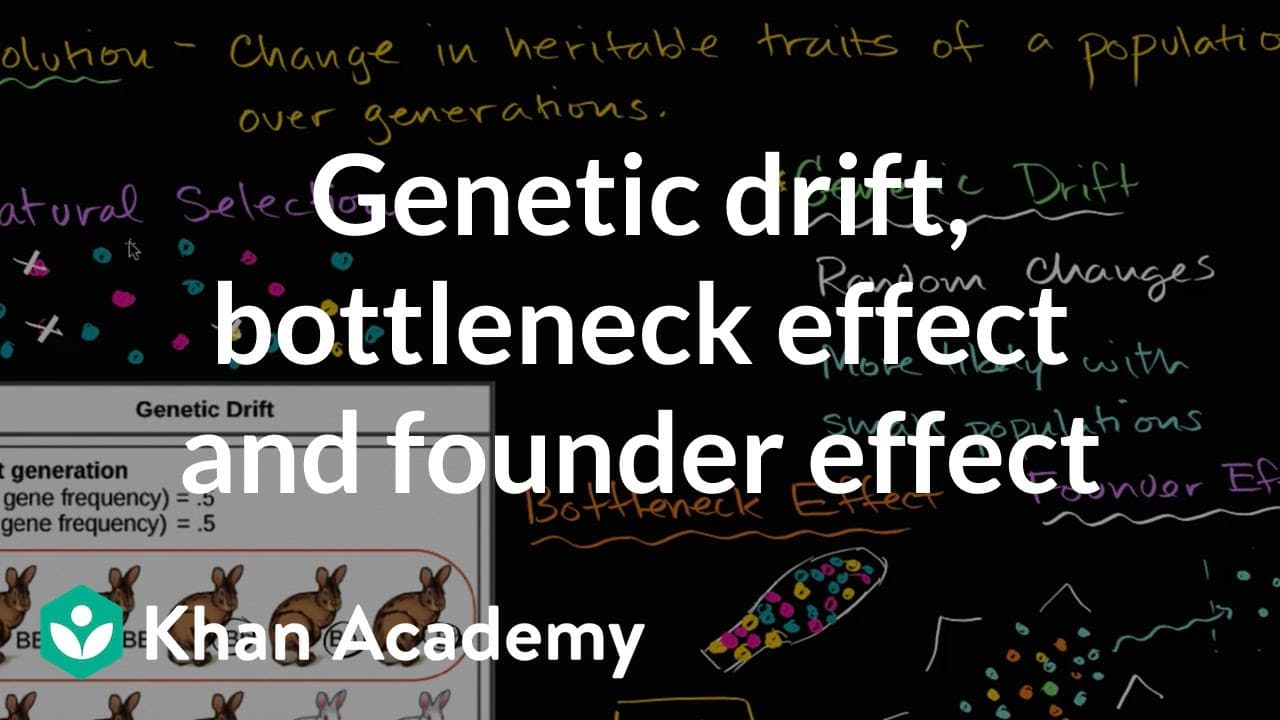
An example of genetic drift is a small population of rabbits with two different alleles for color. Even if the color does not provide any advantage, random chance can lead to some individuals with one allele being able to reproduce while others cannot. Over time, the prevalence of the alleles can change due to this random chance.
Q: Why are small populations more prone to genetic drift?
Small populations are more prone to genetic drift because the chance events that affect allele frequencies can have a larger impact. With fewer individuals, the random changes in reproduction or survival can lead to a greater shift in allele frequencies.
Summary & Key Takeaways
-
Evolution refers to the change in heritable traits of a population over generations.
-
Natural selection is one mechanism of evolution, where the environment selects traits that are most favorable for reproduction.
-
Genetic drift is another mechanism of evolution, involving random changes in traits within a population.
Read in Other Languages (beta)
Share This Summary 📚
Summarize YouTube Videos and Get Video Transcripts with 1-Click
Try YouTube Summary with ChatGPT & Claude or YouTube Transcript Generator
Explore More Summaries from Khan Academy 📚



Summarize YouTube Videos and Get Video Transcripts with 1-Click
Try YouTube Summary with ChatGPT & Claude or YouTube Transcript Generator