Body in to Two Mass with Correction Couple - Dynamically Equivalent Systems
TL;DR
The video explains the process of converting a connecting rod into a dynamically equivalent system with two point masses to minimize inertia effects.
Transcript
hello everyone in this video we'll discuss about conversion of a rigid body into two mass system with a correction coupled now we have already discussed the complexities of the connecting rod in a slider correct mechanism we have already talked about that why the inertia force of connecting rod take the consideration of the inertia force is quite d... Read More
Key Insights
- 😥 Converting a connecting rod into a two mass system with point masses at the ends allows for easier consideration of inertia forces.
- 😴 The masses at the crank pin and piston increase due to the addition of point masses in the dynamically equivalent system.
- 🪜 The dynamically equivalent system requires a correction torque to minimize the effect of the added masses on the system's motion.
- 😥 The positioning of the point masses can vary, but for connecting rods, they are typically placed at the ends.
- 😥 The moment of inertia is greater for point masses at the ends compared to point masses placed elsewhere along the connecting rod.
- 🪜 Torque correction is necessary to reduce the effect of increased inertia caused by the added masses.
- 🧑🏭 The correction torque acts in the same direction as the angular acceleration or opposite to the inertia torque.
Install to Summarize YouTube Videos and Get Transcripts
Explore YouTube Video Summarizer or Get YouTube Transcript Extractor
Questions & Answers
Q: Why is the inertia force of a connecting rod difficult to consider?
The inertia force of a connecting rod is challenging to consider due to the non-uniformly distributed mass and the complexities arising from its connection to a rotating and reciprocating body.
Q: How can a connecting rod be replaced with a dynamically equivalent system?
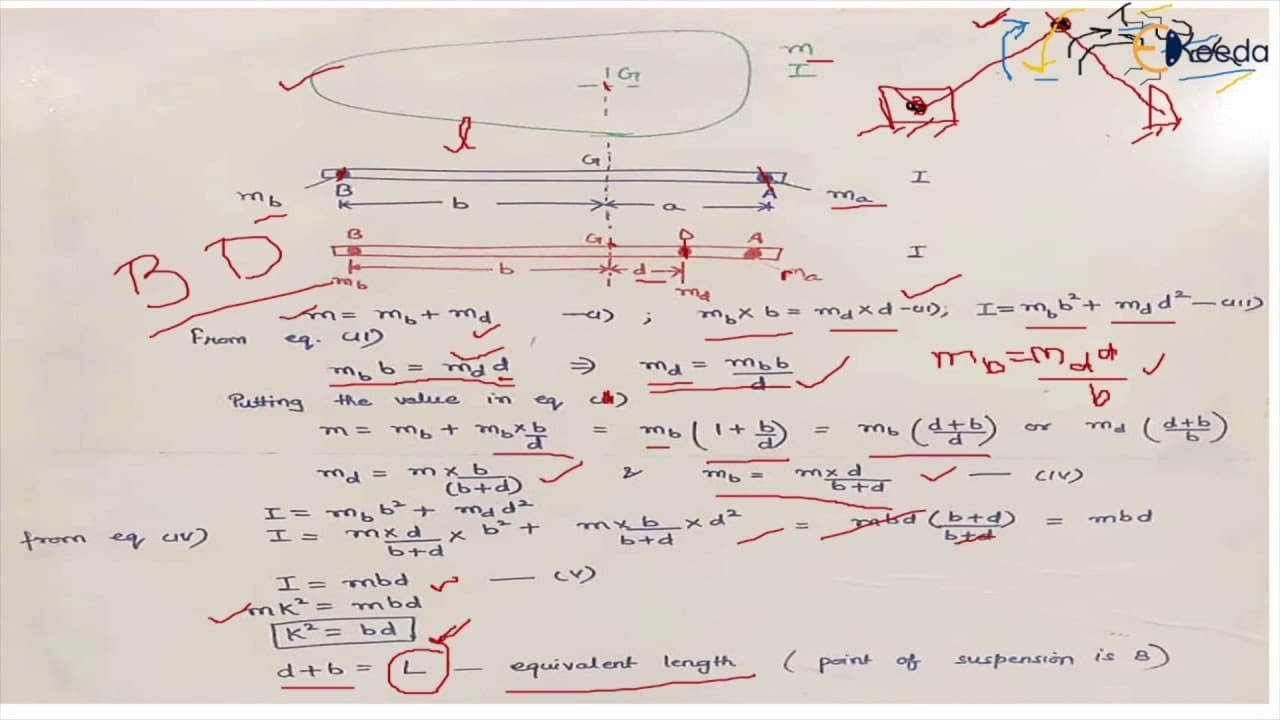
The connecting rod can be replaced with a massless link and two point masses, m1 and m2. The center of mass and moment of inertia should remain the same as the original connecting rod.
Q: Why does the addition of mass at the crank pin increase the inertia effect?
The added mass at the crank pin increases the inertia effect because it requires additional torque to overcome the increased inertia caused by the added mass.
Q: What is the purpose of the correction torque in the dynamically equivalent system?
The correction torque is applied to counteract the increased inertia effect caused by the added mass at the crank pin, reducing its impact on the system's motion.
Summary & Key Takeaways
-
Converting a connecting rod into a two mass system can eliminate the complexities and difficulties in considering the inertia force caused by the non-uniformly distributed mass.
-
The new system should have the same center of mass and moment of inertia as the original connecting rod.
-
The addition of mass at the crank pin increases the inertia effect, requiring the application of a correction torque to minimize its impact.
Read in Other Languages (beta)
Share This Summary 📚
Summarize YouTube Videos and Get Video Transcripts with 1-Click
Try YouTube Summary with ChatGPT & Claude or YouTube Transcript Generator
Explore More Summaries from Ekeeda 📚





Summarize YouTube Videos and Get Video Transcripts with 1-Click
Try YouTube Summary with ChatGPT & Claude or YouTube Transcript Generator