Hindu gods overview | World History | Khan Academy
TL;DR
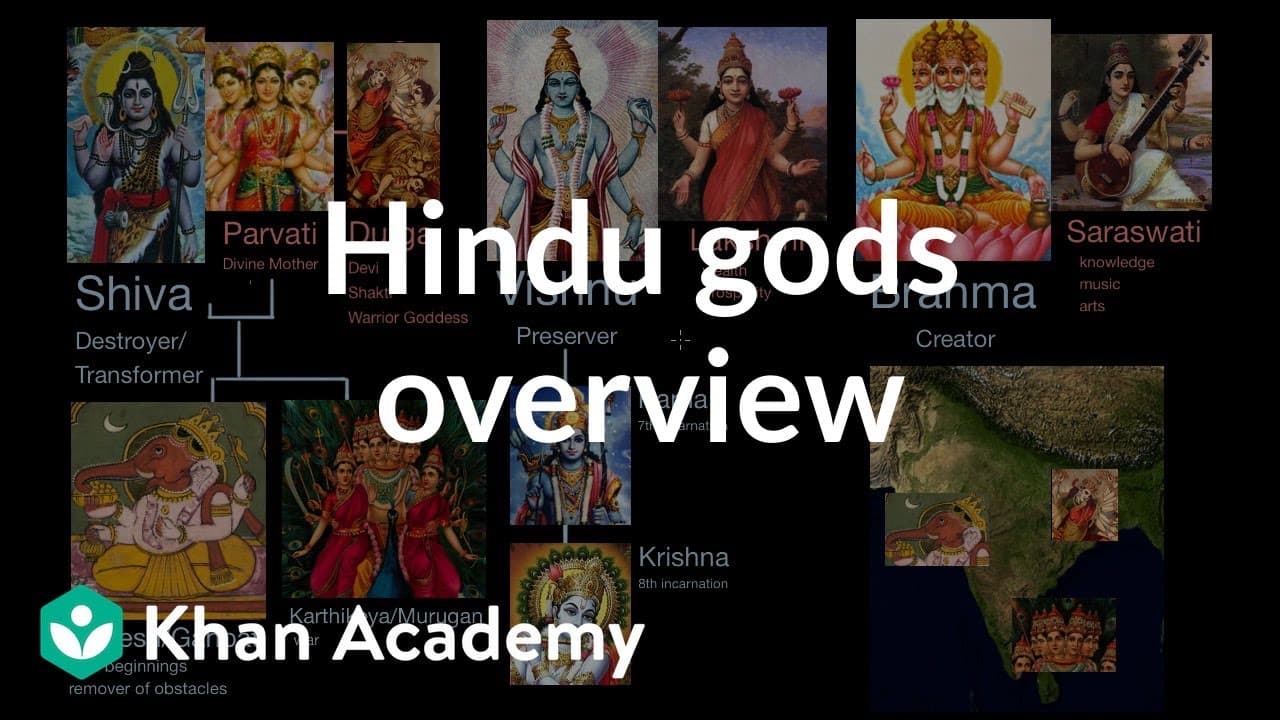
Hinduism has a diverse pantheon of gods, but they are all considered aspects of the one true reality of Brahman, leading to the practice of syncretism.
Transcript
- [Instructor] Hinduism is often known for its large and complex pantheon of gods. The goal of this video is to give an overview of them and to think about how they are connected, and how they are perceived. So the Hindu Trinity, as it is often called, is made up of Shiva, Vishnu and Brahma. They are often considered to be the three most important ... Read More
Key Insights
- 🛐 Shiva and Vishnu are the most worshipped gods in Hinduism, with Shiva being associated with destruction and transformation, and Vishnu with preservation and protection.
- ❓ Brahma, the creator god, has fewer followers in modern Hinduism but is still considered important.
- 👻 Hinduism practices syncretism, allowing for the coexistence and merging of diverse rituals, traditions, and beliefs.
- 💁 Hindu gods are not strictly classified by gender, and there are female forms of deities worshipped in Hinduism.
- 🥺 The diversity of Hindu practices and beliefs does not lead to significant conflicts due to the understanding that all gods are connected to the ultimate reality of Brahman.
- 🛐 Hinduism is often considered polytheistic due to the worship of multiple gods, but some argue that it is monotheistic as all gods are aspects of Brahman.
- 🚨 The concept of syncretism in Hinduism emerged from the amalgamation of traditions from the Indus Valley civilization, Indo-Aryans, and Dravidians.
Install to Summarize YouTube Videos and Get Transcripts
Explore YouTube Video Summarizer or Get YouTube Transcript Extractor
Questions & Answers
Q: Who are the three most important gods in Hinduism?
The three most important gods in Hinduism are Shiva, Vishnu, and Brahma. Shiva is often viewed as the Destroyer or the Transformer, Vishnu as the Preserver, and Brahma as the Creator.
Q: What is syncretism in Hinduism?
Syncretism in Hinduism refers to the merging of diverse traditions, rituals, and beliefs into one religion. It allows for the coexistence of various practices and the recognition of multiple deities.
Q: How do Hindus view gods in terms of gender?
In Hinduism, gods are not strictly viewed as having a specific gender. For example, Vishnu has a female incarnation, and there are groups of Hindus who worship God in female forms, such as the followers of Shaktism.
Q: Is Hinduism considered polytheistic or monotheistic?
Hinduism can be viewed as both polytheistic and monotheistic. While there is a pantheon of gods, Hindus believe that all these gods are manifestations or aspects of the one true God, Brahman.
Summary & Key Takeaways
-
Hinduism has a pantheon of gods, including Shiva, Vishnu, and Brahma, with Shiva and Vishnu being the most worshipped.
-
Gods in Hinduism are seen as aspects of the ultimate reality of Brahman, with different deities representing different qualities and roles.
-
Hinduism practices syncretism, merging diverse traditions and beliefs into one religion, allowing for a wide range of rituals and practices.
Read in Other Languages (beta)
Share This Summary 📚
Summarize YouTube Videos and Get Video Transcripts with 1-Click
Try YouTube Summary with ChatGPT & Claude or YouTube Transcript Generator
Explore More Summaries from Khan Academy 📚



Summarize YouTube Videos and Get Video Transcripts with 1-Click
Try YouTube Summary with ChatGPT & Claude or YouTube Transcript Generator