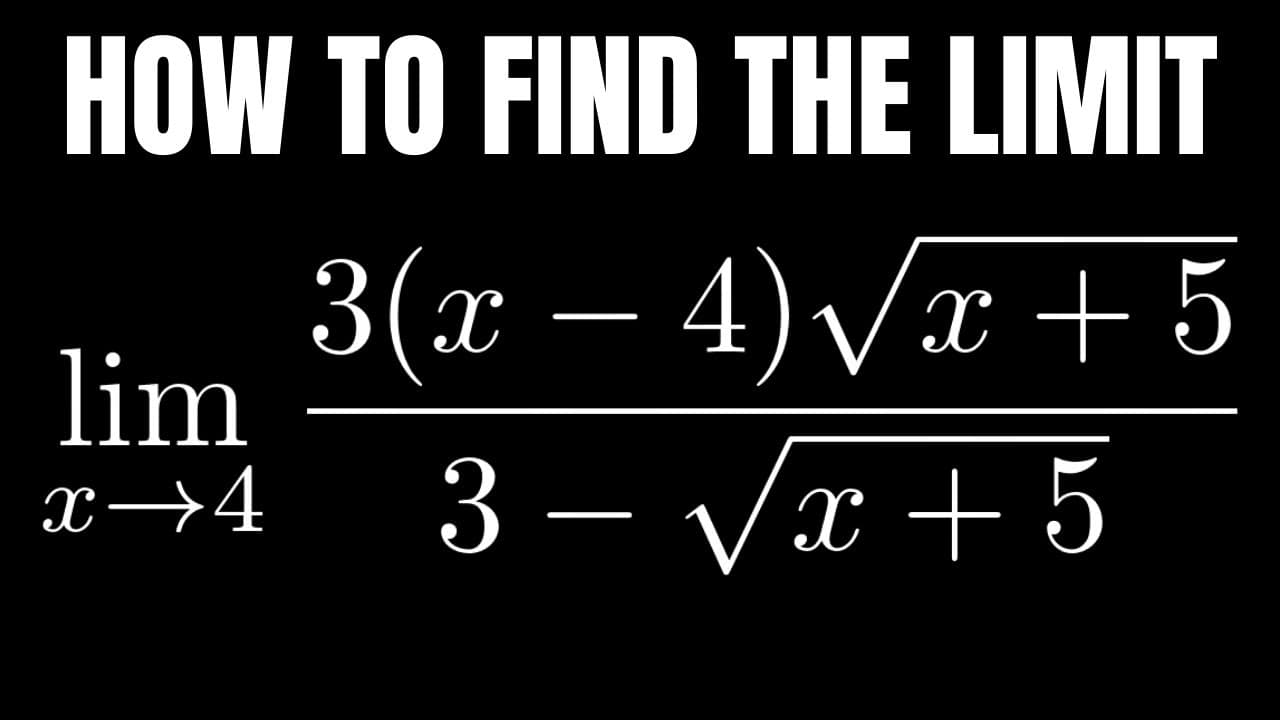
How To Find a Limit By Rationalizing: 3(x - 4)sqrt(x + 5)/(3 - sqrt(x + 5)) as x approaches 4
TL;DR
Demonstrates step-by-step process for calculating limit as x approaches 4 using rationalization.
Transcript
hi in this problem we're going to evaluate the limit as x approaches 4 of this function here so the first thing we want to do is plug in 4 and see if that works and if you notice in this problem here if you plug in 4 on the bottom part you're going to get 3 minus the square root of 4 plus 5. that's the same thing as 3 minus the square root of 9 and... Read More
Key Insights
- 😑 Rationalization is a powerful technique to simplify complex expressions involving radicals in limit calculations.
- 😑 Understanding algebraic formulas such as a² - b² aids in simplifying rationalized expressions in limit problems.
- ⛔ Systematic step-by-step approaches are crucial in tackling intricate limit calculations for accurate results.
- 😑 Leaving complex factors untouched initially can help in focusing on specific parts of the expression for systematic simplification.
- 🍵 The critical role of algebraic manipulation in efficiently handling complex limit calculations is evident from the demonstrated example.
- ⛔ Consistent practice and familiarity with algebraic techniques are essential for mastering limit calculations involving radicals.
- 😑 The importance of correctly substituting the limit value before simplifying the expression to avoid errors and attain correct results is highlighted.
Install to Summarize YouTube Videos and Get Transcripts
Explore YouTube Video Summarizer or Get YouTube Transcript Extractor
Questions & Answers
Q: Why does plugging in 4 directly not work for this limit calculation?
Plugging in 4 directly results in a denominator of 0, which is undefined in mathematics, necessitating an alternate approach through rationalization.
Q: What is the significance of flipping the sign in rationalization?
Flipping the sign in rationalization by multiplying by the conjugate allows the use of algebraic formulas like a² - b² to simplify the expression and eliminate radicals.
Q: How does the speaker handle the complex numerator during the calculation?
The speaker leaves the numerator untouched initially to focus on simplifying the denominator first before addressing the numerator step by step for a systematic approach.
Q: How does the final answer of -54 arise in the limit calculation?
By correctly rationalizing the expression and substituting x with 4 in the simplified form, the limit converges to -54 through systematic algebraic manipulations.
Summary & Key Takeaways
-
The speaker illustrates the method for calculating a limit as x approaches 4 of a complex function.
-
Plugging in 4 directly leads to a 0 in the denominator, prompting the need for rationalization.
-
By rationalizing the expression and applying algebraic rules, the limit can be solved.
Read in Other Languages (beta)
Share This Summary 📚
Summarize YouTube Videos and Get Video Transcripts with 1-Click
Try YouTube Summary with ChatGPT & Claude or YouTube Transcript Generator
Explore More Summaries from The Math Sorcerer 📚


Summarize YouTube Videos and Get Video Transcripts with 1-Click
Try YouTube Summary with ChatGPT & Claude or YouTube Transcript Generator