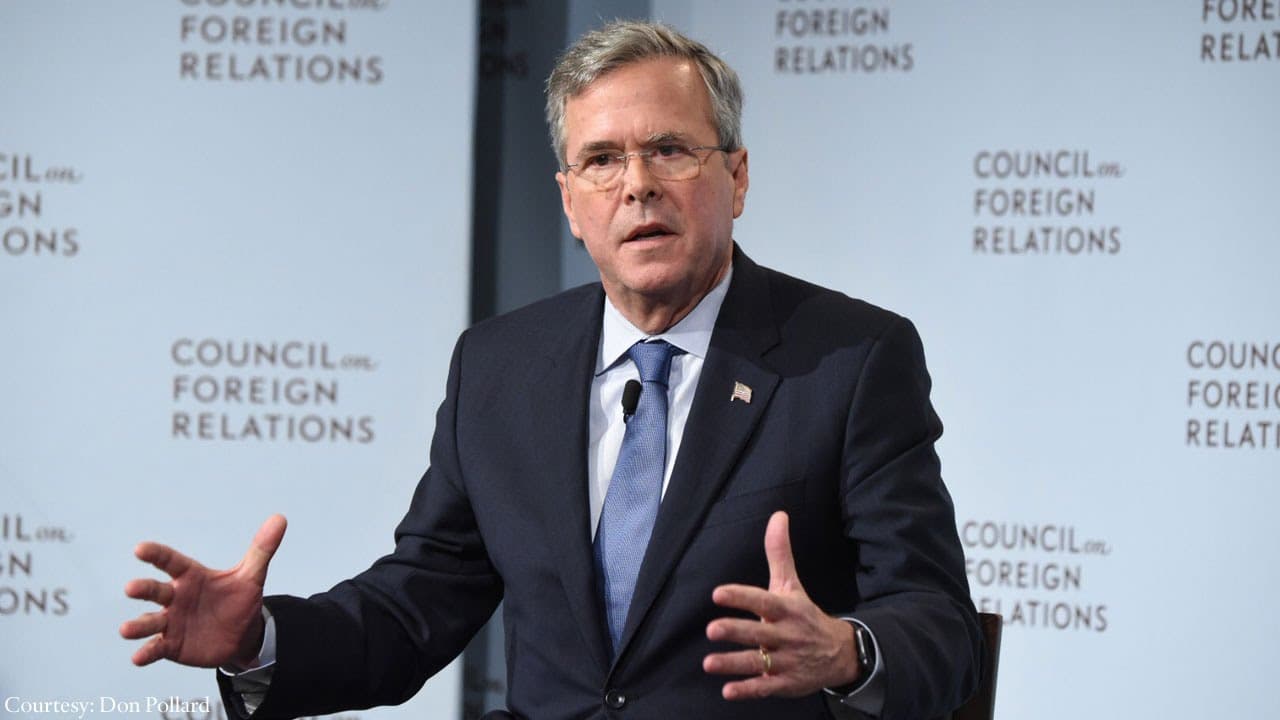
A Conversation With Jeb Bush
TL;DR
Jeb Bush discusses U.S. foreign policy challenges and strategies.
Transcript
HAASS: Well, good afternoon. Ladies and gentlemen, I�m Richard Haass, and I�d like to welcome you all to the Council on Foreign Relations. I also want to take a moment to welcome Senator Lindsey Graham. And I want to thank him for injecting a perspective that was both serious and humorous at the same time into the campaign and into our debate. Sena... Read More
Key Insights
- Jeb Bush emphasizes the importance of U.S. leadership in maintaining global order, advocating for a strong military and economic growth to support this role.
- He criticizes the Obama administration's foreign policy, particularly its handling of ISIS and the Iran nuclear deal, calling for more decisive action and leadership.
- Bush believes in rebuilding alliances, particularly with NATO and Middle Eastern allies, to effectively combat global threats like terrorism.
- He advocates for economic policies that stimulate growth, such as tax reform and energy security, to strengthen the U.S.'s global influence.
- Bush stresses the need for military modernization, including ending sequestration and investing in new technologies to maintain U.S. military superiority.
- He supports a robust intelligence infrastructure to combat terrorism, emphasizing the need for cooperation with allies and technology companies.
- Bush expresses concern over the rise of authoritarian regimes and the need for the U.S. to support democratic movements worldwide.
- He calls for a balanced approach to foreign policy that includes promoting democracy and human rights, alongside economic and security interests.
Install to Summarize YouTube Videos and Get Transcripts
Explore YouTube Video Summarizer or Get YouTube Transcript Extractor
Questions & Answers
Q: What is Jeb Bush's view on U.S. military strength?
Jeb Bush believes that U.S. military strength is crucial for maintaining global order and peace. He advocates for ending sequestration and investing in military modernization to ensure the U.S. maintains its technological superiority. Bush calls for rebuilding the military to project force effectively and support global alliances, arguing that a strong military deters aggression and supports diplomatic efforts.
Q: How does Jeb Bush propose to improve U.S. economic growth?
Jeb Bush proposes several economic policies to stimulate growth, including simplifying the tax code, embracing the energy revolution, and implementing regulatory reform. He argues that these measures will enhance U.S. competitiveness and create jobs, ultimately strengthening the country's global influence. Bush also emphasizes the importance of immigration reform to support economic expansion and address demographic challenges.
Q: What are Bush's criticisms of the Obama administration's foreign policy?
Jeb Bush criticizes the Obama administration for its incremental approach to foreign policy, particularly in handling ISIS and the Iran nuclear deal. He argues that the administration lacked a clear strategy, leading to instability and a weakened U.S. position globally. Bush calls for more decisive leadership and a comprehensive strategy to address threats like terrorism and authoritarian regimes.
Q: What role does Jeb Bush see for the U.S. in combating global terrorism?
Jeb Bush sees a leading role for the U.S. in combating global terrorism, emphasizing the need for a coalition to destroy ISIS. He advocates for embedding U.S. troops with Iraqi forces, directly arming the Kurds, and re-engaging Sunni partners. Bush stresses the importance of intelligence cooperation and a strong military presence to effectively counter terrorist threats and ensure national security.
Q: How does Bush propose to handle relations with China?
Jeb Bush calls for full engagement with China, emphasizing mutual respect and addressing shared strategic interests like North Korea. He advocates for dealing with China from a position of strength, addressing issues like cybersecurity and maritime disputes firmly. Bush supports the Trans-Pacific Partnership to enhance U.S. influence in Asia and counterbalance China's growing power.
Q: What is Bush's stance on the Iran nuclear deal?
Jeb Bush is critical of the Iran nuclear deal, arguing that it empowers Iran's regime and fails to address its regional ambitions. He believes the deal has made it harder to confront Iran's support for terrorism and destabilizing activities. Bush calls for reestablishing sanctions and strengthening U.S.-Israel relations to counter Iran's influence and ensure regional stability.
Q: What is Bush's approach to Latin America?
Jeb Bush advocates for renewed U.S. engagement with Latin America, emphasizing economic cooperation and addressing common challenges like immigration and drug trafficking. He calls for strengthening relationships with Mexico and Canada and supporting democratic movements in countries like Venezuela. Bush believes U.S. leadership can promote stability and prosperity in the region.
Q: How does Bush view the refugee crisis and U.S. responsibilities?
Jeb Bush acknowledges the U.S. role in addressing the global refugee crisis but emphasizes the need for security measures to prevent terrorist infiltration. He supports aiding refugees in camps and addressing the root causes of displacement, like the Syrian conflict. Bush stresses the importance of a comprehensive strategy to stabilize regions and reduce refugee flows, while ensuring U.S. national security.
Summary & Key Takeaways
-
Jeb Bush argues for a restored U.S. leadership role in global affairs, emphasizing military strength, economic growth, and robust alliances. He criticizes the Obama administration's foreign policy, particularly regarding ISIS and Iran, advocating for more decisive U.S. action.
-
Bush outlines a vision for economic policies that promote growth and strengthen U.S. influence, including tax reform and energy security. He stresses the need for military modernization and a strong intelligence infrastructure to address global threats.
-
He highlights the importance of supporting democratic movements and human rights globally, while maintaining a balanced foreign policy that addresses economic and security interests. Bush calls for renewed U.S. engagement with allies and a strategic approach to global challenges.
Read in Other Languages (beta)
Share This Summary 📚
Summarize YouTube Videos and Get Video Transcripts with 1-Click
Try YouTube Summary with ChatGPT & Claude or YouTube Transcript Generator
Explore More Summaries from Council on Foreign Relations 📚


Summarize YouTube Videos and Get Video Transcripts with 1-Click
Try YouTube Summary with ChatGPT & Claude or YouTube Transcript Generator