Risk Management Mitigation and Monitoring
TL;DR
The MMM model helps in identifying, assessing, and managing risks throughout the software development lifecycle.
Transcript
students today we are going to discuss about risk mitigation monitoring and management it is also called as our mmm model now risk it is understand what is risk first risk is the likelihood of failure or error risk is inevitable it is existing in all factors of software development but we have to understand what are the chances of the risk occurrin... Read More
Key Insights
- ✳️ Risk is inevitable in software development, and its likelihood and impact should be assessed.
- ✳️ Risk mitigation involves avoiding or minimizing the impact of risks that are not significant.
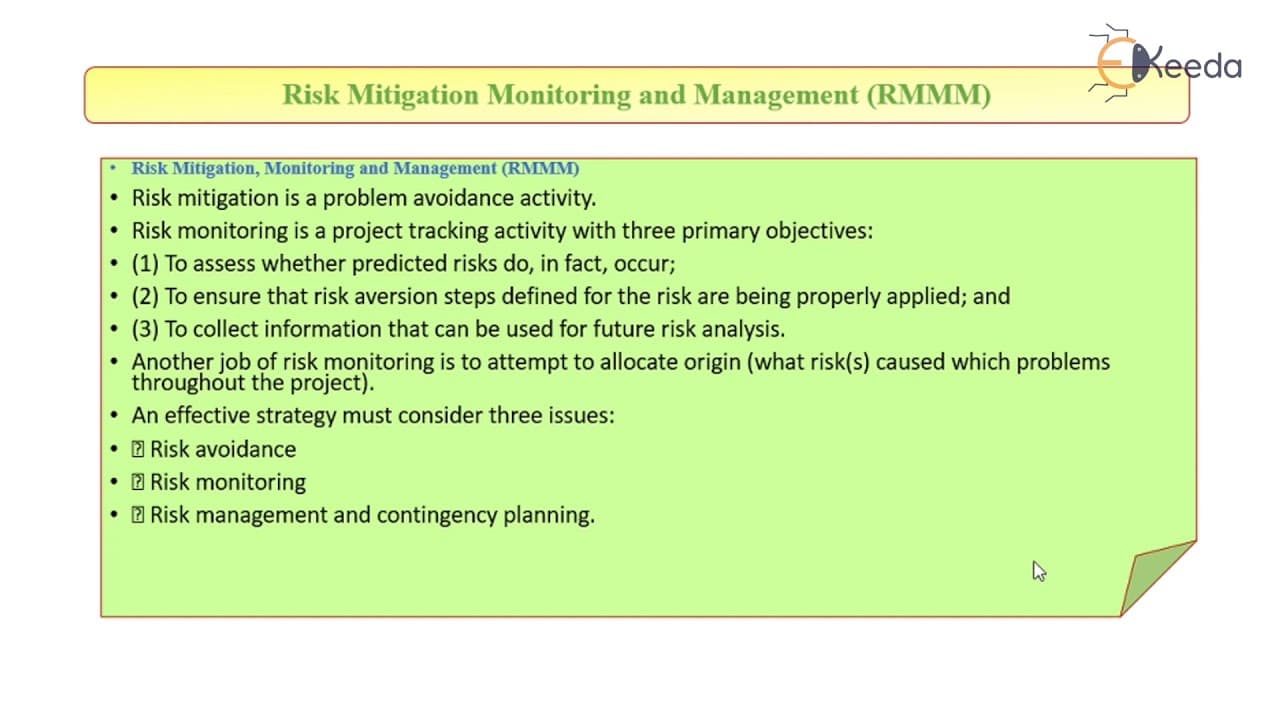
- ✳️ Risk monitoring helps track project activities and assess the likelihood of risks occurring.
- ✳️ Risk management includes identification, assessment, and control of risks.
- 🎮 Risk control strategies need to be justified and monitored throughout the project.
- ✳️ Risk management can be proactive or reactive, depending on the approach chosen.
- ✳️ Effective risk management involves addressing the causes of risks and ensuring continuity.
Install to Summarize YouTube Videos and Get Transcripts
Explore YouTube Video Summarizer or Get YouTube Transcript Extractor
Questions & Answers
Q: What is risk mitigation and why is it important?
Risk mitigation is an activity that aims to avoid problems or minimize their impacts. It is crucial because it helps prevent project failures and reduces the negative consequences of risks on software development projects.
Q: What are the objectives of risk monitoring?
Risk monitoring has three primary objectives: to assess whether predicted risks occur, ensure the proper application of risk aversion steps, and collect information for future risk analysis. It also helps identify the root causes of risks and potential ways to mitigate them.
Q: What are the phases of risk management?
Risk management comprises risk identification, risk assessment, and risk control. Identifying and classifying different types of risks, assessing vulnerabilities and threats, and implementing control strategies are essential components of effective risk management.
Q: What are the two strategies for risk management?
The two strategies for risk management are proactive and reactive. Proactive risk management involves addressing risks before they occur, while reactive risk management waits for risks to manifest and then implements contingency plans to address them.
Summary & Key Takeaways
-
Risk is the likelihood of failure or error in software development, and its impact on projects should be evaluated.
-
Risk mitigation involves avoiding potential problems, while risk monitoring aims to track project activities and assess the likelihood of risks occurring.
-
Risk management consists of risk identification, assessment, and control, with strategies that can be proactive or reactive.
Read in Other Languages (beta)
Share This Summary 📚
Summarize YouTube Videos and Get Video Transcripts with 1-Click
Try YouTube Summary with ChatGPT & Claude or YouTube Transcript Generator
Explore More Summaries from Ekeeda 📚






Summarize YouTube Videos and Get Video Transcripts with 1-Click
Try YouTube Summary with ChatGPT & Claude or YouTube Transcript Generator