Newton's Law of Cooling | First order differential equations | Khan Academy
TL;DR
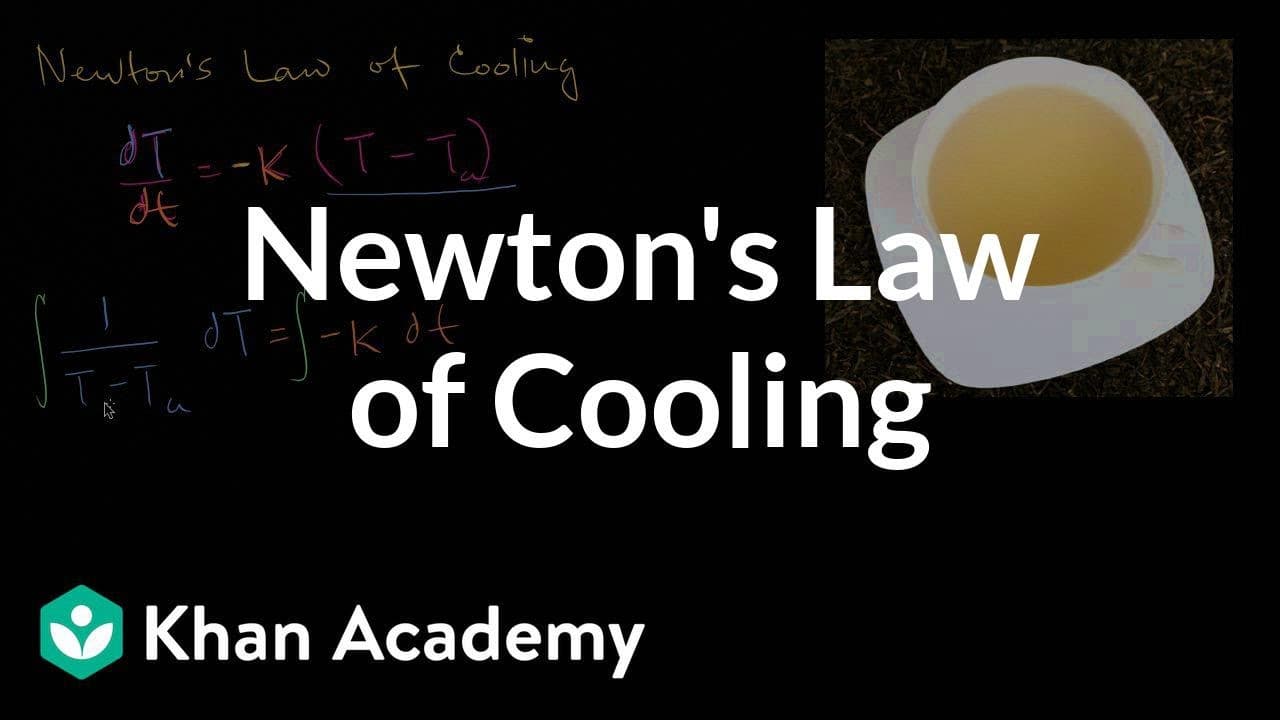
Newton's Law of Cooling states that the rate of change of temperature of an object is proportional to the difference between its temperature and the ambient temperature.
Transcript
- [Voiceover] Let's think about another scenario that we can model with the differential equations. This is a scenario where we take an object that is hotter or cooler than the ambient room temperature, and we want to model how fast it cools or heats up. And the way that we'll think about it is the way that Newton thought about it. And it is descri... Read More
Key Insights
- 😅 Newton's Law of Cooling is a mathematical representation of how hot or cold objects change temperature over time.
- ☠️ The rate of change of temperature is directly proportional to the difference between the object's temperature and the ambient temperature.
- ❎ The constant (k) can be positive or negative, depending on whether the object is hotter or cooler.
- ⌛ Differential equations can be used to solve for the general solution of temperature as a function of time.
- 😎 The sign of the constant determines the direction of temperature change (cooling or heating).
- 🧑🏭 The constant (k) can depend on various factors, such as specific heat and surface area.
- 🆘 Newton's Law of Cooling helps in modeling the cooling or heating process of objects.
Install to Summarize YouTube Videos and Get Transcripts
Explore YouTube Video Summarizer or Get YouTube Transcript Extractor
Questions & Answers
Q: What is Newton's Law of Cooling?
Newton's Law of Cooling states that the rate of change of temperature of an object is proportional to the difference between its temperature and the ambient temperature. This law helps model how quickly an object cools or heats up.
Q: How does the sign of the constant affect the rate of change of temperature?
If the object is hotter than the ambient temperature, a negative constant is needed to indicate cooling. If the object is cooler, a positive constant represents heating. The sign of the constant determines the direction of temperature change.
Q: How can differential equations be used to solve Newton's Law of Cooling?
The differential equation for Newton's Law of Cooling is separable. By manipulating and integrating the equation, it is possible to find the general solution for temperature as a function of time.
Q: What factors can the constant (k) depend on?
The constant (k) in Newton's Law of Cooling can depend on the specific heat of the object, the surface area exposed to the environment, or other relevant factors.
Summary & Key Takeaways
-
Newton's Law of Cooling describes how fast an object heats up or cools down based on its temperature compared to the ambient temperature.
-
The rate of change of temperature is proportional to the difference between the object's temperature and the ambient temperature.
-
A positive constant represents hotter objects cooling down, while a negative constant represents cooler objects heating up.
Read in Other Languages (beta)
Share This Summary 📚
Summarize YouTube Videos and Get Video Transcripts with 1-Click
Try YouTube Summary with ChatGPT & Claude or YouTube Transcript Generator
Explore More Summaries from Khan Academy 📚



Summarize YouTube Videos and Get Video Transcripts with 1-Click
Try YouTube Summary with ChatGPT & Claude or YouTube Transcript Generator