Elements and atoms | Atoms, compounds, and ions | Chemistry | Khan Academy
TL;DR
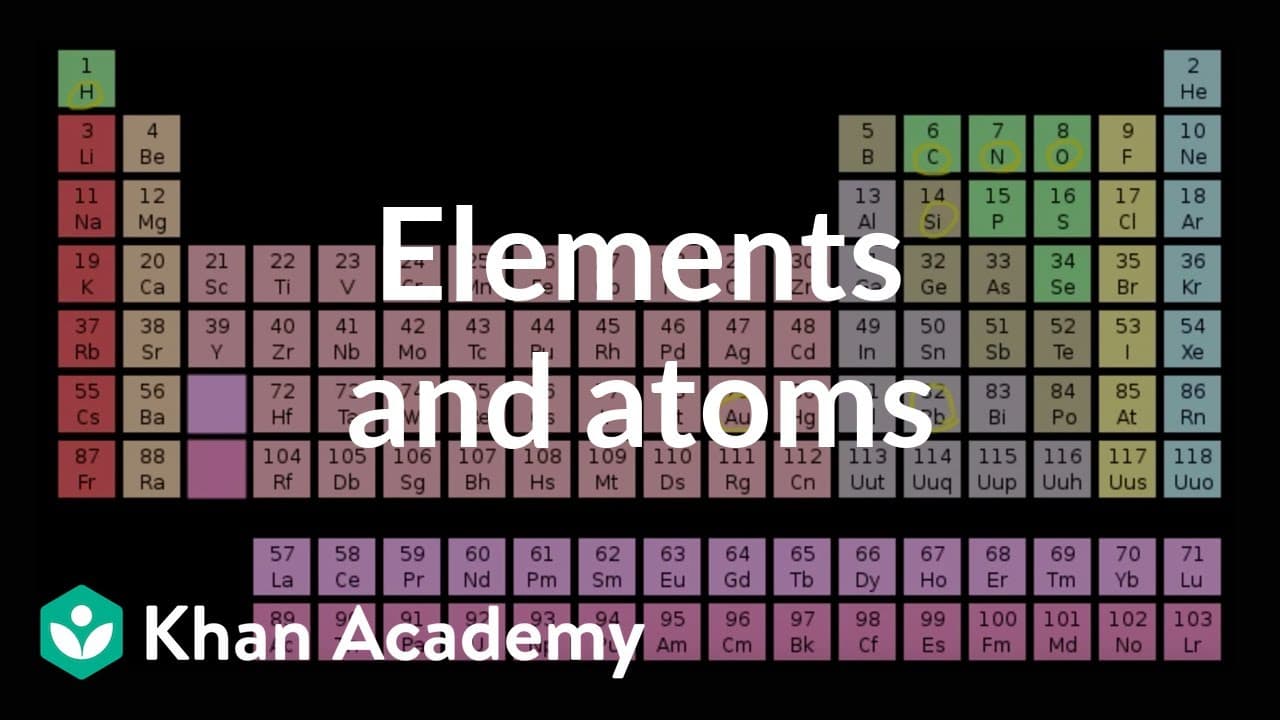
Atoms are the smallest units of matter and elements are pure substances with specific properties determined by the arrangement of atoms. Protons, neutrons, and electrons make up the structure of an atom, and changing the number of these particles can alter the properties of an element.
Transcript
We humans have known, for thousands of years, just looking at our environment around us, that there are different substances. And these different substances tend to have different properties. And not only do they have different properties, one might reflect light in a certain way, or not reflect light, or be a certain color, or at a certain tempera... Read More
Key Insights
- 💁 Different substances have distinct properties and can exist in varying forms.
- 😚 Elements are pure substances with specific properties that cannot be broken down further without losing their characteristics.
- 🫀 Atoms, composed of protons, neutrons, and electrons, are the smallest units of elements.
- 🧘 The number of protons determines the identity of an element and its position on the periodic table.
- 🫀 Electrons are attracted to the nucleus of an atom due to opposite electrical charges.
- 💱 Changing the number of protons, neutrons, or electrons can alter the properties of an element.
- 🫀 The properties of an atom depend on the arrangement and behavior of its electrons.
Install to Summarize YouTube Videos and Get Transcripts
Explore YouTube Video Summarizer or Get YouTube Transcript Extractor
Questions & Answers
Q: What defines an element?
An element is defined by the number of protons in its nucleus, which determines its atomic number. Different elements have different numbers of protons.
Q: Can the number of protons in an element change?
No, the number of protons in an element cannot change without converting it into a different element. The atomic number remains constant for a specific element.
Q: How do electrons contribute to the properties of an atom?
The arrangement of electrons in an atom determines how it interacts with other atoms. The number and distribution of electrons influence an atom's reactivity and bonding behavior.
Q: How small are atoms?
Atoms are unimaginably small, with a cross-section of a human hair able to contain around one million carbon atoms. The size of an atom is difficult to grasp due to its minuscule dimensions.
Summary & Key Takeaways
-
Different substances have different properties and can exist in various forms such as solids, liquids, and gases.
-
Elements are pure substances with specific properties that cannot be broken down further without losing their characteristics.
-
Atoms are the smallest units of elements, composed of protons, neutrons, and electrons.
Read in Other Languages (beta)
Share This Summary 📚
Summarize YouTube Videos and Get Video Transcripts with 1-Click
Try YouTube Summary with ChatGPT & Claude or YouTube Transcript Generator
Explore More Summaries from Khan Academy 📚



Summarize YouTube Videos and Get Video Transcripts with 1-Click
Try YouTube Summary with ChatGPT & Claude or YouTube Transcript Generator