Mechanism Of Hydration Of Ethene - Alcohols, Phenols and Ethers - Chemistry Class 12
TL;DR
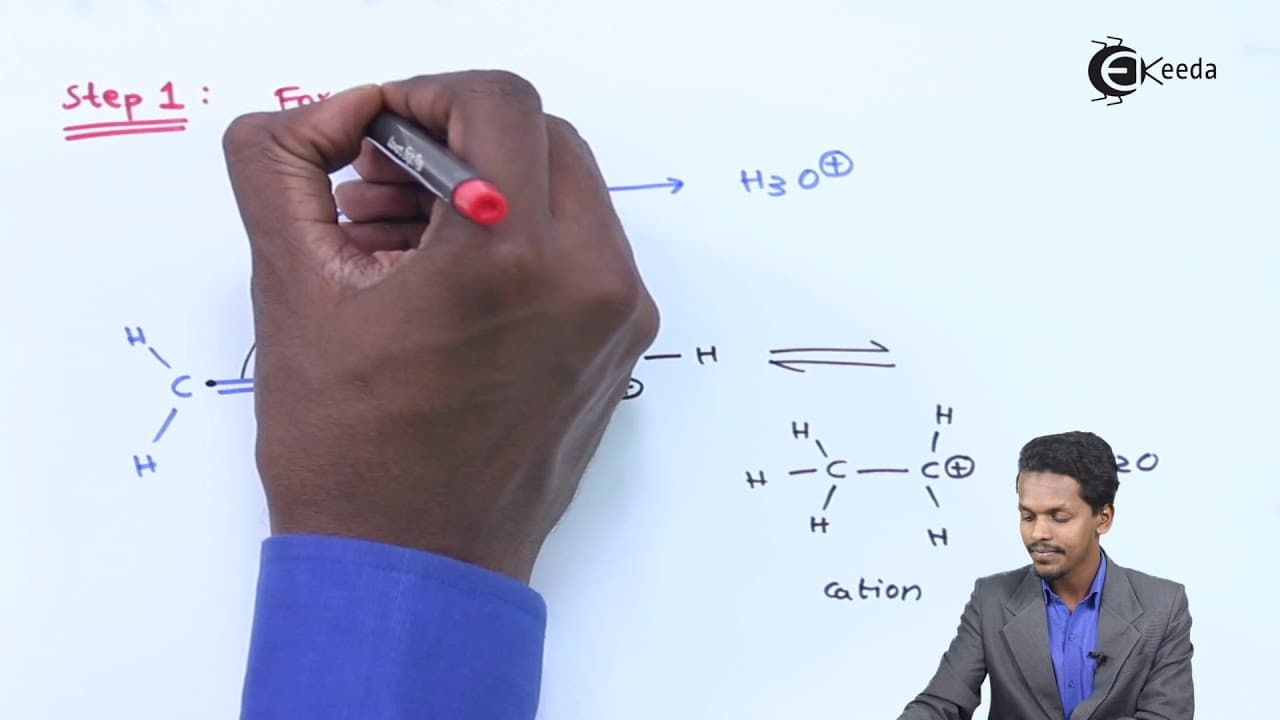
This video discusses the mechanism of hydration of alkenes, explaining how alcohols are formed.
Transcript
click the bell icon to get latest videos from equator primary alcohol by using an alkene and by using by boring so we are again talking about that is the hydration of alkene in this topic that is mechanism of hydration of III so now let us understand the mechanism behind it and just understand that Hungary actually works and how we can update and t... Read More
Key Insights
- 💦 Alkene hydration involves the addition of water and an acidic catalyst to form alcohols.
- 👊 The mechanism follows a three-step process: carbocation formation, nucleophilic attack, and deprotonation.
- 😑 Hydronium ion acts as a catalyst in the reaction.
- ❓ The final product of alkene hydration is an alcohol compound.
- ❓ The process can occur with both symmetrical and unsymmetrical alkenes.
- ☠️ The stability of carbocation intermediates affects the reaction rate.
- ❓ Alkene hydration is an important reaction in organic chemistry.
Install to Summarize YouTube Videos and Get Transcripts
Explore YouTube Video Summarizer or Get YouTube Transcript Extractor
Questions & Answers
Q: What is the general process of alkene hydration?
Alkene hydration involves adding water to an alkene in the presence of an acidic catalyst, resulting in the formation of an alcohol product.
Q: How does the first step of alkene hydration occur?
In the first step, the alkene reacts with the acidic catalyst to form a carbocation intermediate, which is a positively charged carbon atom.
Q: What happens in the second step of alkene hydration?
In the second step, water molecule attacks the carbocation, leading to the formation of an alcohol compound. The carbocation is converted into a hydroxyl group.
Q: What is the role of the hydronium ion in alkene hydration?
The hydronium ion (H3O+) serves as a catalyst in the hydration process. It donates a proton to facilitate the formation of the alcohol product.
Summary & Key Takeaways
-
Hydration of alkenes involves adding water in the presence of an acidic catalyst to obtain alcohols.
-
The mechanism of hydration follows a three-step process: formation of a carbocation, nucleophilic attack of water on the carbocation, and removal of a proton to yield the final alcohol product.
-
The hydronium ion (H3O+) acts as a catalyst in the process.
Read in Other Languages (beta)
Share This Summary 📚
Summarize YouTube Videos and Get Video Transcripts with 1-Click
Try YouTube Summary with ChatGPT & Claude or YouTube Transcript Generator
Explore More Summaries from Ekeeda 📚


Summarize YouTube Videos and Get Video Transcripts with 1-Click
Try YouTube Summary with ChatGPT & Claude or YouTube Transcript Generator