Radioactivity - Nuclear Chemistry & Radioactivity - Chemistry Class 11
TL;DR
Radioactivity is the spontaneous emission of nuclear particles and gamma radiation from unstable nuclei, exhibited by radioactive elements like uranium and radium.
Transcript
click the Bell icon to get latest videos from Akira help frames in the previous topic if we have discussed about the numerical based on the binding energy and here we are going to talk about the radioactivity so what are radioactivity what is the unit of it let me talk about that in this topic so friends here I'm going to talk about the radioactivi... Read More
Key Insights
- ❓ Radioactivity is the spontaneous emission of nuclear particles and gamma radiation from unstable nuclei.
- ☢️ Radioactive elements like uranium and radium exhibit radioactivity.
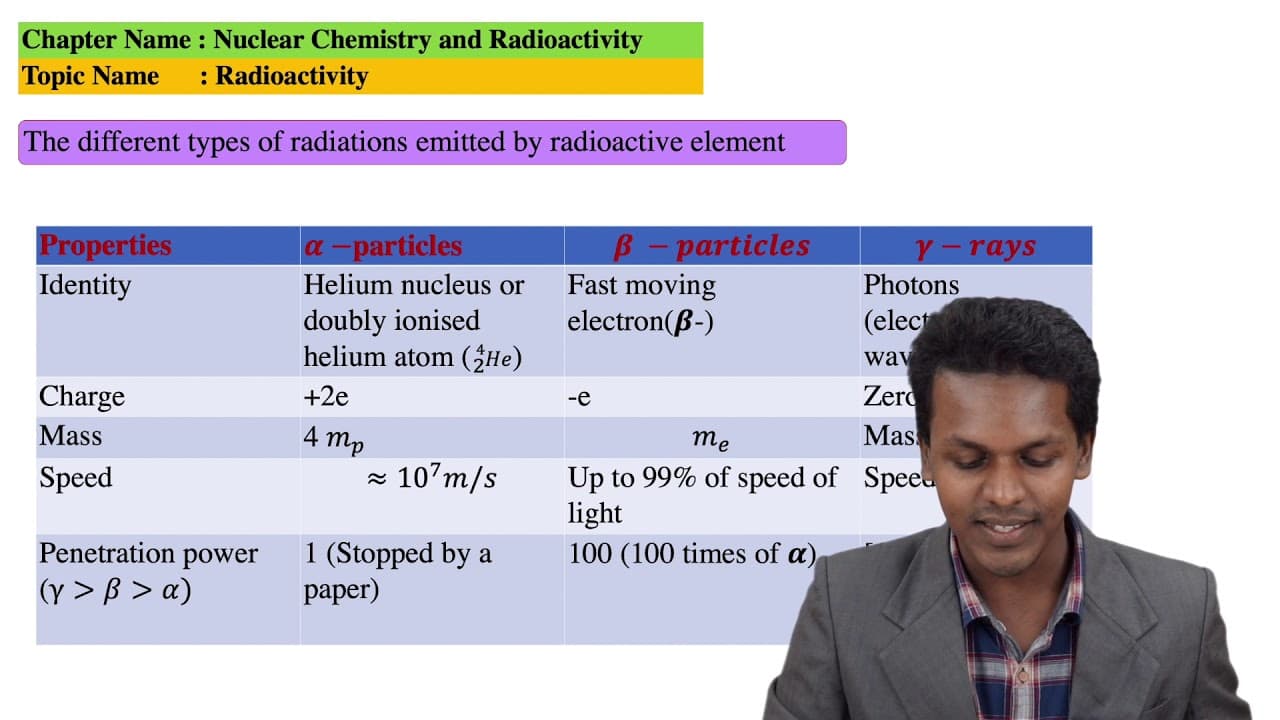
- 🔤 The three types of radiation are alpha, beta, and gamma radiation.
- 💆 Alpha particles are helium nuclei with a positive charge and more mass.
- 💨 Beta particles are fast-moving electrons with a negative charge.
- 😐 Gamma radiation is neutral and consists of electromagnetic waves.
- ✊ Alpha particles have more penetration power and ionization power compared to beta and gamma radiation.
Install to Summarize YouTube Videos and Get Transcripts
Explore YouTube Video Summarizer or Get YouTube Transcript Extractor
Questions & Answers
Q: What is radioactivity?
Radioactivity is the phenomenon of spontaneous emission of nuclear particles and gamma radiation exhibited by unstable nuclei of radioactive elements like uranium and radium.
Q: What are the three types of radiation?
The three types of radiation are alpha radiation (helium nuclei), beta radiation (fast-moving electrons), and gamma radiation (electromagnetic waves).
Q: How do alpha particles differ from beta particles and gamma radiation in terms of charge?
Alpha particles have a positive charge (+2), beta particles have a negative charge (-1), and gamma radiation is neutral (no charge).
Q: What is the speed of alpha particles?
The speed of alpha particles is 10^7 meters per second.
Q: What is the unit of radioactivity?
The unit of radioactivity is the Curie, where 1 Curie is equal to 3.7 x 10^10 disintegrations per second.
Summary & Key Takeaways
-
Radioactivity is a phenomenon where radioactive elements emit nuclear particles and gamma radiation, transforming into new nuclei.
-
There are three types of radiation: alpha radiation (helium nuclei), beta radiation (fast-moving electrons), and gamma radiation (electromagnetic waves).
-
Alpha particles have a positive charge, beta particles have a negative charge, and gamma radiation is neutral. Alpha particles have more mass and penetration power, while beta particles have more speed and ionization power.
Read in Other Languages (beta)
Share This Summary 📚
Summarize YouTube Videos and Get Video Transcripts with 1-Click
Try YouTube Summary with ChatGPT & Claude or YouTube Transcript Generator
Explore More Summaries from Ekeeda 📚





Summarize YouTube Videos and Get Video Transcripts with 1-Click
Try YouTube Summary with ChatGPT & Claude or YouTube Transcript Generator