Interquery Parallelism - System Architecture In DBMS - Database Management System
TL;DR
Interquery parallelism allows queries or transactions to run simultaneously, increasing efficiency on a CPU and reducing IO overhead.
Transcript
click the bell icon to get latest videos from ekeeda hello friends today we are talking about an interquery parallelism we will know what is an interquery parallelism and finally we will go within share nothing and share disk protocol to follow this interquery parallelism there are several database management systems which allows that the queries o... Read More
Key Insights
- 👻 Interquery parallelism allows queries or transactions to run simultaneously, increasing efficiency on a CPU and reducing IO overhead.
- ❓ It is particularly efficient in systems with multiple processors and in distributed systems.
- 💦 Joining relations, such as complex join, natural join, and equi join, work well with interquery parallelism.
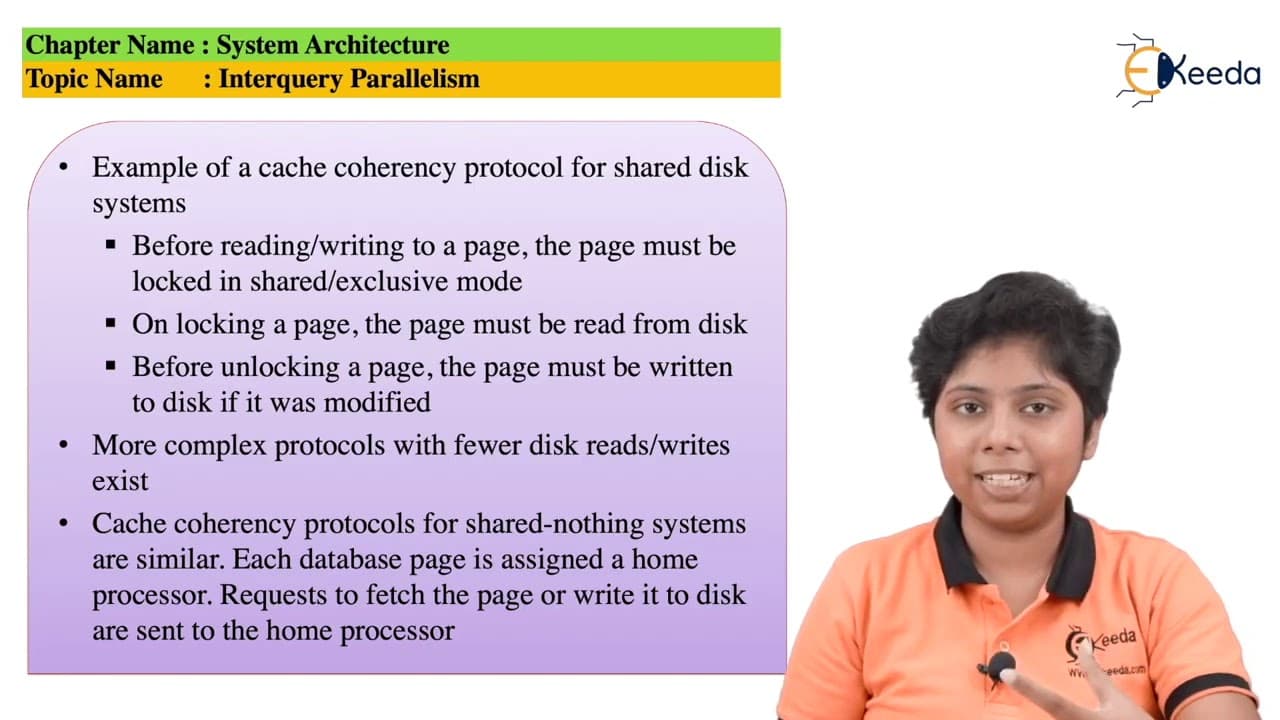
- ❓ Cache coherency is crucial in ensuring that the cached data and original database remain consistent.
- ❓ Various protocols are available to provide cache coherency in interquery parallelism.
- 🫠 Acquiring an appropriate mode lock is necessary for read or write operations.
- 😳 Flushing the cache to the disk before releasing the lock avoids data inconsistencies.
Install to Summarize YouTube Videos and Get Transcripts
Explore YouTube Video Summarizer or Get YouTube Transcript Extractor
Questions & Answers
Q: What is interquery parallelism and how does it benefit database management systems?
Interquery parallelism allows multiple queries or transactions to run simultaneously, increasing efficiency on a CPU and reducing IO overhead. It improves performance in database management systems by allowing queries to be performed simultaneously.
Q: How does interquery parallelism work in distributed systems with multiple processors?
In distributed systems with multiple processors, interquery parallelism allows queries from different processors to run smoothly. This means that queries from different sites or nodes can be fetched from the database and processed simultaneously.
Q: What role do joining relations play in interquery parallelism?
Joining relations, such as complex join, natural join, and equi join, work well with interquery parallelism. They can be performed effectively when interquery parallelism is maintained in the database management system.
Q: How does cache coherency play a role in interquery parallelism?
Cache coherency is related to interquery parallelism and ensures that the cached data and original database are coherent with each other. This helps avoid problems or discrepancies in the data when multiple queries are running simultaneously.
Summary & Key Takeaways
-
Interquery parallelism allows multiple queries or transactions to be performed simultaneously, increasing efficiency on a CPU and reducing IO overhead.
-
It becomes extremely efficient in systems with multiple processors, allowing queries from different processors to run smoothly.
-
Joining relations, such as complex join, natural join, and equi join, work well with interquery parallelism, improving performance.
Read in Other Languages (beta)
Share This Summary 📚
Summarize YouTube Videos and Get Video Transcripts with 1-Click
Try YouTube Summary with ChatGPT & Claude or YouTube Transcript Generator
Explore More Summaries from Ekeeda 📚






Summarize YouTube Videos and Get Video Transcripts with 1-Click
Try YouTube Summary with ChatGPT & Claude or YouTube Transcript Generator