Olga Troyanskaya, Princeton University - Stanford Medicine Big Data | Precision Health 2016
TL;DR
This content discusses the analysis of tissue-specific genomic data and its implications for understanding complex human diseases.
Transcript
thanks very much Christina so I'm going to talk about tissue-specific genome-wide view of complex human disease and then how we can use these very very diverse functional genomic data sets to be able to look at very specific questions that are relevant to human disease so how do we really go from this big genomic data and functional genomics data t... Read More
Key Insights
- 😑 Genomic data can provide valuable insights into the regulatory effects of genetic variations on chromatin and gene expression.
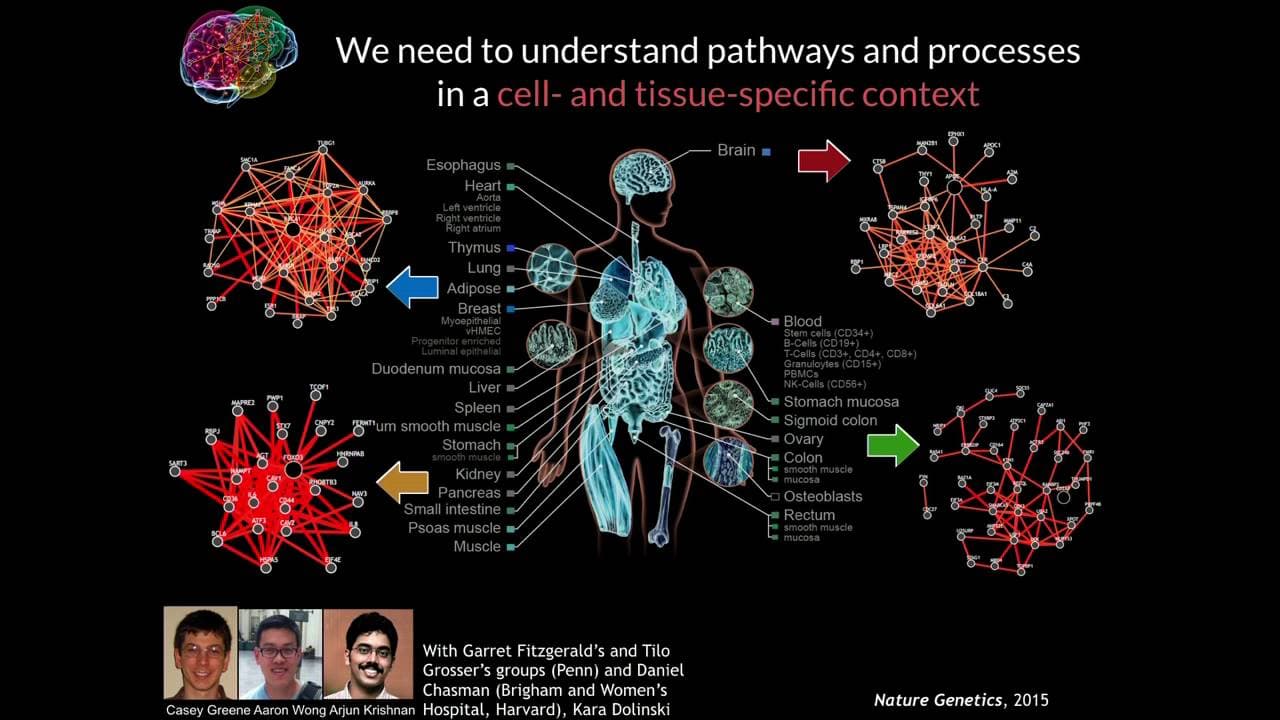
- 🆘 Tissue-specific networks generated from heterogeneous data can help understand how proteins function and interact in different tissues and cell lineages.
- 🤢 Deep learning-based methods, such as "deep sea," can accurately predict the effects of single nucleotide changes on chromatin and gene regulation.
- ❓ Combining tissue-specific networks with GWAS data improves the prioritization and discovery of disease-associated genes.
- ❓ Integrating computational, experimental, and clinical approaches is crucial for a comprehensive understanding of complex human diseases.
Install to Summarize YouTube Videos and Get Transcripts
Explore YouTube Video Summarizer or Get YouTube Transcript Extractor
Questions & Answers
Q: How does a single nucleotide polymorphism in the genome affect chromatin and gene regulation?
A single letter change in the genome can impact chromatin and gene regulation by altering the interactions between proteins and specific genomic regions. This can result in changes in gene expression and potentially contribute to human disease.
Q: How can tissue-specific networks be generated from heterogeneous data?
Tissue-specific networks can be created by integrating various functional genomic data sets, including gene expression, physical interaction, and transcription factor binding data. Machine learning classifiers can then be used to generate networks specific to different tissues, allowing for the prediction of tissue-specific protein function and interactions.
Q: How can genomic data be used to prioritize disease-associated single nucleotide polymorphisms (SNPs)?
Genomic data, such as predictions of chromatin marks and protein expression, can be used to prioritize disease-associated SNPs. By comparing the predictions for a SNP to known disease catalogs or experimental data, the functional significance of the SNP can be determined, helping to identify potential disease-causing variants.
Q: How can tissue-specific networks and genome-wide association study (GWAS) data be combined to discover disease-associated genes?
Tissue-specific networks can be combined with GWAS data to prioritize disease-associated genes. By ranking genes based on their association with the disease in GWAS data and their connectivity in the tissue-specific network, more accurate predictions of disease-associated genes can be made compared to using GWAS data alone.
Summary & Key Takeaways
-
The speaker discusses the challenge of understanding the regulatory effects of genomic changes on a molecular level in specific cells and situations.
-
A deep learning-based framework called "deep sea" is introduced, which can predict the effects of single nucleotide changes on chromatin and gene regulation.
-
The speaker explains the use of tissue-specific networks created from heterogeneous data to understand how proteins interact and function in different tissues and cell lineages.
Read in Other Languages (beta)
Share This Summary 📚
Summarize YouTube Videos and Get Video Transcripts with 1-Click
Try YouTube Summary with ChatGPT & Claude or YouTube Transcript Generator
Explore More Summaries from Stanford 📚






Summarize YouTube Videos and Get Video Transcripts with 1-Click
Try YouTube Summary with ChatGPT & Claude or YouTube Transcript Generator