Prokaryotes: Bacteria and Archaea | Biology
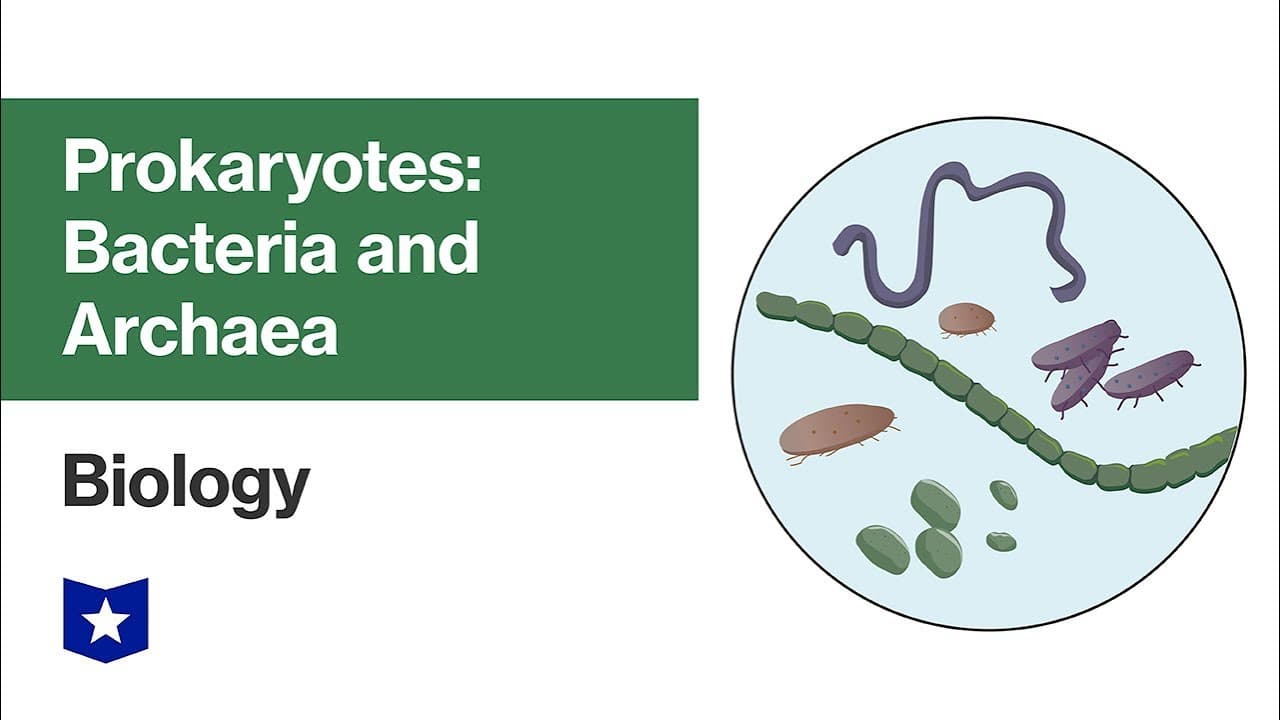
TL;DR
Prokaryotes, including bacteria and archaea, play crucial roles in ecosystems and human health through diverse metabolic processes and contributions to atmospheric composition.
Transcript
although members of the domains bacteria and archaea have many important differences the united by the general cell type unlike members of the domain Eukarya bacteria archaea of prokaryotes and the four single-celled and lacking a nucleus there some prokaryotes lived together in colonies are attached in a group they do not share the same level of c... Read More
Key Insights
- 🖤 Prokaryotes, like bacteria and archaea, lack a nucleus, reproduce asexually, and exhibit diverse metabolic processes for energy acquisition.
- 🏍️ Bacteria's metabolic diversity enables crucial ecological functions like nitrogen fixation and decomposition, influencing nutrient cycles and ecosystem sustainability.
- 👻 Archaea, sharing traits with eukaryotes, possess unique characteristics like branched lipids, allowing adaptation to extreme environments as extremophiles.
- 🧑⚕️ The microbiome's significance in human health underscores the role of bacteria in metabolic processes, immune system regulation, and disease development.
- ❓ Archaea's genetic and metabolic uniqueness, including histones and branched lipids, distinguishes them from bacteria and eukaryotes and highlights their extremophile adaptability.
- 🌱 Nitrogen-fixing bacteria's ability to convert atmospheric nitrogen into ammonia supports plant growth and nutrient cycles essential for ecosystem functioning.
- 🌐 Bacteria's role in atmospheric oxygen production and nutrient cycling showcases their ecological importance and impact on global biogeochemical processes.
Install to Summarize YouTube Videos and Get Transcripts
Explore YouTube Video Summarizer or Get YouTube Transcript Extractor
Questions & Answers
Q: What are plasmids in prokaryotic cells, and how do they contribute to genetic diversity?
Plasmids are small, circular DNA pieces that replicate independently and can transfer genetic material between cells, enhancing genetic diversity and potentially conferring advantageous traits.
Q: How do nitrogen-fixing bacteria contribute to the ecosystem, and why is their role essential?
Nitrogen-fixing bacteria convert atmospheric nitrogen into ammonia, vital for plant growth and subsequent food chains, showcasing their crucial role in the ecosystem's nitrogen cycle.
Q: What is the microbiome, and how does it impact human health?
The microbiome consists of organisms, including bacteria, in the human digestive tract, influencing obesity, diabetes, cardiovascular disease, and digestive disorders by playing critical roles in metabolic processes and immune system regulation.
Q: What distinguishes archaea from bacteria and eukaryotes in terms of genetic traits and metabolisms?
Archaea exhibit unique genetic traits like histones and introns, as well as metabolically divergent features such as branched lipids in cell membranes, supporting their adaptation to extreme environments.
Summary & Key Takeaways
-
Prokaryotes, such as bacteria and archaea, lack a nucleus, reproduce via binary fission, and have diverse mechanisms for obtaining energy and carbon.
-
Bacteria, a highly diverse kingdom, have significant ecological functions, including atmospheric oxygen production and nitrogen fixation.
-
Archaea, more closely related to eukaryotes, exhibit unique traits like branched lipids and thrive in extreme conditions as extremophiles.
Read in Other Languages (beta)
Share This Summary 📚
Summarize YouTube Videos and Get Video Transcripts with 1-Click
Try YouTube Summary with ChatGPT & Claude or YouTube Transcript Generator
Explore More Summaries from Course Hero 📚




Summarize YouTube Videos and Get Video Transcripts with 1-Click
Try YouTube Summary with ChatGPT & Claude or YouTube Transcript Generator