Products
Features
YouTube Video Summarizer
Summarize YouTube videos
Web & PDF Highlighter
Highlight web pages & PDFs
Chat with PDF
Ask any PDF questions with AI
Ask AI Clone
Chat with your highlights & memories
Audio Transcriber
Transcribe audio files to text
Glasp Reader
Read and highlight articles
Kindle Highlight Export
Export your Kindle highlights
Idea Hatch
Hatch ideas from your highlights
Integrations
Obsidian Plugin
Notion Integration
Pocket Integration
Instapaper Integration
Medium Integration
Readwise Integration
Snipd Integration
Hypothesis Integration
Apps & Extensions
Chrome Extension
Safari Extension
Edge Add-ons
Firefox Add-ons
iOS App
Android App
Discover
Discover
Ideas
Discover new ideas and insights
Articles
Curated articles and insights
Books
Book recommendations by great minds
Posts
Essays and notes from readers
Quotes
Inspiring quotes collection
Videos
Curated videos and summaries
Explore Glasp
Glasp Newsletter
Weekly insights and updates
Glasp Talk
Interview series with great minds
Glasp Blog
Latest news and articles
Glasp Use Cases
Learn how others use Glasp
Build & Support
Glasp API
Access Glasp's API for developers
MCP Connector
Connect Glasp to Claude & ChatGPT
Community
Glasp Reddit Community
Students
Student discount and benefits
FAQs
Frequently Asked Questions
AboutPricing
DashboardLog inSign up

CMFB Using Triode Devices - Stability and Frequency Compensation Op-Amp - Analog & Mixed VLSI Design
92 views
•
April 8, 2022
by
Ekeeda
YouTube video player
CMFB Using Triode Devices - Stability and Frequency Compensation Op-Amp - Analog & Mixed VLSI Design

TL;DR

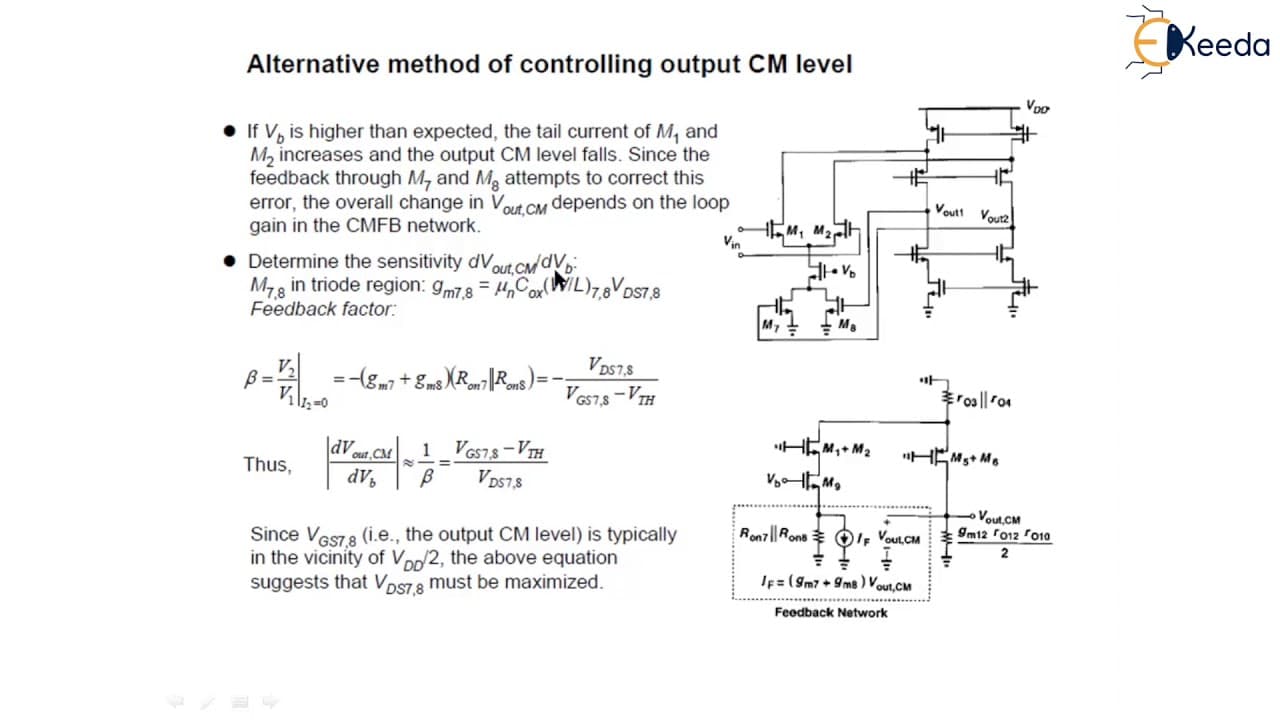
This lecture discusses a feedback topology that converts the output common voltage to resistance or current, addressing drawbacks such as limited voltage swing and dependence on device parameters.

Transcript

hello everyone in this lecture we will study about cmmv using tryout devices okay in this we'll study about a simple feedback topology which utilizes the output common volt voltage to be directly converted to a resistance or a current which prohibits comparison with a reference voltage and where we are on 7 and in parallel with r of 8 it's just the... Read More

Key Insights

  • âš¡ The feedback topology converts the output common voltage to resistance or current for comparison with a reference voltage.
  • âš¡ Device parameter dependence and limited voltage swing are drawbacks of this topology.
  • 💦 Applying feedback to the tail current minimizes the voltage drop but does not address all the drawbacks.

Install to Summarize YouTube Videos and Get Transcripts

Explore YouTube Video Summarizer or Get YouTube Transcript Extractor

Questions & Answers

Q: How does the feedback topology convert the output common voltage?

The output common voltage is directly converted to a resistance or current in this feedback topology, allowing for comparison with a reference voltage.

Q: What are the drawbacks of this topology?

The drawbacks include the dependence of the output common mode level on device parameters, limited voltage swing due to voltage drop, and the introduction of capacitance by wider devices.

Q: How can the voltage drop across R0.7 in parallel with R0n be minimized?

Applying feedback to the tail current of the input differential pair can minimize the voltage drop across R0.7 in parallel with R0n, but it does not address the other two drawbacks.

Q: How can the sensitivity of the output common mode level to the input voltage be determined?

The sensitivity can be determined using the equation dVout cm / dVb = (Vds 7-8 / (Vgs 7-8 - Vth)), where Vds 7-8 and Vgs 7-8 are the drain-source and gate-source voltages of F7 and M8, respectively.

Summary & Key Takeaways

  • The lecture explains a feedback topology that utilizes the output common voltage to generate a resistance or current.

  • This topology balances drain currents to set the output common mode level.

  • Drawbacks include dependence on device parameters, limited voltage swing, and the introduction of capacitance.


Read in Other Languages (beta)

English

Share This Summary 📚

Summarize YouTube Videos and Get Video Transcripts with 1-Click

Download browser extensions on:

Try YouTube Summary with ChatGPT & Claude or YouTube Transcript Generator

Explore More Summaries from Ekeeda 📚
Initiating a project on truffle thumbnail
Initiating a project on truffle
Ekeeda
Non   Homogeneous Linear Equations with Constant Coefficients thumbnail
Non Homogeneous Linear Equations with Constant Coefficients
Ekeeda
Average Outgoing Quality AOQ - Sampling Technique - Metrology and Quality Engineering thumbnail
Average Outgoing Quality AOQ - Sampling Technique - Metrology and Quality Engineering
Ekeeda
Integrals of the form Type A Problem No 6 - Integration - Diploma Maths - 2 thumbnail
Integrals of the form Type A Problem No 6 - Integration - Diploma Maths - 2
Ekeeda
Problem no.1 on Super Node - DC Circuits - Basic Electrical Engineering thumbnail
Problem no.1 on Super Node - DC Circuits - Basic Electrical Engineering
Ekeeda
How to Calculate Individual Capacitance of Two Capacitors thumbnail
How to Calculate Individual Capacitance of Two Capacitors
Ekeeda

Summarize YouTube Videos and Get Video Transcripts with 1-Click

Download browser extensions on:

Try YouTube Summary with ChatGPT & Claude or YouTube Transcript Generator

Apps & Extensions

  • Chrome Extension
  • Safari Extension
  • Edge Add-ons
  • Firefox Add-ons
  • iOS App
  • Android App

Key Features

  • YouTube Video Summarizer
  • Web & PDF Summarizer
  • Web & PDF Highlighter
  • Chat with PDF
  • Ask AI Clone
  • Audio Transcriber
  • Glasp Reader
  • Kindle Highlight Export
  • Idea Hatch

Integrations

  • Obsidian Plugin
  • Notion Integration
  • Pocket Integration
  • Instapaper Integration
  • Medium Integration
  • Readwise Integration
  • Snipd Integration
  • Hypothesis Integration

More Features

  • APIs
  • MCP Connector
  • Blog & Post
  • Embed Links
  • Image Highlight
  • Personality Test
  • Quote Shots

Company

  • About us
  • Blog
  • Community
  • FAQs
  • Job Board
  • Newsletter
  • Pricing
Terms

•

Privacy

•

Guidelines

© 2026 Glasp Inc. All rights reserved.