Nuclear Transmutation and Artificial Radioactivity - Nuclear Chemistry & Radioactivity
TL;DR
This video discusses the concepts of nuclear transmutation and artificial radioactivity in relation to modes of dije, explaining the processes involved.
Transcript
click the bell icon to get latest videos from akira help friends in the Prius topic we have discussed about the modes of dije that is alpha beta and gamma and here basically we are going to talk about the terms nuclear transportation and artificial radioactivity so what are these two terms let me talk about that in this topic so friends let me talk... Read More
Key Insights
- 🔤 Nuclear transmutation involves converting stable nuclei into unstable radioisotopes by bombarding them with particles like alpha, beta, or gamma.
- ❓ The process of nuclear transmutation can be illustrated using the example of boron transforming into nitrogen.
- 🛰️ Artificial radioactivity occurs when a radioisotope transforms into another nucleus by emitting another particle, such as a positron.
- 🛰️ Artificial radioactivity is a separate step that occurs after nuclear transmutation.
- 🛰️ The video highlights the importance of understanding the processes of nuclear transmutation and artificial radioactivity in the context of modes of dije.
- 🛰️ The concepts of nuclear transportation and artificial radioactivity are explained, providing clarity on their definitions and significance.
- 🫀 Understanding nuclear transmutation and artificial radioactivity can deepen the knowledge of how particles behave and interact within atomic structures.
Install to Summarize YouTube Videos and Get Transcripts
Explore YouTube Video Summarizer or Get YouTube Transcript Extractor
Questions & Answers
Q: What is nuclear transmutation?
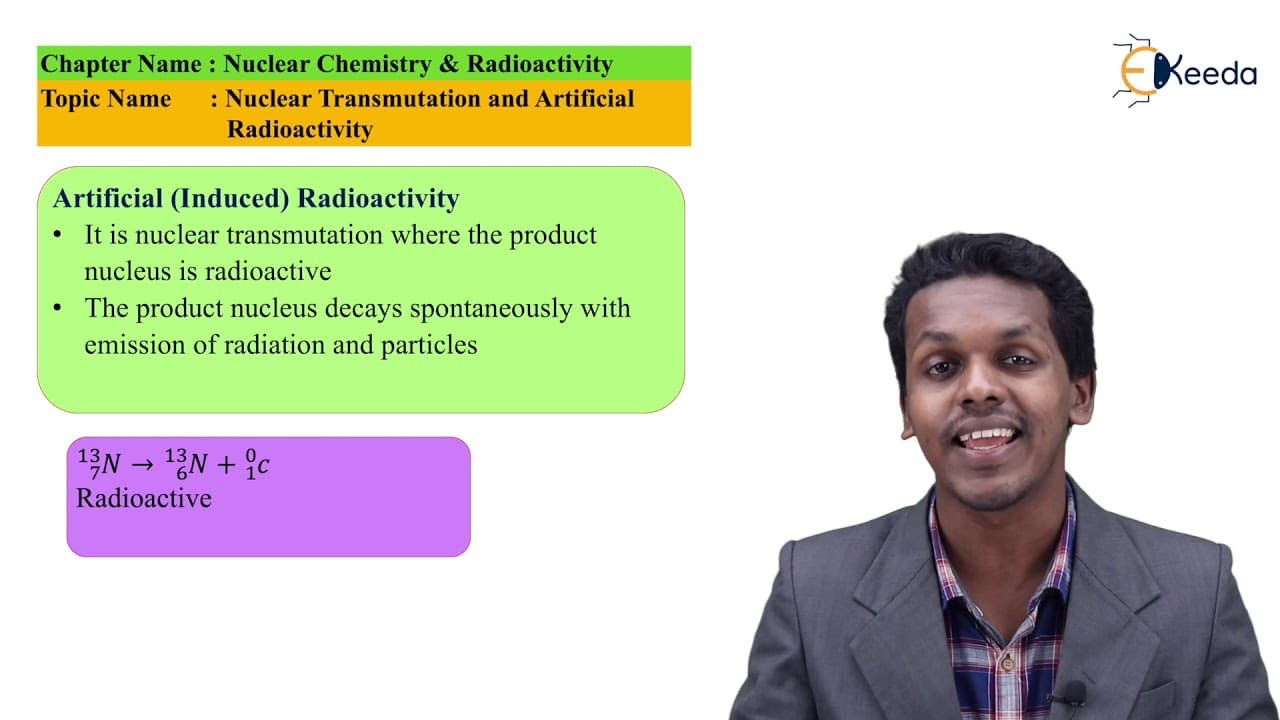
Nuclear transmutation is a nuclear reaction where a stable nucleus is converted into an unstable radioisotope by bombarding it with alpha, beta, or gamma particles.
Q: How is artificial radioactivity different from nuclear transmutation?
Artificial radioactivity involves the transformation of a radioisotope into another nucleus by emitting another particle, such as a positron. It is a separate step that occurs after nuclear transmutation.
Q: Can you provide an example of nuclear transmutation?
Yes, when boron is bombarded with helium, it transforms into an unstable isotope of nitrogen. The excess mass is released in the form of a neutron.
Q: How does artificial radioactivity occur?
In the example given, the unstable isotope of nitrogen can transform into carbon by emitting a positron, resulting in artificial radioactivity.
Summary & Key Takeaways
-
Nuclear transmutation involves converting a stable nuclear into an unstable radioisotope by bombarding it with alpha, beta, or gamma particles.
-
Artificial radioactivity refers to the transformation of a radioisotope into another nucleus by emitting another particle.
-
The video explains the steps involved in both processes and provides examples to illustrate the concepts.
Read in Other Languages (beta)
Share This Summary 📚
Summarize YouTube Videos and Get Video Transcripts with 1-Click
Try YouTube Summary with ChatGPT & Claude or YouTube Transcript Generator
Explore More Summaries from Ekeeda 📚

Summarize YouTube Videos and Get Video Transcripts with 1-Click
Try YouTube Summary with ChatGPT & Claude or YouTube Transcript Generator