Understanding Logical Statements 1
TL;DR
The absolute value of a real number x is greater than 0 except for when x is equal to 0.
Transcript
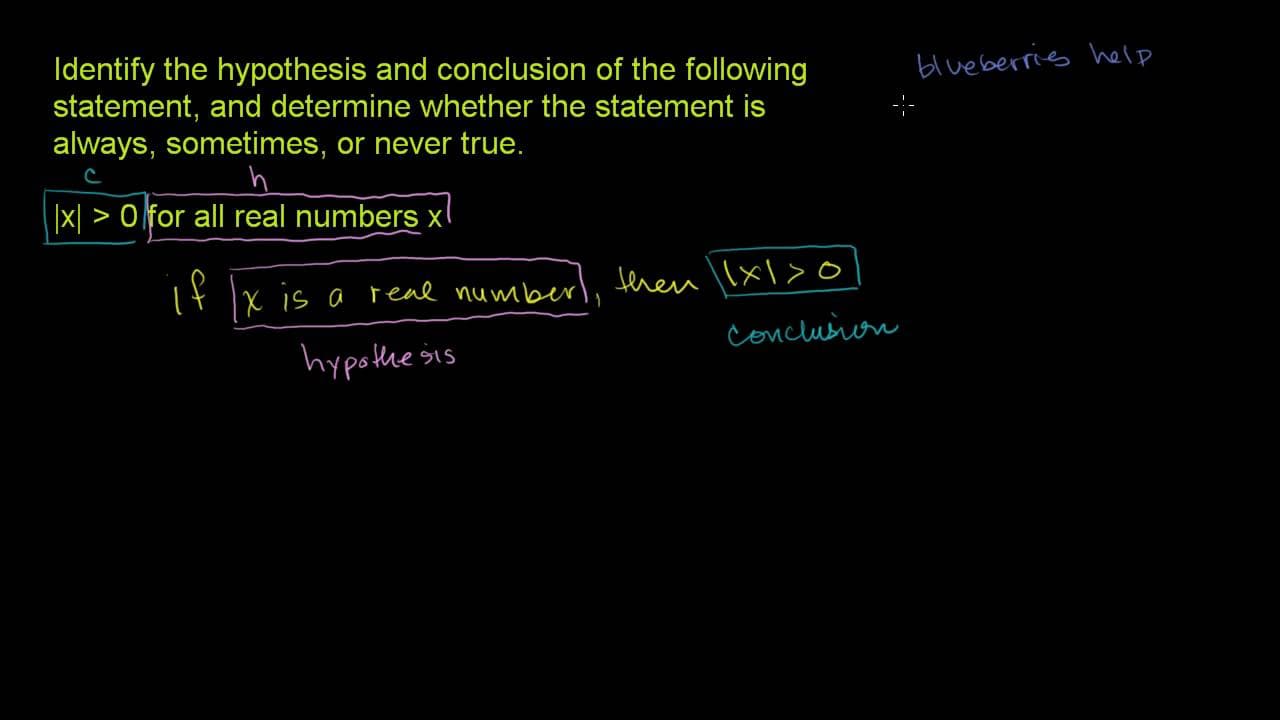
Identify the hypothesis and conclusion of the following statement, and determine whether the statement is always, sometimes, or never true. And the statement here is, the absolute value of x is greater than 0 for all real numbers x. Now if I want to decide what the hypothesis and conclusion is here, it's usually a lot easier to figure them out if y... Read More
Key Insights
- ❓ The hypothesis in this context refers to the "if" part of the proposition, while the conclusion refers to the "then" part.
- ☺️ The statement is not always true, as it is false when x is equal to 0.
- #️⃣ Any other real number, except for 0, will have an absolute value greater than 0.
- ❓ The concept of hypothesis in mathematics is different from a scientific hypothesis.
Install to Summarize YouTube Videos and Get Transcripts
Explore YouTube Video Summarizer or Get YouTube Transcript Extractor
Questions & Answers
Q: What is the hypothesis and conclusion in the statement?
The hypothesis is "x is a real number" and the conclusion is "the absolute value of x is greater than 0."
Q: What is the difference between a mathematical hypothesis and a scientific hypothesis?
In mathematics, a hypothesis refers to the "if" part of a proposition, while in science, a hypothesis is an explanation for a phenomena that can be tested.
Q: Is the statement "the absolute value of x is greater than 0 for all real numbers x" always true?
No, the statement is not always true. It is false when x is equal to 0, as the absolute value of 0 is equal to 0.
Q: When is the statement "the absolute value of x is greater than 0 for all real numbers x" true?
The statement is true for all real numbers except for when x is equal to 0. Any other real number will have an absolute value greater than 0.
Summary & Key Takeaways
-
The statement "the absolute value of x is greater than 0 for all real numbers x" is equivalent to "if x is a real number, then the absolute value of x is greater than 0".
-
The hypothesis of this statement is "x is a real number" and the conclusion is "the absolute value of x is greater than 0".
-
The statement is sometimes true, except when x is equal to 0.
Read in Other Languages (beta)
Share This Summary 📚
Summarize YouTube Videos and Get Video Transcripts with 1-Click
Try YouTube Summary with ChatGPT & Claude or YouTube Transcript Generator
Explore More Summaries from Khan Academy 📚



Summarize YouTube Videos and Get Video Transcripts with 1-Click
Try YouTube Summary with ChatGPT & Claude or YouTube Transcript Generator